In a few hours we again head north to another remote campground in the Sierra Nevada Mountains. At almost 8000 feet, with few neighbors and a new moon, it should be a quiet, enjoyable weekend. Completely disconnected from the world - no internet, no television, no cell phone - we will find out what has changed in the world when we return on Monday.
This has been a harrowing week for many - the news from the Gulf Coast seems to get worse with each passing hour. We hope that the situation is brought under control in New Orleans and that rescue workers can safely get to those in need of assistance. A Red Cross link has been added to the right, if you are so inclined.
It has been an unproductive week here, but we'll attempt to correct that starting next Tuesday.
We leave you with two items. The first is a cartoon by Tom Toles at the Washington Post, which we've taken the liberty of reprinting here in the hope that it will help us get back into the swing of things next week:
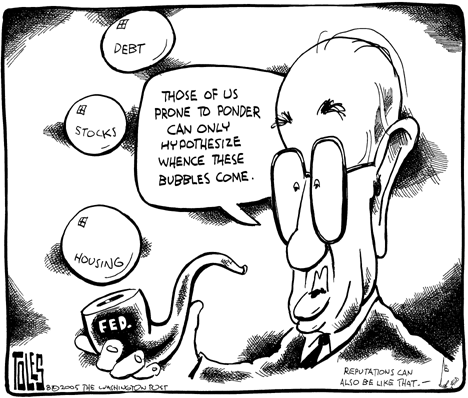
Mr.Toles has many other fine cartoons available in his archive, here's one on the housing bubble.
The second is a repeat of a post which most readers have probably not seen - this first appeared almost five months ago when only a few people stopped by. When wondering what might have gone on yesterday as George W. Bush, Alan Greenspan, and the White House economic team met, then searching for one of our favorite Economist articles, we stumbled across this post, read it, and found that the vim and vigor that have been so lacking this week were there, just waiting to be called upon again when needed in a pinch such as this.
ooo
Past, Present, and Future
April 11, 2005
They were all in the news in the last few days - Paul Volcker, Alan Greenspan, and Ben Bernanke - the past, present, and likely future Chairmen of the banking cartel more commonly known as the Federal Reserve. Volcker was screaming at the top of his lungs "Somebody do something - Now! Before this thing explodes!". Greenspan was pondering his legacy, while at the same time trying to distance himself from the GSEs. And, young Ben was just giddy - with the prospect of hanging out with Dubya and Dick and the rest of the Bush economic dream team, until it's time for him to take the con at the FRB and show us what he really meant when he said "helicopter money". Let's recap.
Paul Volcker (Fed Chairman from 1979 to1987)
So , what did Mr. Volcker have to say this week? Let's see ... last year he said "unless America changes course, there is a '75 percent' chance of an economic crisis in the next five years". This due to various global imbalances - international trade, savings rates, currency ... you know the story. Has his view changed at all in recent months? Well, I guess yesterday's Washington Post article An Economy On Thin Ice answers that question:
"Yet, under the placid surface, there are disturbing trends: huge imbalances, disequilibria, risks -- call them what you will.Altogether the circumstances seem to me as dangerous and intractable as any I can remember, and I can remember quite a lot. What really concerns me is that there seems to be so little willingness or capacity to do much about it."
Uh ... Paul, this is the second paragraph, and you're like, all gloom and doom already - come on, flip on CNBC or one of those swell Fox business shows, and get with the program. Baby boomers not saving, spending like there's no tomorrow, home ownership as a vehicle for borrowing ... la la la la la la la - I'm not listening.
Now, about half way through, Paul seems to come to his senses a bit:
"Some, such as China, depend heavily on our expanding domestic markets. And for the most part, the central banks of the emerging world have been willing to hold more and more dollars, which are, after all, the closest thing the world has to a truly international currency."
Yes, that's right - we are the hegemon, they need us, they would be nobodies without us - Japan, China, South Korea, and the rest of them. And, this will go on for as long as we say so ... end of story ... you can stop now.
"The difficulty is that this seemingly comfortable pattern can't go on indefinitely ... The clear lesson I draw is that there is a high premium on doing what we can to minimize the risks and to ensure that there is time for orderly adjustment. I'm not suggesting anything unorthodox or arcane. What is required is a willingness to act now -- and next year, and the following year, and to act even when, on the surface, everything seems so placid and favorable. What I am talking about really boils down to the oldest lesson of economic policy: a strong sense of monetary and fiscal discipline."
Well, you've really gone off the deep end now - you should have stopped when you were talking about how great we are compared to those Asian fellas. Not sure where you're going with this - "willingness to act now", "monetary and fiscal discipline"? I've read about this stuff ... just what decade are you from man? Oh, that's right, you're the guy who raised interest rates to about 20% back in the 80's when we had out-of-control oil prices, gas prices, and housing prices, and gold was like $800 an ounce ... uh ... but this is completely different now.
Alan Greenspan (Fed Chairman from 1987 to 2006)
Last week, almost the entire week was devoted to Alan Greenspan (see here, here, and here) - oil, Fannie and Freddie, consumer credit. To summarize: oil - hopefully not a problem, Fannie and Freddie - maybe a problem, and consumer credit - just can't get enough of the stuff. OK, done - now let's dig a little deeper, take a look back, see if we can figure out what Volcker's all bent out of shape about.
What can you really say about the last eighteen years - about the credit and money creation machine that has been built during the Greenspan years? In the mid nineties, we were helping to save the rest of the world from one financial crisis after another. Then in the late nineties, all of Wall Street was getting rich through the miracle of rising asset prices (equities this time) and traders worshipped little Greenspan dolls before the opening bell - Stuart and his boss "lit the candle" which was his new Amertrade account.
Never being able to identify an asset bubble while it was forming, the equities mania of the late nineties, that culminated in the bursting of the Nasdaq bubble in 2000, morphed with relative ease into a bubble in a different asset class (real estate this time). Real estate prices have been rising parabolically in the last few years, much like equities did years before. Although recently there has been an acknowledgement of "signs" of a housing bubble in "some areas", it's clear that in many parts of the country houses are being flipped like dot.com shares and pre-construction sales have taken the place of internet IPOs.
Interest rates at historically low levels, liquidity like Niagra Falls, and nary a sign of inflation (until recently), or trade deficit problems (until recently), or budget deficits problems (until recently). Eighteen years of unprecedented economic expansion, prosperity, wealth creation, and ... money creation.
That's right, none of this would be possible without pushing what was then a surprisingly respectable, pure fiat currency system left by Paul Volcker, to its maximum potential, using ever shrinking reserve requirements, ever lower interest rates, and other stuff like this and this that no one is supposed to know about. With one Asian country after another selling us cheap, high quality consumer goods to keep measured inflation at reasonable levels, it was a no brainer - just keep lowering interest rates for 18 years and see how many friends you can make!
No wonder Paul Volcker sounds a little bitter these days.
Volcker put an unstable pure fiat currency system back onto a path that could be sustained for some period of time - he brought on the pain, only to be upstaged when the Greenspan money creation circus came to town.
For the last deade or so, Greenspan has fooled many of us, but he certainly hasn't fooled these two men - Kurt Richebacher: "In actual fact, in the past few years, the Greenspan Fed has systematically and deliberately fostered parabolic credit and financial excess with the explicit purpose of inflating asset prices. What manifestly is duping most people is the fact that the bulk of the credit excess poured into asset prices and the soaring trade deficit, rather than into the CPI, as had been usual."
And Hans Sennholz:
"The popular notion that an increase in the stock of money is socially and economically beneficial and desirable is one of the great fallacies of our time. It has lived on throughout the centuries, embraced by kings and presidents, politicians and businessmen. It has shattered numerous currencies, inflicted incalculable harm, and caused social and political upheavals. It springs forth again and again, no matter how often economists may refute it. American statisticians and economists want to make us believe that America is a new-paradigm exception in this respect, being miraculously able to generate unprecedented productivity growth with zero savings and record low fixed business investment. The consensus readily believes it. For us, this is macro economic rubbish"
Many more will write about the Greenspan Fed this year and next - expect to hear more from Paul Volcker as Greenspan's retirement draws nearer.
Ben Bernanke (Fed Chairman from 2006 - ?)
Ben hasn't been talking much lately - this is the quiet period before his public offering to Congress in the form of confirmation hearings for the post of White House Council of Economic Advisers. He is considered the favorite to become the new Federal Reserve Chairman next year, but first he needs to spend some time at the White House, where the economic future of the civilized world is being meticulously planned. The whole idea of borrowing money from the rest of the world to goose the stock market for the next decade (also known as Social Security reform) doesn't seem to be getting the traction that it needs - perhaps Ben can help with that.
But, Ben needs to be careful as he speaks more in public as part of his new duties at the White House - after many years of Greenspan Fedspeak, there is a danger of Ben stumbling out of the gate, saying something that might be misinterpreted, and having a destablilizing effect on markets:
"Bernanke possesses one credential crucial for any Greenspan replacement: The ability to translate econo-speak into plain language. "Bush is going to want to appoint someone who can sit down with him and speak in a language he understands," Beach said."
I'm not sure that's such a good idea - plain language about this economy from top government officials - using an approach of "simple solutions to complex problems" that has worked so well in foreign policy these last few years. Will this work when it comes to today's economy ... instead of nuances and hedges and equivocations that we've all gotten used to in the last eighteen years? Better think about that a bit.
Well, we'll have lots more to say about Mr Bernanke in the coming months, as the retirement party planning gathers pace. Ben will surely try to rid himself of his "helicopter money" label and we'll see just what he has in store for us after he starts work at the White House.
It does seem strange, though, when you look at the state of affairs when Volcker turned things over to Greenspan in 1987, versus what things will probably look like in less than a year, when Greenspan calls it quits - they say timing is everything, and Ben will probably learn that lesson the hard way.
Read more...



 Posts
Posts


![[Most Recent Quotes from www.kitco.com]](http://kitconet.com/charts/metals/gold/t24_au_en_usoz_2.gif)
![[Most Recent Quotes from www.kitco.com]](http://kitconet.com/charts/metals/silver/t24_ag_en_usoz_2.gif)
![[Most Recent USD from www.kitco.com]](http://www.weblinks247.com/indexes/idx24_usd_en_2.gif)


