Wikinvest Wire

Under the Weather, Still

Tuesday, March 07, 2006

Update (Thursday 3/9) - Headed to the doctor today, will return here when able - thanks for the get well wishes.

Check back in a day or two... hopefully, by that time, whatever malady is impairing current cognitive and digestive functions will have eased and a normal schedule will resume.

Read more...

Occasional Paper No. 1

Monday, March 06, 2006

Late in the day on Friday of last week, the Treasury Department released a new report titled Petrodollars and Global Imbalances. It contains all sorts of great information about the enormous amount of oil and U.S. dollars that are sloshing around the world, but the most intriguing aspect of this report, at first glance, is that they chose this as the first subject for a series of "occasional" papers.

While the casualness of this characterization belies the significance of the subject matter, the "addicted to oil" theme does seem to be spreading in the nation's capitol.

It's hard to believe that in 1998 oil was selling for near $10 per barrel. This was largely a result of the Asian financial crisis, an event that continues to influence behavior today. The difficulties experienced during that time and the manner in which they were resolved have resulted in a broad-based risk-averse approach to international trade and global finance in much of the rest of the world.

While at the same time, these events cemented the role of the U.S. as the proverbial father who bails his son out of jail for youthful indescretions. Recall that Fed Chairman Alan Greenspan, Treasury Secretary Robert Rubin, and Deputy Treasury Secretary Larry Summers were dubbed the "Committee to Save the World" by Time Magazine for their efforts at that time, in conjunction with the International Monetary Fund.

Few in the West appreciated the severity of this crisis, as we were all in the midst of an internet and technology boom, while illicit White House encounters were heating up. There was a brief lull in the stock market euphoria that had gripped the country, but the Asian Financial Crisis was largely a non-event across the Pacific.

These events go a long way in explaining the nature of global imbalances we find today.

In seven years, $10 oil turns into $70 oil. The aging father figure turns into a bit of a free-loader, constantly needing to borrow money while living a lifestyle he really can't afford - money which the maturing son is all too happy to lend because their relationship since the crisis has resulted in great prosperity and stability.

Meanwhile, petrodollars pile up in oil exporting countries at an unprecedented rate in order to perpetuate this relationship, and life goes on. Take a look at this table from the Treasury Department report to see where oil and dollars have been flowing.


Click to enlarge

The first item of interest in the chart above is that oil export revenues have more than doubled in the three-year period from 2002 to 2005. Saudi Arabia and Russia alone have accounted for nearly half of this increase, with Russia more than tripling its oil exports during this time.

What are they doing with all these petrodollars?

By and large, they are doing responsible things - building up reserves and paying down debt. Their imports have increased, but only by a fraction of the increase seen in their oil exports. Recall that a few months ago, Vladimir Putin made clear Russia's intention to exchange some of the paper money held as reserves for more tangible money in the form of gold.

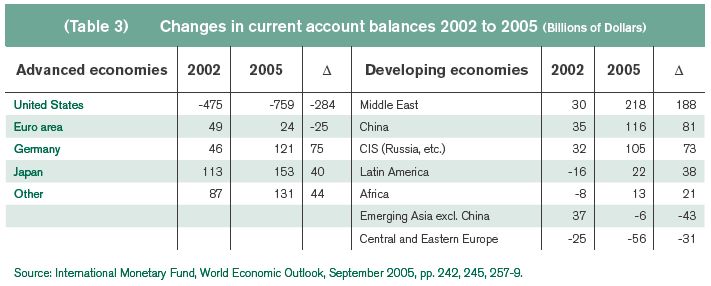
During this time, China has emerged as the second leading importer of oil, behind the U.S., where much of the increased demand is a result of their booming export business with the U.S. This trade relationship is evident in the changes to current account balances for the same time period as shown below.


Click to enlarge

So, the U.S. goes from a dangerous level ($475 billion) to a critical level ($759) with no reversal in sight, while China racks up a huge positive change to their annual current account without the benefit of the relatively easy job of pumping oil out of the ground.

Note the standing of Germany in the chart above - a large swing in exports relative to the rest of Europe and all other non-oil exporting countries, and notably, one of the very few Western countries not experiencing a housing boom. Is there a connection there?

The more you think about it, the more unbalanced it seems to be - the U.S. borrows money from Asia to buy their exports, while the Middle East and Russia supply both the U.S. and Asia with oil at ever-rising prices.

Think of the oil exporters as being "the house" in Las Vegas - the U.S. and Asia are in a high-stakes game of poker, where the U.S. keeps losing hand after hand, but the Asian poker players continue to lend money back to the U.S., so the game can go on.

They are both having a swell time.

Meanwhile, "the house" continues to take their cut on every hand and as the dealer tires, the house cut increases. Both the U.S. and Asia would like for the game to continue indefinitely, but it is looking more and more like "the house" will determine when the game ends - either by making it prohibitively expensive for the players to continue or by exhausting the supply of cards.

Read more...

Another View on Rebates

Sunday, March 05, 2006

Barry Ritholtz doesn't seem to appreciate the true value of rebates offered by many computer equipment manufacturers via their retailers. In a nutshell, buyers who purchase products with mail in rebates can get a discount roughly twice what would be available had a rebate not been offered, all other things being equal.

We'll explain in a minute, but first, have a look at the first scan to come out of a new Epson CX4200 printer/scanner/copier/back massager that was recently purchased for $30 (after rebates).

Not too bad.

The backside of the page shows through, and with the photo editing software provided with the printer along with all the gizmos and gadgets in the various control panels, this week's Economist cartoon might be made a little more presentable. But, there is little time to fiddle with these extra goodies when there is the larger issue of rebates on which to opine.


Yes, rebates are a pain - sometimes a big pain.

This particular printer cost $130 plus about another ten dollars in sales tax and the combined value of the three rebates (yes, there was one for $50, one for $30, and one for $20) was $100. It seems the most grating thing about the whole rebate process is that you have to pay sales tax on the rebate amount, which in this case is about $8.

So, it's really a $40 printer (after rebates).

Anyway, once the equipment was found to be in working order, all the rebate instructions were studied and the required material was assembled, filled-out, punched, stapled, folded, and then inserted into envelopes and sent on their way.

Please allow 8 to 10 weeks for processing and delivery of your rebates.

The nice thing about mailing in a rebate for a piece of equipment such as this is that it is very easy to make copies of all the completed paperwork. The copies of the paperwork can then be assembled, punched, stapled, and affixed via a push-pin to some bulletin board - somewhere out of the way but in plain sight, so that it can be retrieved, dusted off, and scoured for a phone number to call if the checks fail to arrive after three months.

So, how do you get double the discount when you buy something with a rebate? The explanation begins with this comment left by yours truly over at The Big Picture:

Statistics are hard to come by, but I believe the real reason why rebates exist is that many people never send in the rebate material to claim the rebate. I've heard numbers as high as 50 percent, but, this data is hard to come by.

The psychological effect is that if the buyer paid $1100 for the computer and had a $200 rebate, in his mind he has only paid $900. End of story - regardless of what happens next.

Many people are unorganized enough to throw away the box before they cut out the UPC label or fail to fulfill some other term of the agreement, so they just abort the process and go on thinking that they only paid $900.

So, others who have purchased the same $130 printer may have come home, unpacked the equipment, set aside the rebate forms to be filled out later, set the boxes out by the trash, and began fiddling with their new toy.

They probably think of it as a $30 printer, even though there is work yet to be done...

A couple days go by, and it's still a $30 printer, but the rebate work is beginning to fade from memory, and the rebate forms have worked their way down into a pile of other paperwork...

A week later, it's still a $30 printer and the boxes went out with last week's trash and the rebate forms are nowhere to be found - but that's OK, because all thoughts about doing rebate work have exited the owner's consciousness days ago.

This particular rebate is only available when you purchase a notebook computer, so some smarty at Epson probably figured out that the rebate submittal rate becomes exceptionally low when the new printer owner is distracted from his printer rebate forms by a new notebook computer.

So, if you figure that half the people never send in these three rebate forms to claim the hundred dollars, as Epson probably did when deciding to offer the rebates, then the real retail cost of this peripheral, all other things being equal, is about $80 - the average of the final cost paid by those who submitted the rebate and those who did not.

Both purchasers continue to think of it as a $30 printer.

Read more...

It's Friday!

Friday, March 03, 2006

Another week is about to go into the books as the dual non-events of the opening of the Iranian Oil Bourse and the cessation of M3 reporting later this month draw nearer and Ben Bernanke completes his fourth full week at the helm of the Federal Reserve.

Mr. Bernanke is rapidly approaching the two-months-in danger period associated with the transition from one Fed chairman to the next. Alan Greenspan in 1987, Paul Volcker in 1978, and Arthur Burns in 1970 all presided over significant stock market declines about two months after they began their term.

Ill will is not wished upon the new Fed Chair, it is just that the timing of these three non-events is far too intriguing to not consider the possibilities.

On Dark Matter and Wedgies

BusinessWeek seems to be getting a lot of mileage from the comment that your humble scribe left at Barry Ritholtz's Big Picture blog about a month ago (search on 10:27:18 to go directly to the comment, although Barry's remarks and most of the other comments are quite good as well.)

There is an upcoming March 13 print article, titled "Do I Deserve a Wedgie?" and a search on "wedgie" at BusinessWeek Online reveals a post on Michael Mandel's blog by the same name along with a few other entries. Michael and two others penned the original BusinessWeek story, Unmasking the Economy, which many found so reprehensible.

OK, if you were too lazy to go read the comment, here it is - fairly short and sweet, but lacking any real substance for reasons clearly stated (see the entry by trader75 two comments prior for a well reasoned reply to the BusinessWeek arguments):

I haven't read the article yet (I will), but seeing that Mike Mandel and Chris Farrell are two of the authors goes a long way in understanding what its about.

I subscribed to BusinessWeek for many years, just to get another Wall Street perspective, but they have become so over-the-top with their non-inflationary growth, Larry Kudlow, supply-side Nirvana that it became unbearable.

Both of these guys are so far out of touch with Main Street - one of these days some laid-off worker is going to give both of them a wedgie.
More meaningful remarks on the subject of dark matter have been offered in this space (see here and here), but the wedgie comment was by far the funniest.

Hi Yo Silver!

Wow! Look at what a not-so-little mining strike can do for the price of silver. This news combined with the soon to be available exchange traded fund for the white metal caused a sort of rocket launch yesterday as the poor man's gold shot past ten dollars an ounce without even stopping to admire the roundness of the number.

Of course, silver sometimes goes down even more quickly than it goes up, but "ten dollars" and "silver" in the same sentence certainly has a nice ring to it even if it is only temporary.


As with all hard goods when measured in dollar terms, the long-term trend is up. In a few years we'll all probably look back at ten dollar silver as being cheap, but as always, the timing is uncertain, and silver has almost assuredly not seen the last of the single digits.

The discussion of the illiquidity of silver relative to the launch of the ETF is kind of interesting. There have been stories of silver short positions at the Comex which were selling something like five years of future production into the market a the same time that margin requirements were being raised for buyers, so if yesterday is any indication, look for lots and lots of big swings.

Don't be surprised if sometime in the not too distant future silver swings $10 in just one day, as it did back in the 1980s.

Dollars Not Making Sense?

Related to the topic of the relative value of the U.S. dollar comes this editorial from the Asia Times regarding the cost of the Iraq war. There were hopes for some juicy references to "printing money" or discussions of "debasing the currency", but they never came.

What was found, however, was a new clock that tracks U.S. dollars.

There is now a Cost of the War in Iraq clock to go along with the National Debt clock, and out here on the left coast, there is of course the California Budget Debt clock. Note the line on the National Debt clock where it shows the increase in the debt just since you logged in - it's good to keep a sense of humor at times like this.

Don't Ask the Needy

It looks like another bit of unpleasant data collected by the government is about to be suspended. The M3 money supply reporting will cease in a few weeks and now the Washington Post reports that Census Bureau is planning to stop collecting information on the needy.
A Commerce Department proposal to eliminate a Census Bureau survey on the economic well-being of U.S. residents is drawing fire from researchers and lawmakers concerned about losing a source of information about the impact of government social programs on needy families.
...
The survey, which costs $40 million annually, follows people for two to four years, asking about their use of welfare, unemployment insurance, Medicaid and other government programs.
Based on a quick back of the envelope calculation it seems that continuation of this survey and four others just like it could be funded with a single pallet of one-hundred dollar bills.

A Room with a View

In Australia it seems sellers of homes are seeking every possible advantage when trying to get full price in a difficult real estate market:
In the dead of night, shadowy figures armed with axes, drills and poison are leaving a trail of death around Sydney's wealthiest suburbs.

Their victims are trees, and the perpetrators are property-obsessed Sydney homeowners seeking to increase the value of their land by adding or improving views of the city's world-famous harbor and beaches.
...
Water views can add tens of thousands of dollars to the price of a house or apartment.

Sydney housing was once the most expensive on the planet before the property bubble burst in 2003, with the speculative excess of its harbor-hugging homeowners even dragging on the national economy.
Somehow this seems almost normal or routine.

Read more...

Managing "Inflation" Expectations

Thursday, March 02, 2006

Two recent items in the news make a whole lot more sense when looked at together rather than separately. The first item is Federal Reserve Chairman Ben Bernanke's speech from about a week ago at Princeton on The Benefits of Price Stability. The other is a Welling@Weeden interview (PDF) with John Williams of Shadow Government Statistics notoriety.

The connection between the two should be immediately clear to readers here - it is the details that carry the intrigue, as you'll soon see.

While the economic and monetary policy history described in the new Fed Chair's speech is quite interesting and demonstrative of his academic background and the zeal with which he approaches his current job, it is the discussion of "inflation" expectations that is deserving of scrutiny today.

The key to explaining why price stability promotes stability in both output and employment is the realization that, when inflation itself is well-controlled, then the public's expectations of inflation will also be low and stable.
If people believe that "inflation" is low and that it will remain so, interest rates can also be kept low providing stimulus for both economic growth and employment.
This mechanism can be illustrated by comparing the effects of the recent rise in oil prices to the effects of the oil price increases of the 1970s. Thirty years ago, the public's expectations of inflation were not well anchored. With little confidence that the Fed would keep inflation low and stable, the public at that time reacted to the oil price increases by anticipating that inflation would rise still further. A destabilizing wage-price spiral ensued as firms and workers competed to "keep up" with inflation. The Fed, attempting to gain control of the deteriorating inflation situation, raised interest rates sharply; however, initially at least, these increases proved insufficient to control inflation or inflation expectations, and they added substantially to the volatility of output and employment. The episode highlights the crucial importance of keeping inflation expectations low and stable, which can be done only if inflation itself is low and stable.
Setting aside the very significant effect of globalization on both the prices of consumer goods and domestic wages, it seems that the other key to low "inflation" over the longer term is the setting of expectations for the future based on current conditions.

That is, regardless of the reality that individuals may experience in their daily lives today, if the perception is maintained that "inflation" is currently low, "inflation" expectations for the future will also be low. Under these conditions, interest rates can remain accommodative and economic growth and job creation will result.

Apparently, had "inflation" been managed better back in the 1970s, maybe there wouldn't have been such a fuss over rising prices and Paul Volcker wouldn't have had to raise interest rates to 20 percent.

How do you manage "inflation"?

We'll get to John Williams shortly, but the "core" issue with managing "inflation" today is all about excluding things that are going up in price.
By contrast, the oil price increases of recent years appear to have had only a limited effect on core inflation (that is, inflation in the prices of goods other than energy and food), nor do they appear to have generated significant macroeconomic volatility... But, the crucial difference from the 1970s, in my view, is that today inflation expectations are low and stable (as shown, for example, by many surveys and a variety of financial indicators). Oil price increases in the past few years, unlike in the 1970s, have not fed through to any great extent into longer-term inflation expectations and core inflation, as the public has shown confidence that any increases in inflation will be temporary and that, in the long run, inflation will remain low. As a result, the Fed has not had to raise interest rates sharply as it did in the 1970s but instead has been able to pursue a policy that is more gradual and predictable.
It remains to be seen how long the public will view increases in "inflation" as temporary, but again, the point here is that, irrespective of other factors, given low current "inflation", it is easier to maintain low "inflation" expectations, which allows interest rates to remain relatively low.

Readers may at this point be wondering why the word "inflation" has been in quotes everywhere it has appeared outside of the text of Mr. Bernanke's speech. The short answer is that the quotes indicate ambiguity or uncertainty, something that is readily admitted when it comes to using this word in today's musing.

Others either see no ambiguity or perhaps view the ambiguity as something that can be used to their advantage. It may interest you to know that in the three excerpts provided thus far from the Princeton speech, the word "inflation" has appeared 18 times, the word "low" has appeared six times, and the word "core" two times.

Repetition, selective qualifiers, and, of course, statistical wizardry are also keys to low "inflation" and the management thereof, which, naturally brings us to John Williams.

Much of this interview deals with federal budgets and related topics, but the history of the consumer price index and its attendant data collection and reporting should shed new light on just how "inflation" has been managed since the 1970s. Presumably, a different sort of management than what Mr. Bernanke was referring to in his speech.
There was a very deliberate effort in the early 1990s under the auspices of Michael Boskin, who at the time was the head of the Council of Economic Advisors, in conjunction with Alan Greenspan, who, of course, was Fed Chairman, to “fix” the CPI. The story, very simply, was that CPI was supposedly overstating inflation. The pitch was that if people go out to shop and find that buying a steak is getting expensive, they buy hamburger instead... The problem is that if you allow substitutions, you aren’t measuring a constant standard of living. You’re measuring the cost of survival. You can keep substituting down and have people buy dog food instead of hamburger. It happens. But that’s not the original concept behind the CPI.
Of course the owner's equivalent rent substituted for homeownership costs as well as understating rising health care costs also go a long way in making "inflation" appear as something increasingly different from what people actually experience in their lives.

Lately, with rising energy prices, the emphasis has been on the two-percent rate of core "inflation", rather than the much higher all-items rate of "inflation" currently in the four percent range.
All in all, if you were to peel back changes that were made in the CPI going back to the Carter years, you’d see that the CPI would now be 3.5%-4% higher. The difference that it makes is significant: if the same CPI were used today as was used when Jimmy Carter was President, Social Security checks would be 70% higher.
That would put the all-items CPI close to eight percent which would undoubtedly capture much more of the public's attention. A side effect of reverting to the old calculation would make real GDP much different than official reports - the just released sub-two percent GDP figure for December would swing far into negative territory.

Higher "inflation" numbers can cause all kinds of problems.

Maybe the management of "inflation" has more to do with the work of the statisticians at the Bureau of Labor Statistics than it does with Federal Reserve policy, or maybe they are really one in the same.


Read more...

The Gold / Gold Stock Tango

Wednesday, March 01, 2006

The tango that gold and gold stocks have been doing lately has become fascinating to watch. While generally following the lead of the underlying metal, gold stocks have recently appeared confused and somewhat untrusting of their dance partner. At other times they have embraced like passionate Latin lovers.

Why?

On the one hand, gold stocks are company shares that rise or fall based on the profitability of the company's primary business - digging gold out of the ground and selling it at market rates. As the gold price goes up, they become more profitable without changing a thing, similar to vertically integrated oil companies like Exxon Mobil.

On the other hand, gold shares rise and fall along with the broader stock market - drug stocks, financials, technology, and the like. The bottom lines for other companies are completely unrelated to the price of gold, however, the herding instinct is still quite strong amongst investors today - when the broader market moves in one direction, often times mining stocks follow.

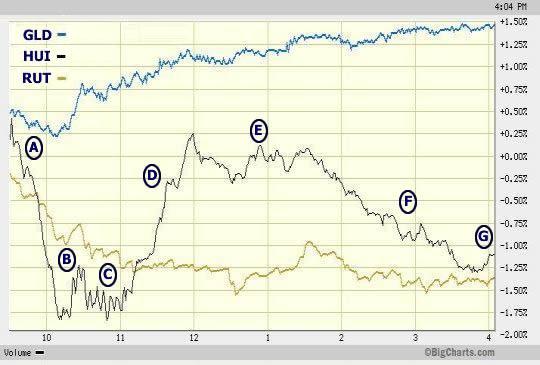
Sometimes the two hands look a little silly and the dance becomes chaotic - yesterday was a good example as shown in the chart below.

GLD - StreetTacks gold exchange traded fund - tracks the spot price of gold
HUI - Gold Bugs Index - contains the top fifteen unhedged gold miners
RUT - Russell 2000 Index - smallest 2000 securities in the Russell 3000

Having gotten all the mileage out of the dance metaphor as seems prudent at the moment, a brief narrative may better convey one day in the life of the HUI Gold Bugs Index.

A. Up a little bit overnight gold gets its thrice weekly New York breakfast whacking - other stocks are down - best for the HUI to get ahead of the trend and go directly south.

B. Hmmm ... maybe that was too much - small caps are showing a little life and gold has now swung $4 in the other direction - it's time to ease up a bit.

C. Uh... getting confused now.

D. Time for some independent thinking here - someone's 'gotta do something with gold headed back over $560 - let's go a little higher to get a better look at gold - pretty unbelievable how it stays up like it does after months and months - isn't it supposed to head back to the $500 range for a few months so everyone can catch their breath?

E. Uh... confused again - not sure where to go from here, but the feeling of hanging out here in the middle is a little uncomfortable.

F. Getting scared now - can't just hang out here all day - maybe head back to the other stocks for a while and wait for gold to come back down - surely it will come back down.

G. In a safe place now with the other stocks - maybe one last jog to the upside before trading closes for the day.

It sure is fun to watch. Traders must be confounded by the buoyant gold price after so many months, as many have predicted early and often of a large correction coming for the precious metal and the equities, but it just never seems to come.

As long as gold rises, it seems mining shares will rise too - it's as simple as that.

Most gold bugs would generally concur with this assessment, it's just that when the price of gold defies explanation to the upside for such a long period of time, longtime followers believe that the rug is about to be pulled out from under them.

But the rug stays put, and the tango becomes more unpredictable.

Read more...
IMAGE

  © Blogger template Newspaper by Ourblogtemplates.com 2008

Back to TOP