Wikinvest Wire

Only a Phone Call Away

Sunday, May 07, 2006

Those funny fellows at The Economist reflect on the changing of the guard at the Federal Reserve in the wake of the "misunderstanding" revealed by CNBC personality Maria Bartiromo after speaking with new Fed Chief Ben Bernanke at the White House Correspondent's Dinner.

America's markets responded skittishly to comments by Ben Bernanke, rallying after the chairman of the Federal Reserve signalled that the policy of raising interest rates was over, and falling in response to a later report that he thought his comments had been misunderstood.

Pundits made inevitable comparisons with Mr. Bernanke's predecessor, Alan Greenspan, who made a point of never being understood.
Somehow this plainspoken, transparency thing isn't working out quite as expected. Maybe next time Ben Bernanke should do as Dick Cheney suggested a while a back and give 'ol Greenie a call and ask him what he would do.

In the words of the Veep, "Chairman Greenspan is only a phone call away."


Thanks to VHB for sending this cartoon.

ooo

A reader posted this link about the postage rate and inflation question raised during last week's Friday Lite post (be careful if you use a Mozilla browser - the Zeal site is one of those that uses Microsoft Front Page and will peg your Firefox performance meter).

Since there's plenty of room left on this post, open source devotees will be spared the indignity of another Microsoft plot to foil their competition by displaying the chart here.


ooo

What the heck? Here's a recent cartoon from Tom Toles.

Read more...

Friday Lite

Friday, May 05, 2006

Another five days, another $20 more for an ounce of gold. Or is it $40? Is anyone keeping track anymore? It's a good thing that this economy is booming and that inflation is under control or the rising gold price would be scaring the bejeebers out of everybody.

The Jobs Report

"Bad news is good news", the "one and out mentality", "a monkey-wrench in the works" - that's what 138,000 new jobs means for the month of April, as reported by the Bureau of Labor Statistics today. The big loser was retail trade with a net loss of 36,000 jobs, but that may have been affected by some weird seasonal adjustments around Easter this year.

Construction companies are still hiring and the always reliable Education and Health Services led the way in job creation once again. Hourly earnings rose 0.5 percent taking the year-over-year change to 3.8 percent, which is the largest increase since 2001.

M!ssundaztood

Barry and Berry over at the Big Picture about Bartiromo blind-siding Bernanke before the black-tie ...

Well, it was all kind of silly - let's see if it can be made any sillier here.

When "Lonely Girl" Maria said lets "Get the Party Started", Ben became "Numb", "Eventually" confiding, "Don't Let Me Get Me":

I'm my own worst enemy
Its bad when you annoy yourself
So irritating
Don't wanna be my friend no more
I wanna be somebody else
That somebody else?

Ben confided to Maria - Alan Greenspan. This has all been a big mizunderztanding.

A Square to Spare?

If you think gas at $3.35 a gallon is bad, just think what it must be like to use a bathroom in Zimbabwe. According to this report, they've got a little inflation problem.
How bad is inflation in Zimbabwe? Well, consider this: at a supermarket near the center of this tatterdemalion capital, toilet paper costs $417.

No, not per roll. Four hundred seventeen Zimbabwean dollars is the value of a single two-ply sheet. A roll costs $145,750 — in American currency, about 69 cents.

The price of toilet paper, like everything else here, soars almost daily, spawning jokes about an impending better use for Zimbabwe's $500 bill, now the smallest in circulation.

But what is happening is no laughing matter. For untold numbers of Zimbabweans, toilet paper — and bread, margarine, meat, even the once ubiquitous morning cup of tea — have become unimaginable luxuries. All are casualties of the hyperinflation that is roaring toward 1,000 percent a year, a rate usually seen only in war zones.
A thousand percent a year is not so bad - at the height of the Weimar inflation in 1923 Germany, prices quadrupled every month. (The meaning of the word tatterdemalion is unknown to us here - but if you ever have to go to a city whose name is preceded by this word, bring toilet paper from home.)

Rich Dad Don't Know Silver Storage

Robert Kyosaki has been writing incessantly about commodities lately. Not knowing his background that well and not bothering much with his book, it's hard to pass judgement on his views aside from the obvious fact that he's definitely in the right sector - oil, natural gas, gold, and silver.

In an article appearing this week at Yahoo! Finance, he talks about buying and storing silver.
I'm also excited about silver because -- unlike real estate, which can require a lot of money, some finance skills, lots of due diligence and property management skills to do well -- silver is affordable to the masses, and management skills are minimum. Just buy some silver, put it in a safety deposit box at a bank, and your management nightmares are over.
Well, it's not clear how much silver Mr. Kiyosaki owns, but for a man of his wealth, storing his silver in a safe deposit box just doesn't sound right. It's even worse for coins because the bag can break and then you hear the clankety-clank of silver coins all over the vault floor, but even if you store 99.999% fine silver bars in a safe deposit box, you are confronted with the immediate problem of weight.

Right now silver sells for roughly $200 a pound, meaning that just to store a few thousand dollars worth you're talking about 15 pounds. If you're really serious about silver investing, say you want $10,000 worth, now you've got 50 pounds in a safe deposit box, and you'll get all kinds of strange looks when you say, "Here, I'll get that, it's pretty heavy".

How Can you Get Fired Before you Get Hired?

Better half Linda raised a very good question about Donald Trump's smash hit (no, not the Vegas condo project or his hair) - the TV series The Apprentice. The question was, "If these people are on this sixteen week long job interview, and he's trying to decide which one to hire, how can he be firing someone each week? Don't you have to be hired before you can be fired?"

Details, details...

The Forever Stamp

It is presumed that the timing of this stinging criticism of the U.S. Postal Service's pricing plan earlier in the week had nothing to do with the report of a possible new "Forever" stamp from the nation's mail carriers. But, you never know.

Stinging criticism:
The U.S. Post Office should learn something from the newspapers and stop their two and three cent rate hike madness by just going directly from the current 39 cents (or did they already change it to 41 cents?) to 50 cents, and then just leave it there for a while. Please. If not fifty cents, can they at least try to get two consecutive first class postage rates that are not both prime numbers?
Stamps are forever:

After increasing rates 13 times in 32 years, the U.S. Postal Service proposed a way yesterday for consumers to lock in the price of a first-class stamp, which officials want to raise by 3 cents, to 42 cents, next year.

Postal officials pitched the idea of creating a "forever stamp" that would be good for sending first-class mail no matter how much -- or how often -- the cost of a postage stamp goes up. The announcement came on the same day that the Postal Service said it would seek to raise the price of a first-class stamp for the second consecutive year.

They say that the price of a first class stamp has increased at the same rate as "inflation" (the CPI all items category most likely, however, none of this has been investigated). An interesting long-term exercise, to better assess the government's version of "inflation", would be to track postal rates vs. inflation over time.

Not so much for years past, but for the years ahead.

Is this What Max Baer Felt Like?

It's a good bet that as long as there are Hummers and high gas prices, that little story from last November is going to be popular. Six months after it's original publication, it still ranks in the top five entry pages for this site, people continuing to discover it for the first time.

Is this what Max Baer, Jr. of The Beverly Hillbillies fame felt like?

Will Hummers be as hard to shake as Jethro's double naught spy career.

Striking Back at Exxon-Mobile

Here's a report of a small Texas town hoping to ignite a prairie fire during what has already been a record year for fires in that part of the country.
Deep in the belly of Texas oil country, Bee County commissioners took a stand last week — one they hoped would ignite a prairie fire of protests throughout rural America.

They passed a resolution calling on their constituents to boycott Exxon Mobil Corp. until gasoline prices plummeted to $1.30 a gallon.

What they didn't count on was how it would divide this south Texas county.

"We certainly look like hicks now!" Pam Tull wrote the local newspaper.

Added another letter writer, teacher Charles Marley: "You have a standing invitation to come to high school economics class and learn how supply and demand affects gasoline prices. You are embarrassing us in Texas."

What set off this fury was an honest effort to strike back against gasoline price avarice, said County Judge Jimmy Martinez, Bee County's top elected official, who proposed the boycott.

But it forced the citizens of Beeville, population 13,129, to make a personal decision: Do I declare war on Big Oil, or fill up at Leticia's stations?

There are three Exxon Mobil gas stations in Bee County. All are independently owned by the family of Leticia Quiroga Muñoz, who also operates the adjacent convenience stores.
Another fine example of politicians doing something ... anything, to combat high gas prices.

One Last Hurrah Before Serfdom
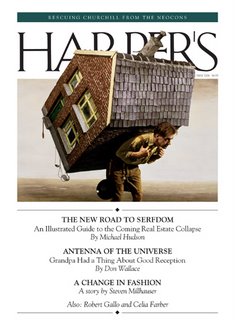
The thrill of cash-out refinancing is not gone until there's no money left to cash out.

It's as simple as that.

This soon-to-be-classic Harper's cover illustrates how homeowners can ensure that no pennies are left in any nooks and crannies - pick the thing up, strap it to your back, and shake hard.

For many, particularly in areas like Denver and Michigan where foreclosure rates are approaching all-time highs, the shaking is immediately followed by setting the thing down and casually walking away.

The Washington Post reports that home equity cash outs during the first quarter of 2006 are at fifteen year highs - at levels not seen since the peak of the last housing boom in 1990.
A greater proportion of mortgage refinancers tapped their home equity for cash in the first three months of this year than in any other quarter in the past 15 years, according to an analysis released yesterday.

About 88 percent of people refinancing their homes took out loans for at least 5 percent more than their original balances, according to the latest quarterly review of loans owned by Freddie Mac, a government-backed home mortgage company. However, more than half took loans at higher interest rates than they previously paid. In years past, refinancers chased lower rates.
...
"The short story is that everyone has a ton of equity," said Glenn Schwartz, president of Vision Mortgage LLC in Rockville. He said local homeowners are refinancing to arrange fixed-rate mortgages, get cash for home improvements or, in some cases, to buy beach houses.

Ira Rheingold, general counsel of the National Association of Consumer Advocates, said he feared that some people are spending too much of their equity, which could leave them financially exposed.

"I don't want to sound like Chicken Little here, but we're heading for a big fall," Rheingold said. "Our policy of using our homes as our banks is bad public policy, and we need to think of the long-term implications of the debt we have. It's a homeownership economy where people don't really own their homes."
So, the mortgage broker and the consumer advocate have distinctly different views of what this all means. That's not very surprising. It's as if it's 2 AM and the mortgage broker is saying, "Come on, have another drink", and the stodgy consumer advocate counters, "You're going to hate yourself in the morning".

It looks like homeowners are taking that last drink, content to deal with the hangover later.

A Flock of Dodos

This story about a Harvard biologist turned filmmaker is sure to bridge the gap between the two sides of the evolution debate.
The biologist in Randy Olson cringed at news reports of evangelical Christians challenging the teaching of evolution to schoolchildren in places such as Kansas on the grounds it was just a theory.

But the filmmaker in him feels just as strongly that scientists have done a lousy job explaining their side of the debate.

The result is "Flock of Dodos: The Evolution-Intelligent Design Circus," a humorous and entertaining documentary that premiered at New York's Tribeca Film Festival this week.

The film shines a spotlight on "intelligent design," a school of thought that says many of the seemingly miraculous and complex elements of nature must be the work of an intelligent designer -- namely God.
...
Perhaps the brightest moments of the film come as Olson invites his academic pals to a poker game, recording an unscripted and at times tense round-table discussion among Ph.D-wielding scientists expressing frustration at the growing popularity of intelligent design.

Olson also shared his press briefing platform in New York with three actors in bright orange dodo costumes, modeled after cartoons that bridge different scenes of the movie.

Olson gives the intelligent design advocates plenty of airtime but the film exposes what Olson sees as the fallacies of best-selling authors who provide the intellectual firepower of the intelligent design movement.
Poker playing Harvard scientists with fancy letters at the end of their names determined to convert the already converted. How is this a good idea?

Read more...

An Interview With Jim Rogers

Thursday, May 04, 2006

This interview with Jim Rogers by Business Day correspondent Lindsay Williams was found yesterday, however, no link to the original source is available. There shouldn't be any doubt as to its authenticity - this is classic Jim Rogers.

JOHANNESBURG (Business Day) -- Jim Rogers shoots to prominence as co-founder of Quantum with U.S. multi-billionaire George Soros. The international best-selling author more recently achieves investment cult status with prophetic views on commodities. Below is an interview with Classic Business Day on the current state of the market.

Lindsay Williams: Jim Rogers has been on Classic Business Day a few times, and his preference for commodities has proved spectacularly correct - maybe more correct than even Jim thought! Jim, as I said in my introduction, commodities continue moving up, but it seems to be gathering momentum - have these moves surprised you at all?

Jim Rogers: Not in general terms - it has more than tripled in the last seven-and-a-half years. As you may remember I started a commodities index fund on 1 August 1998 - it’s up maybe 250% since then, which is a pretty hefty move - but it’s seven-and-a-half-years. In the end - as with all bull markets - when we get to the end in five, 10 or 15 years it’s going to startle everybody, including me, and I’m the bull. But that’s the way bull markets are - who would’ve thought that the Nasdaq would have gone up 10 times, who would’ve thought that Cisco would’ve gone up 100 times in the stock bull market - but that’s what happens in bull markets.

Williams: The bull market in oil has continued to surprise people it got very close to $75 a barrel the other day, maybe we could start with that - has it still got legs?

Rogers: Sure, and how. There may well be some setbacks - there should be - but adjust it for inflation and oil should be over $100 a barrel, and it’s going to go there because nobody’s discovered any giant oil fields in over 35 years. We just don’t have any oil - maybe there’s a lot of oil out there, but nobody knows where it is - so until somebody comes up with a lot of new supply of everything, the prices are going to be amazing.

Williams: Talking about inflation-adjusted prices - somebody suggested that the gold price should be over $2,000 an ounce. It’s currently around $650 - do you think there’s any chance we could get anywhere near that number?

Rogers: There’s no question that in every bull market, and in any asset class throughout history - in the end nearly everything makes a new all-time high. Gold’s old all-time high was $875 - unadjusted for inflation - so we’re certainly going to go to $900 or $1,000 and that’s in the cards. I’m sure we will get to $2,000 on an adjusted basis, but not this year or next year, but certainly in the next 10 years everything is going to go to astonishing levels. By the way, I’m probably less bullish on gold than I am on most things - but most mines are depleting, and every other kind of mine - so there are problems brewing in all raw materials.

Williams: When you say that you’re not as bullish on gold as others, that’s all relative - what would be your chosen commodity if it’s not gold?

Rogers: I’m not smart enough to tell you which is the best one right now - I can tell you if I were looking for new opportunities, it would be looking in the agricultural area. Those are the places where they haven’t moved up nearly as much on a historic basis, and where there are positive fundamental changes taking place - so that’s where I would be looking.

Williams: Sugar has done very well indeed -we spoke about that about six months ago. It has gone to about 18 cents per pound from its low not that long ago of 2.5 cents a pound. The corn market seems to have gone completely flat - maize as we call it in South Africa - is that one you’d pick?

Rogers: Yes, I would definitely be looking at maize - there’s no question about that, especially given that the US is about the throw huge amounts of money at maize to turn it into ethanol. It’s absurd - because it’s uneconomic, and it’s just a huge subsidy to buy some votes from the Republicans - but who cares? They’re going to throw the money whether I like it or not - so certainly there’s going to be great opportunities in maize.

Williams: Apart from the fundamentals that I know you’ve been very keen on - the Chinese economy, and the Indian economy - there other things out there as well. The last few days has seen a tumble in the U.S. dollar, also we’ve seen political considerations start to raise their head again with the Iran nuclear stand-off - are those things you watch very carefully?

Rogers: I try to watch everything very carefully - if you’re going to be an investor you’d better watch everything very carefully, and even then you’re probably going to make mistakes, I certainly do. Yes, geopolitical considerations are major - whether we like or not the oil is in the Middle East, and that’s where there are potential problems - but there are also potential problems in other oil countries. Equally important is that all the oil fields in the world are in decline because there haven’t been any gigantic discoveries in over 35 years.

Williams: Yes, and statistics from the U.S. government says there were 11,000 terror attacks last year - 14,600 people dying, more than 30 a day - and that doesn’t look as though it’s going to get any better. What’s the general feeling from the American public about the situation with Iran? Do you think that Donald Rumsfeld and US president Bush might actually do something about this situation?

Rogers: I would be dumbfounded, amazed if they did - because it would be such a foolhardy thing to do - but these guys have proven themselves very capable of doing foolhardy things, so I would not put it past them. It would be a major disaster for the world, for the rand, for the U.S. - for all of us - but that doesn’t mean these guys won’t do it, because they really believe that they’ve got the message and nobody else does.

Williams: One thing that seems to surprise people over here is the resilience of the U.S. stock market - we’ve seen a little bit of a crack today with Microsoft coming down, but even then the major indices all hovering near multi-year highs - what’s your view on U.S. equities?

Rogers: First, let me just point out that the last couple of years they’ve been flat. They were very good in 2003 but in 2004 and 2005 they were essentially flat - they were up a bit this year, but over the past two-and-a-half years they were not up very much. Maybe some are, but the general averages are not. I expect a U.S. general recession sometime later this year - or certainly within a year - and you’re going to see bad things happening in the stock market as result. I would not be buying U.S. stocks.

Williams: So we stick with commodities?

Rogers: Yes, if you got to own something - and I guess we all do - one of the things that you should consider owning is commodities, especially agricultural commodities. If there is a recession commodities may go down, but they’ll go down less than everything else - and they will be the first thing to start rising again, just as they have in the past seven-and-a-half years.
If Jim Rogers is one thing, it is consistent. He has talked about little other than commodities for the past six or seven years, and to date he has been proven correct on nearly every count (e.g., sugar and lead rising faster than oil and gold).

Can you imagine what the response was when he founded his commodity fund in 1998 and then was out looking for buyers in 1999? People must have looked at him like he was crazy with the technology boom going on at the time.

Crazy like a fox, as it turns out.

His books Adventure Capitalist and Hot Commodities are highly recommended. The story of his 152,000 mile, three year, 116 country journey around the world in a custom Mercedes is not only easy reading but it provides fascinating insight into many other parts of the world and how he thinks.

His on-the-ground take of economic conditions, favored over government reports or business news commentary, is something that all international investors should consider. For example, the real value of a country's currency is better represented by local black market currency traders, rather than local banks.

The commodities book is an excellent primer and includes not only a very good historical perspective, but great explanations of how futures markets work and lengthy discussions on less popular individual commodities such as sugar and lead.

Aside from the bow-tie it's hard to find much fault in Mr. Rogers.

Read more...

From Perma-Bear to Teddy Bear

Wednesday, May 03, 2006

Is the world really on the mend? That's what Stephen Roach would have his readers believe in his Monday commentary. Wall Street's most famous perma-bear over at Morgan Stanley, now sounds a lot like a Teddy Bear. What gives?

Having been a big fan of Mr. Roach's writing in recent years and referencing his work about once a month in the last year, this latest missive is, at first glance, quite a surprise.

The World on the Mend.

Hmmm...

This from the same man who referred to monetary policy under the Greenspan Fed as, "A policy blunder of monumental proportions" and to the Maestro himself as a "batonless" and a "serial bubble blower".

It almost sounds too good to be true - Wall Street's number one doomsayer now praising the same world economy about which he has been so critical for years.

Let's see what all the fuss is about.

It seems like eternity since I was last optimistic on the world economy. It was back in 1999 when I argued that “Global Healing” would allow the world to make a stunning comeback from the ravages of the worst financial crisis in 60 years. My enthusiasm was short-lived, however, as the cure led to the mother of all liquidity cycles, multiple asset bubbles, and an unprecedented build-up of global imbalances. While an unbalanced world has yet to shake its hangover from global healing, I must confess that I am now feeling better about the prognosis for the world economy for the first time in ages.

The reason: The world is finally taking its medicine -- or at least considering the possibility of doing so. Central banks are carefully adjusting the liquidity spigot -- taking advantage of the luxury of low inflation to move very slowly in doing so.
...
Central banks remain leading actors in this drama. They almost blew it -- especially the monetary authorities in Japan and the US. By condoning asset bubbles and their concomitant distortions of debt cycles and increasingly asset-dependent real economies, both the BOJ and the Fed flirted with the most corrosive of macro diseases -- deflation. Japan actually succumbed to a mild, yet protracted, strain of this ailment, while the US had a close brush in 2003.
...
While Japan finally seems to be exiting from its long slump, the jury is still out in America, as one bubble (equities) has morphed into another (housing).
Taking its medicine or considering the possibility of doing so? Not very convincing so far. Now would be a good time to remind readers that Mr. Roach is still an economist, and although he's of that rare breed that criticizes the world's most famous economists at the Federal Reserve, he is still an economist.

And, as has been pointed out many times in this space, economists are a tad naive about the real world. The liquidity spigot as represented by interest rates has obviously been dialed back slowly, but money has never been more available - easier to come by, just at a higher cost.

The interest rate moves have largely benefited those who hold dollars - the nation's creditors and traditional savers - and have left the impression that the banking system is once again acting responsibly, but lending standards, still largely based on Fannie Mae's bold innovations of a few years back (yes, back when they could actually file financial statements) - these lending standards have yet to be reigned in.

Moreover, Wall Street has not missed a step in coming up with ever more clever ways to create new money in the form of mortgage backed securities and new derivative products for any and all those seeking higher yield in a world where insipient inflation is causing the yield bar to be raised quickly.
We are in the midst of what could well be the mother of all liquidity cycles. Courtesy of an extraordinary monetary accommodation, financial markets have enjoyed open-ended support from central banks. This has been a key role reversal for the tough guys who are supposed to take away the “punch bowl” just when the party gets good. Given the power of this liquidity cycle -- evidenced not just by asset bubbles in major markets but also by an extraordinary compression of spreads on risky assets such as emerging-market debt and more traditional credit instruments -- a serious monetary tightening could prove devastating for financial markets and increasingly wealth-dependent economies. As long as inflation remains low, however, the authorities can set their sights on the more benign target of neutrality.
Sorry, but we're still not buying the premise that since the Fed Funds rate is about to go to five percent and core inflation is benign, that the Fed has done its job. It must be that inner-economist speaking here - Stephen was much more likeable a few years back when interest rates were one percent and he was yelling from rooftops that they should be immediately raised by 200 or 300 basis points, or the whole world was going to implode.

On China, now, there's something to be hopeful about - serious thought about unhitching their wagon from the greatest debtor nation the planet has ever seen.
I have just returned from my second trip to Asia in the past month, and I sense a major change in the region’s global perspective. That’s especially the case in China, where the need to stimulate internal consumption has gained great traction in policy circles (see my 24 April Special Economic Study, “China’s Rebalancing Challenge”). If China pulls this feat off, it would do so considerably earlier in its development than Japan, Korea, and other Asian economies. This only underscores China’s amazing capacity to leapfrog everything we know about economic development. Export-led Asia is finally coming to grips with the need to diversify its sources of growth. Given the likely consolidation of US consumer demand -- long the region’s most important customer -- that’s certainly a good thing. A rebalancing of the Asian growth model is a big plus for an unbalanced world.

As I put all these pieces together, I now believe that the odds are shifting away from a disruptive global rebalancing. That tempers my long-standing concerns over the possibility of a sharp decline in the US dollar and a major back-up in real long-term US interest rates that such a currency crisis might have triggered.
That whole "foreign lenders will demand higher interest rates" always seemed to be a canard. The Beijing Olympics are in the Summer of 2008 - maybe higher interest rates will be demanded in the fall of 2008, but the more the Chinese are understood (which, admittedly is not much), the less likely it appears that they would do anything to spoil their coming-out party.

Just think of the possibilities though in 2009, when Social Security turns from virtuous to vicious - when demographics and short-sighted accounting gimmickry begin to add to the budget deficit instead of making it appear smaller than cash flows would indicate.

In summary, the light appears to have changed from red to yellow.
No, I am not prepared to give an unbalanced world the green light. But it’s time to give credit where credit is due: First, to globalization for holding down inflation. Second, to central banks for collectively embarking on policy normalization campaigns. Third, to the stewards of globalization for facing up to the imperatives of architectural reform. And fourth, to Asia -- especially China -- for recognizing the unsustainability of export-led growth models. Notwithstanding the risks noted above -- all of which need to be taken very seriously -- I am delighted that the global economy finally seems to be taking its medicine. Let’s hope the cure works.
Giving a little credit shouldn't come too hard from someone who has been predicting the end of the world for a few years now with nary a whiff of confirmation of said outcome.

But it seems that only the easy part is now complete - normalizing interest rates. Living with higher interest rates is the hard part, and there is a long way to go on that account.

Is Mr. Roach's most recent commentary the ultimate contrary indicator? Everyone cross their fingers - we're about to find out.

Read more...

Is it Getting Weimar in Here?

Tuesday, May 02, 2006

You can't help but look around these days and think that things are changing rapidly for the U.S. Dollar. Of course you have to know where to look and what to look for - most people don't have the foggiest idea on either count.

But now most people do know that last year's $3 plus gas prices were not just a hurricane induced aberation. Most people now realize that gas prices have risen dramatically and they are reminded of that fact once every week or so.

Though a mild winter did leave the impression that the global energy picture has not yet reached crisis stage, the increasing talk of $4 or $5 gasoline and $100 oil when combined with their personal experience at the pump has to be making people think a little bit about the value of the dollar.

The buzz of activity from elected officials undoubtedly soothes some nerves, but all the rising prices taken together - energy, housing, health care, transportation, tuition, and others - are beginning to have an effect that is contrary to the intent of the designers of the Bureau of Labor Statistics inflation report.

The inflation reporting methodology may need to be reworked once again because recently, inflation again appears to be overstated, or more accurately, the number being reported is higher than those in power would like it to be.

This seems to be the real inflation fighting work done by a government that has little choice other than to debase their currency in an attempt to forestall as long as possible the inevitable conclusion of this latest experiment with fiat money.

Unrestricted creation of money and credit, the real "mother's milk" of economic growth, always ends badly.

That was the point of the gold standard, however flawed that it was - to restrict the creation of money. Let money creation loose from the shackles of gold backing and combine with fractional reserve banking and Wall Street financial products, and there are virtually no limits to the amount of money and credit that can be created.

But, the funny thing about fiat money is that up until the point that the wheels are about to fall off, everything seems to be going along swimmingly.

Look at stock markets these days - the Dow Jones Industrial Average is getting ready to poke through the 2000 high and many foreign stock exchanges are setting new highs daily.

Is this what it felt like in the early days of the Weimar Inflation?

Before things really got out of hand?

Alarm Bells

Gold and silver should be setting off alarm bells around the world, as their rise since the hurricanes struck the Gulf Coast last year has been no less than meteoric. And there are no signs yet of any slow down.

Since last summer, gold has risen by 60 percent and silver over 100 percent.

Many old-timers have taken note of this development, but much of the rest of the world, including nearly all economists and financial news TV pundits, view this condition as a sort of freak occurrence - something completely and totally irrelevant to today's economy. An oddity.

The demand for commodities can be explained by robust global growth, but the flight away from fiat money is not something that is covered in the curriculum for economics majors these days.

Economists boldly assert that they, and not the market forces that determine relative value, are in control. Gold and silver are simply in a speculative bubble, an unnecessary inflation hedge, or an unneeded safe harbor during rising global tensions - that's the story.

While the economic statistics show a healthy economy with robust growth and benign inflation, the reality is far from this rosy scenario, and one by one, people will begin to understand the fundamental problems of this economy as it hits them time and again in their pocket book.

Obviously, we are nowhere near the condition of the Weimar Republic, where, at the height of the inflation, postage stamps had a face value of fifty billion marks and one poor old lady was assaulted as she transported a wheelbarrow full of marks to the baker to buy a loaf of bread.

The perpetrator dumped the marks out onto the sidewalk and absconded with the wheelbarrow.

In the months and years, ahead, when economic weakness is treated with the same U.S. Dollar remedy that has worked so many times in the past and the cure is found to no longer works its magic, that's when people will begin to realize what is happening.

That time may be sooner than most people think.

When the antidote must be applied in stronger and stronger doses despite the repercussions, despite the impact that these actions have on prices, that's when things will really heat up.

Until then, it will just feel a little Weimar.

Read more...

Marriage and Debt

Monday, May 01, 2006

It's nice to occasionally get away from the computer and the normal sources of news and information, to be forced to watch commercials on a hotel room TV that is not equipped with a Tivo, and to generally look at the world a little differently for a couple days at a time.

Such was the case over the weekend.

Before breakfast on Saturday, this story, Many marriages today are 'til debt do us part, was spotted on the front page of the weekend edition of USA TODAY. Not having purchased a newspaper of any sort for quite some time, and not having purchased a copy of USA TODAY for at least a few years, it was no surprise to find that the purchase price had risen to 75 cents, which seems reasonable, as it had been stuck at 50 cents for what seems like about fifteen years now.

[The U.S. Post Office should learn something from the newspapers and stop their two and three cent rate hike madness by just going directly from the current 39 cents (or did they already change it to 41 cents?) to 50 cents, and then just leave it there for a while. Please. If not fifty cents, can they at least try to get two consecutive first class postage rates that are not both prime numbers?]

Anyway, there are sure to be lots more stories in major newspapers in the coming months and years as the crazy debt binge that Americans have been on for the better part of this decade begins to unwind in a big way. USA TODAY often times has good insights into what ails ordinary Americans - this series may be one of those times.

In a seven-week series that begins today, USA TODAY will explore the ins and outs of couples' finances. Each Monday, we'll profile one of five couples who agreed to a Money Makeover from USA TODAY and the Financial Planning Association. Each Friday, we'll cover couples' most pressing financial issues and offer advice on how to handle them.
It's hard to imagine what the family in this picture must be going through these days with rising energy costs, rising medical costs, and rising costs for just about everything else they spend money on, little of which shows up in government inflation statistics.

It's reasonable to assume that they have at least one inexpensive DVD player and maybe a nifty digital camera whose quality far surpasses that of last years model. It's also reasonable to assume that they'd trade some of the features on their electronics for cheaper gasoline.

So what's ailing this family and millions of other families like them? Money. Borrowing too much, spending too much, saving too little, and not talking about it.
Which financial issues most often cause strife? Spending too much and saving too little, according to couples who responded to a USA TODAY/CNN/Gallup Poll in March. (Many couples don't admit to financial troubles, though. More on that later.)

Making matters worse is that couples don't talk much about money before committing to each other. Nearly two-thirds of married couples who responded to USA TODAY's poll said they talked little or not at all before the wedding about how to combine their finances.

"It's the No. 1 taboo topic," says Syble Solomon, a motivational speaker who created Money Habitudes, playing cards for planners and counselors to use in getting couples talking about money. "People will tell you about their intimate sexual lives before they'll tell you about their money."
Speaking of intimate sexual lives, in our new favorite new HBO show, Big Love, wife number two seems to be having a bit of a spending problem lately (that would be wife number two as in number two out of three current wives).

Actually wife number two's problem lies not with spending, as her outstanding credit card balances are rising at a rate of at least $3,000 a week - the problem is in the debt accumulation.

As wife number two's mother told her, "We all spend like there's no tomorrow. Of course we've been told there's no tomorrow three times now, so it's understandable that we behave this way".

Elsewhere in the U.S., as in Utah, money can lead to problems at home.
In the worst cases, money can be a home wrecker. In fact, two of the five couples USA TODAY originally chose to profile for this series split up a few weeks later. At least one partner within each couple said the breakup was due, in part, to the conflicts that ignited once they began to dig into their finances with the help of a financial planner. (USA TODAY chose two other couples to replace the ones who split up.)
Oops!

Two of five - that would be close to forty percent of this very unscientific sample of couples that not only couldn't stand the scrutiny of a financial planner, but when it was all said and done, they couldn't stand each other.

This was by far, the most interesting statistic in this story.

The least scientific, but, by far the most interesting.

The lesson to be learned here is that if you want to stress test your relationship, sit down with a financial planner and bare your checkbook. Either that or do what most couples do - let one person take care of the money and hope for the best.
It's still more common to have one person take the lead on finances. In the FPA poll, 75% of planners said men make the majority of the family's investment decisions. About one in five couples make these decisions jointly, the planners' survey showed.

The person who makes the investment decisions — and thus controls the bulk of family assets — tends to manage the couple's long-term financial goals. The other partner may take on short-term tasks, such as paying monthly bills. Nearly 60% of FPA planners say women tend to pay the bills.

In general, women know less about investing but make fewer mistakes, such as holding a stock for too long, when they do invest, according to 2004 research by Merrill Lynch Investment Managers. Men tend to enjoy investing more but are also more likely to invest without research.
Somehow the whole idea of an ownership society seems a little optimistic when considering that most people are challenged by balancing their check book.

Human nature is what it is. Instant gratification enabled by easy access to credit is a lot more fun than watching a savings balance grow over time.

Planning for the future, saving, investing, financial literacy for the masses - it all seems to be going awry, this conclusion waiting for confirmation as the nation's housing market wends its way to its inevitable conclusion.

By the time the decade is done, will we find that people really own anything other than more debt?

Read more...
IMAGE

  © Blogger template Newspaper by Ourblogtemplates.com 2008

Back to TOP