Wikinvest Wire

Friday Lite

Friday, October 06, 2006

The jobs report just came in - nonfarm payrolls for September rose by 51,000 after upward revisions of 62,000 for July and August. In a result akin to kissing your sister, the latest month's data, when added to the prior months' revisions, yields a total that is near the consensus estimate.

The unemployment rate fell to 4.6 percent, but does anyone believe this number provides any value other than allowing pundits to point to it instead of the more reliable establishment survey when the need suits? Average hourly earnings rose 4 percent year-over-year and workers were thrilled.

The big story continues to be the decline in retail trade and residential construction jobs. Retail trade employment was one of the first categories to peak last year, now with about 100,000 fewer jobs than at the beginning of the year.
There are fewer drywall nailers and granite countertop installers as well - about 50,000 less than in January when the housing market was still booming. In September alone, over 17,000 jobs were lost in this sector, a trend likely to continue if the housing market continues to slump. As shown in the chart below, since 2001, this sector has accounted for more than a half million new jobs.
Not on as large a scale, but still significant, nonresidential specialty trade employment has been booming lately. In September the increase almost completely offset the decline in its residential equivalent, however, it's hard to imagine that the line in the chart below will maintain its current slope as the economy continues to cool.

Overall the case for a soft landing improves with each new bit of economic data and the Fed pause in August appears to have been the right choice. Now if we could just get the stock market and the bond market to agree on the outlook for the economy next year.

Oh well, it's Friday.

A Rough Crowd In New York

A big thanks to Barry Ritholtz at The Big Picture for spotlighting this little blog over at his much higher trafficked site. This is what it looked like there on Tuesday when talk of conspiracy theories momentarily occupied the thoughts of his readers.
A few of his regular readers were taken aback, some apparently shocked at what they first saw in his "Blog Spotlight" series. It was an interesting set of comments on a controversial topic that Daniel Gross later picked up on in a piece at Slate - The Oil Conspiracy.

Interestingly, the story Gasoline Prices Could Fall More($) appeared in yesterday's Wall Street Journal (hat tip to Aaron), where they dryly noted:

A chief influence on the selloff, analysts say, has been a decision by Goldman Sachs Group Inc. to reduce the weighting of gasoline futures in its Goldman Sachs Commodity Index, the market's largest commodities index.
It looks like the debate on cause and effect is over.

Oil and Natural Gas Everywhere

How quickly things change. Two months ago, oil was near $80 a barrel and natural gas was around $8 - consumers were complaining about the price at the pump and their summer air conditioning costs. Now OPEC is talking about production cuts to support oil prices closer to $60 and they're paying customers to take natural gas off their hands - apparently the pipelines are backing up.
A glut of natural gas supplies in Britain has seen prices collapse and left traders having to pay for it to be taken off their hands.

Wholesale gas prices for immediate delivery turned negative on Tuesday as supplies surged in from the new Langeled pipeline from Norway.

Britain's gas storage capacity is 96% full so firms need to offload supplies.
It looks like we're in the clear on the whole energy crisis - what were people worried about anyway? The only crisis now seems to be what to do with all the excess inventory.

The Heat is Off

The picture accompanying this story($) about falling oil prices appears only in the print edition of The Economist, thus the reason for mentioning it here. We Americans must seem like a strange lot from across the pond.
The world is still consuming almost as much oil as it can pump, so any reduction in supply could send prices skywards again. Both the relative calm of this year's hurricane season and the diminishing threat of an interruption to Iran's oil exports seem to have contributed to the recent fall. But should clouds gather over the Atlantic, or tempers rise in the Middle East, the price could jump again.
...
Above all, cheaper oil would ease concerns about inflation, and so reduce the need for central bankers to increase interest rates. American inflation slowed in August, thanks in part to smaller increases in the cost of energy and transport. That's good news, except that it might simply prompt Americans to drive more.
Americans were born to drive. That is, born to drive big vehicles.

The 33 Year Old Millionaire Guy

It's not clear what happened to this blog, My First Million at 33, but obviously something is amiss. Some time was spent poking around over there the other day, but now things don't seem to be operable. You know it's bad when you see something like this:
WordPress database error: [Table './wordpress/wp_posts' is marked as crashed and last (automatic?) repair failed]
SELECT DISTINCT * FROM wp_posts WHERE 1=1 AND post_date_gmt <= '2006-10-06 01:24:59' AND (post_status = "publish") AND post_status != "attachment" GROUP BY wp_posts.ID ORDER BY post_date DESC LIMIT 0, 14
In addition to an intriguing personal story and a host of common sense ideas about how to save and invest, his current investment portfolio, available online, was found to be about 60 percent precious metals and about half again as much in energy. As soon as the site is back up, correspondence will be sent his way, as he seems to be a particularly bright fellow (despite what you might think if the only information you get about commodity markets is via the mainstream financial media).

Guess the Year-End Prices for Oil and Gold, Win Big

After all the ups and downs of late, maybe some fun can be had with the volatile prices of oil and gold. For those who dare, a contest is being offered - guess the year-end closing price for each of these important commodities and whoever is closest wins a free one-year subscription to Iacono Research.

Here are couple charts to help you out with your prognostication.
The combined percentage differences between the guessed value and the closing price on December 29th will be used to determine a winner. Entries may be made either by sending mail or posting them in the comments section of this or any subsequent post. All entries must be received no later than one week from today (a reminder will be provided next week).

Special recognition will given for the best snarky comment, given recent price trends.

No Word Yet From the Colbert Report

At noon yesterday, when the fraudulent nature of Guest Blogger Stephen Colbert on Housing was revealed, an email was submitted to the Colbert Nation website informing them of what had transpired and asking if Stephen was interested in doing a real guest post. The query generated an automated reply beginning with this:
Thanks for emailing ColbertNation.com. Here's the information you sent:
which was followed by the text that had been submitted. Despite the initial thought that there were messages popping up and alerts being posted on computers throughout the offices of Colbert Nation, more likely, the query is buried with the other thousands of similar-looking messages awaiting the attention of an overwhelmed staff of this popular show.

Kendra Todd on Housing

Lost in yesterday's excitement was this story from Kendra Todd, one of the winners of Donald Trump's Apprentice series from a couple years ago. She was quoted toward the end of yesterday's post, but more attention is warranted here.
You can't go anywhere without hearing people talk about "the real estate bubble." Such talk drives me to distraction, and I'll tell you why. It's because there is no real estate bubble. Bubbles are for bathtubs.
Despite a thousand articles in Sunday newspaper real estate sections, the bubble is a myth. The real estate markets in many areas are going through a normal correction cycle.
...
A bubble is a market in which the value of the key asset is inflated based on speculation and psychology. Because of this, true bubble markets can burst overnight when something happens to shatter the perception of value ... Talking about a bubble implies a sudden burst, and real estate does not work that way. You don't go to sleep one night with your house worth half a million dollars and wake up to find it's lost half its value.
No, that process might take a number of years (see Southern California 1990-1996 or Texas in the 1980s). Why do all the bubble debunkers think that bursting, like the Nasdaq, is the required outcome of a financial bubble? It is not. It is usually the case, but is not a requirement. The essential part of the definition of a bubble is that prices move to unsustainable levels based on speculation, rather than underlying fundamentals.

Ben Stein on Housing

Also in Yahoo! the other day was Ben Stein who was also talking about housing. Ben's old enough to remember that home prices can go down, something that it appears every generation has to learn anew.
In March of 1990, after two years of looking for a house during a hysterical real estate boom, I bought a modest home in Malibu for exactly $600,000.

The owners had paid about half that five years earlier, but I really loved the house and thought that in a highly desirable area like Malibu the downside would be limited.

The real estate crash to end all real estate crashes began the next month. Within three years, I couldn't have given that house away. If I'd been able to sell it, I might have gotten $350,000 for it.

The price languished in the same miserable range for a few years, then revived, and then took off for the moon. By early 2005, I might have been able to sell it for $1.8 million -- a tidy profit.
So if history repeats, Ben's Malibu home purchased last year for $1.8 million may be worth $5.4 million in 2020. The bad news is that it may go as low as $1 million in the coming years. History doesn't usually repeat, as Mark Twain once famously said, but it does rhyme.

A Long Way to go to Reach 1.24 Trillion

This story of a Japanese mental health counselor who recited pi to 100,000 decimal places from memory over a 16 hour period is just fascinating. How the heck do you to that?
Haraguchi, a psychiatric counselor and business consultant in nearby Mobara city, took a break of about 5 minutes every one to two hours, going to the rest room and eating rice balls during the attempt, said Naoki Fujii, spokesman of Haraguchi's office.

Fujii said all of Haraguchi's activities during the attempt, including his bathroom breaks, were videotaped for evidence that will later be sent for verification by the Guinness Book of Records.
...
In 2002, University of Tokyo mathematicians, aided by a supercomputer, set the world record for figuring out pi to 1.24 trillion decimal places.
He's got a long way to go.

Read more...

Guest Blogger Stephen Colbert on Housing

Thursday, October 05, 2006

Hi, this is Stephen Colbert of the Colbert Report. I've been bugging Tim for a while now about doing a guest post here at his blog, and he finally got me all set up with an account yesterday. It was a bit odd when we spoke on the phone - he mumbled something about oil prices and black helicopters and then the line went dead. I hope he's OK.

Anyway, he wanted me to talk about housing. I've been reading up on housing and this so-called "housing bubble" and I have a few thoughts on the subject.

First of all, housing can't be "in a bubble". Houses are much too big for that or bubbles are much too small - take your pick.

Second, those who are calling it a bubble are mostly people who don't own a house and they just want the bubble to pop so that prices will come down and they can afford to buy one.

Everyone wants to own their own home, in fact, almost everyone does now - at least one ... sometimes two, three, or four.

These people who talk about a housing bubble - people who either just sold their home and now rent, or those who never bought real estate because they thought it was crazy to spend so much of their income on housing even though prices were skyrocketing and banks were bending over backwards to lend any amount, for any house, to anybody - these people have taken a keen interest in the nation's housing market now that prices are going down.

Which brings us to today's word - Schadenfreude.

Since last week, when the year-over-year change to national home prices turned negative for the first time in many years, this word has been popping up all over the place.

[Along with for sale signs]

This is a German word, one that you don't hear that much anymore, and it means, "pleasure taken from someone else's misfortune". Now, enjoying someone else's bad luck doesn't seem like a nice thing to be doing.

[Unless they're condo flippers]

People need places to live so they buy houses. Prices have been going up for a while but that's because we have a booming economy with plenty of jobs available for everyone.

[Would you like fries with that?]

Combine a booming economy with a housing supply that can't keep up with demand and what do you get? Rising prices. Big deal. Now, in some parts of the country prices were pushed a little too high and now they're coming down a little bit.

[A little? Try selling a condo in San Diego]

A small price decline shouldn't worry anybody, it's what's called a "correction".

[Like in the stock market]

Now some people are afraid that prices went too high because of all the nontraditional mortgage products that have become so popular lately, and that people are going to have problems paying their mortgages because they don't understand the terms of their loans. They don't understand that their payments can go up.

[A lot - next year]

The mortgage industry has factored all of this into their lending standards and there's nothing to worry about.

[Until next year]

Lending standards have in fact been strengthened recently to ensure that people borrowing money really can pay it back.

[Fogging a mirror now mandatory]

Regulators have warned lenders that nontraditional mortgage products, particularly when they have "risk-layering features" - one of the greatest technological advancements of the early 21st century and the primary reason why we, as a nation, are wealthier than ever before - are untested in a stressed environment and that stronger risk management standards must be implemented.

[Like at Amaranth]

They're going to let these risky loans continue - lenders just have to be more careful.

[No more paper boys making $13,000 a month]

So, the little dip in home prices that we see right now is temporary. Nothing to worry about. Mortgage lending is sound, the real estate industry is sound, and home prices will be going back up again.

[Starting in 2011]

All the people who got into trouble by taking on too big a mortgage are going to do just fine because if they get in a tight spot, with the loss of a job or medical expenses, they can always borrow against their house.

[If they bought before 2005]

Foreclosures are up a little bit, but this is all part of the "correction" that is going on, and it won't affect the overall market or you.

[Unless you have to sell]

So all you schadenfreuders out there, you can wipe that smile off your face because the housing bubble isn't a bubble at all - and if it ain't a bubble, it ain't gonna pop. I know this because I just read Kendra Todd's article at Yahoo! Real Estate where she said that the bubble is a myth and that, "real estate markets in many areas are going through a normal correction cycle."

[It was an ad - look at the URL - it says promo]

I'm expecting a soft landing for housing and there's nothing to worry about.

[Until next year]

I'm also expecting peace to break out all over the world, energy supplies to remain plentiful and cheap forever, the trade and budget deficits to correct quickly and painlessly,
Republicans and Democrats to end their bickering, real wages to rise, health care costs to fall, education to improve, and all the world's religions to merge seamlessly into a single unified understanding of God.

And that's the word.

--------------------------------------------------------------------------------------------------------------

UPDATE - Thursday, Oct 5th - 12:15 PM PST


OK, if you were thinking that this was really Stephen Colbert, it's time to come clean - it was just me (but it felt as though I was channeling his thoughts).

I sent mail to The Colbert Report a short time ago offering to add Stephen as a team member in the hope that he might impersonate me (hey, it was worth a shot).

- Tim

Read more...

Not Sustainable

Wednesday, October 04, 2006

It's always a pleasure to read the writing of Dr. Kurt Richebacher. At around 80 years old, he still knows how to blast a Federal Reserve Chairman and, having been around so long and having seen so much, he takes great issue with what he's witnessed in the U.S. economy in the last couple decades.

From the little noticed but resurgent Austrian school of economics, he maintains a point of view that seems to make obvious sense to a few, yet most carry on as if what's been happening in recent years is just par for the course - as if asset bubbles expanding, hissing, contracting, and in some cases popping, is the way that economies are supposed to function.

Recall that the Austrians were blamed for the severity of The Great Depression.

With a rigid gold standard, after the credit excess of the 1920s (something that few contemporary economists acknowledge), there was little that could be done to stimulate the economy after the stock market crash of 1929.

Dismal practitioners from the Austrian school, who had the ear of policy makers in the White House at the time, thought it would be best if things were left to work themselves out alone rather than printing up money in an attempt to fix what ailed the economy.

That decision sent the Austrians "back to school" for about seventy years, however, they seem to have recently completed their course work and are gaining new respect.

As he predicted, Keynes is dead in the long run, leaving bankers, businessmen, and politicians the world over to asses the long run impact of decades of problem solving facilitated by money printing and expanding credit.

Dr. Richebacher's commentary from last week focused on (what else?) asset bubbles.

Has Mr. Greenspan ever realized that he has turned the U.S. economy into a bubble economy? Who else among former and present policymakers and top economists on Wall Street has realized this? Some certainly have. In Japan, even policymakers frankly used this word in public. But in America, everybody painstakingly avoids this admission.

In order to eschew mentioning the dirty word, a new definition has come into general use. U.S. economic growth is neither "bubble driven" nor "debt driven"; it is "asset driven." It is a term especially invented for the American public to convey the good feeling that the U.S. economy is creating assets, while in reality, with its consumer borrowing-and-spending binge, it is consuming its capital, reflected in falling investment and soaring foreign indebtedness.
The first task, of course, is always to identify undesirable increases in asset prices, emphasis on "undesirable," classified as "asset bubbles." In this respect, Mr. Greenspan made his famous remark: "But bubbles generally are perceptible only after the fact. To spot a bubble in advance requires a judgment that hundreds of thousands of informed investors have it all wrong. Betting against markets is usually precarious at best."

Now compare this trivial talk of the world's leading central banker with the reasoned assessment by economists in a study by the International Monetary Fund (IMF), titled "Monetary Policy, Financial Liberalization and Asset Price Inflation," published in the World Economic Outlook of May 1993:

"Financial liberalization, innovation and other structural changes in the 1980s created an environment in which excess liquidity and credit were channeled to specific groups in the markets. This includes large institutions, high-income earners and wealthy individuals, who responded to the incentives associated with the changes. These groups borrowed to accumulate assets in the global markets - such as real estate, corporate equities, art and commodities such as gold and silver - where the excess credit apparently was recycled several times over."

And here is a crucial part of the conclusions of this study:

"To the extent that asset price changes are related to excess liquidity or credit, monetary policy should view them as inflation and respond appropriately. There is nothing unique about asset markets that would suggest that asset prices can permanently absorb overly expansionary policies, without leading to costly real and financial adjustment."

Actually, the study explicitly and precisely pinpoints the key feature of asset price inflation. It is "a credit expansion in excess of the expansion of the real economy." In 2005, a credit expansion of $3,335.9 billion in the U.S. economy was matched by nominal GDP growth of $752.8 billion and real GDP growth of $379.1 billion.

In the United States, credit growth since the 1980s has developed increasingly in excess of GDP growth. During the past five years of recovery, though, this discrepancy has widened to extremes that defy economic and financial reason.

We regard this escalating gap between credit and GDP growth as a very serious, however completely unrecognized, problem, and it is rapidly escalating. In the first quarter of 2006, credit expanded by $4,386.5 billion annualized.
Yes, one of these days, all the recent credit creation that has been driving all the recent GDP growth in the U.S. economy may turn out to be a problem that can't be solved by more credit creation.

We'll see.

But, the problem of credit creation does seem to be more recognizable these days. It will likely become more so next spring when more than a trillion dollars of adjustable rate mortgages adjust upward. Those loans were a sort of "emergency" credit creation from a few years back when the aftermath of the prior asset bubble was looking dire.

Over the last two years, despite all the talk of normalizing interest rates and fighting inflation, credit creation has actually increased not decreased, as one might believe when hearing of actions taken by the Fed.

There is no choice but for the credit creation juggernaut to continue on, destination unknown. It remains to be seen whether it will be a long, smooth ride or if recent bumps in the road portend a shorter, more difficult journey now that prices for the latest asset bubble are no longer rising.

Did anyone really think this was sustainable?
The question to ask in the face of these facts, of course, is whether this runaway credit expansion in relation to grossly lagging GDP and income growth is sustainable. For sure, it is not. All this prodigious borrowing and lending has been undertaken in the grossly flawed assumption that rising asset prices, rather than rising incomes, will some time in the future take care of interest payments and repayments.

Assuming the normal rule that debts have to be serviced and amortized by future income, the great mass of American consumers could never afford the debts they have incurred in recent years. For many, the borrowing has even been the substitute for lacking income growth. In real terms, in 2005, this was 1.2%, well below its growth rate of 1.9% during recession year 2001. Given the reported sharply slower employment growth, further deterioration is clearly on its way.
But, isn't that the whole basis of this latest monstrous asset bubble in the form of real estate - that the borrowed money would never have to be paid back? Does anybody who just purchased a $600,000 home, taking on $500,000 in new debt in the process really think that they're going to pay back all that money out of their earnings?

While asset prices continue to rise faster than debt, all seems well in the world and the wealth creation feels both pleasant and sustainable.

But, when asset prices stop rising and then reverse - look out.

Read more...

The Public Pension Backlash

Tuesday, October 03, 2006

This was bound to happen - in fact you might wonder why it's taken so long. The move from traditional pensions to 401ks began over twenty years ago in the private sector while most public employees have retained their defined benefit plans to this day.

Back in the roaring nineties, when company stock was overflowing in selected individual retirement accounts, making millionaires of some lucky hourly employees, private sector workers gloated while those toiling for the government felt left behind.

Now the tables have turned.

Private sector workers, disappointed at the performance of their stock portfolios and fearful of calculating how much it may yield when the time comes to start drawing it down - these workers are now protesting the high taxes required to support the guaranteed income of those they thought they had passed by in the last decade.

This story from the LA Times tells of Steve Adams and a group in New Jersey who have had it with the high taxes required to fund the high cost of government pensions.

Public employee pensions, one of the last bastions of guaranteed retirement plans in America, are under assault as cash-strapped state and local governments struggle to cover rising costs and as resentful taxpayers refuse to pay more to cover them.

The development has led to "pension envy" among people like Adams, as baby boomers struggling to make it to retirement see state workers retire early to reap rewards they may never enjoy. The tension has crept into relationships between friends, neighbors, parents and teachers.
Well, the people in New Jersey should see what's been going on in San Diego. Now that house prices are in retreat, there may be a growing chorus of protestors envious of the city's generous (some would say illegal) pension deals.

Adding to the drama for retirees on both coasts is the exposure that the state of New Jersey and the city of San Diego had to the world's favorite hedge fund du jour - Amaranth Advisors.

Things will probably get worse before they get better regarding the current pension imbalance. Most mid-career workers with 401ks have no idea what's about to hit them, and as evidenced by last year's failed attempt to reform the California state retirement system, changes to public pensions will come grudgingly.

In an eye-opening look into the state of defined contribution retirement plans a short time ago, the speaker before a group of fifty-year olds at a small retirement information and planning session was heard to say, "I have some bad news for everyone in the room".

It's hard to imagine that the same words might be someday spoken to fifty year olds expecting to start collecting government pensions, but you can't keep raising taxes forever.
About 90% of state and local workers in the U.S. have pensions, compared with about 20% of private-sector workers, said Keith Brainard, research director at the National Assn. of State Retirement Administrators.

Instead of company-paid pensions with guaranteed payments, most private-sector workers now are offered 401(k) plans, investment accounts that employees pay into and manage while they're working, then tap when they retire. Some employers contribute to 401(k) plans.

With state pensions, investment management is up to the state, but taxpayers are often called on to cover costs. As of last year, 84% of state pension plans were underfunded, meaning their assets don't cover projected payments, according to Santa Monica-based Wilshire Associates. Some lawmakers plan to make up the difference by raising taxes.

The tension between public employees and taxpayers is playing out across the country, but nowhere more sharply than in New Jersey.

Several of New Jersey's major private employers recently eliminated pensions. Telecom giants Sprint Nextel Corp. and Verizon Communications partially froze pensions last year, affecting some 18,000 workers in New Jersey. DuPont Co., which employs about 1,300 in New Jersey, announced plans this summer to freeze pensions, meaning the company intends to drastically reduce its pension fund for current employees and deny any coverage to new hires.

"More and more New Jerseyans find themselves without pensions and become resentful of the double whammy that they face: fewer benefits for themselves and higher taxes so that the public-sector workers can receive generous benefits," said David Rebovich, managing director of the Institute for New Jersey Politics at Rider University in Lawrenceville.
It's already starting to get ugly, and understandably so.

Very few workers take retirement planning very seriously - the nice thing about defined benefit pensions is that someone else does all the work for you. All you do is complain about how much money gets taken out every week and then when you retire you complain about how little you get every month.

With a 401k you put off contributing until you're so far behind that you'll never catch up, and then you just resign yourself to working for the rest of your natural life.

With two retired parents receiving checks from the state of Pennsylvania, just across the Delaware River from these folks in New Jersey, it's easy to side with the pensioners, but you can't help but wonder where the money is going to come from in the years ahead - you can't keep raising taxes forever.
Public employees say resentful taxpayers should instead defend private-sector benefits, which continue to erode.

"Private-sector workers, who should be angry as hell at their employers for walking away from pensions, are angry at public employees," said Jon Shure, president of New Jersey Policy Perspective, a nonpartisan Trenton think tank.

He said eliminating state pensions would feed further cuts in the private sector, leaving all workers with less for retirement. "If the people who are fomenting this have their way, public benefits will stink too and we'll have dumbed it down to the way it is in the private sector," Shure said. "If anything, the public sector should set an example for how benefits should be."
Well, Mr. Shure's view is not likely to be very popular with those in the private sector - there are powerful market forces at work there making these kinds of changes near impossible. Globalization anyone? The effects of these market forces have already been seen in wages in recent years, where public workers are now coming out ahead too.

In New Jersey, state workers already make more than private sector workers - $54,742 to $43,979, on average. For them to have a more generous retirement plan and little fear that their job will be outsourced to India doesn't seem completely fair.

Lower pay while working used to be the price that was paid by public employees in return for golden years that were more secure. This had the added benefit of reigning in spending during a long career, learning to do with less when compared to their private sector counterparts.

Come retirement time, it's a snap. Thirty years of service goes into a relatively simple formula that has the new-retiree pulling down 75 percent of their salary starting at age 54 (or something like that). They never knew retirment planning could be so easy.

Meanwhile private sector worker become used to spending more and saving less, and they wind up in their fifties, attending a retirement planning seminar where some guy tells them, "I've got some bad news for every one in the room".

At the moment, the nation's retirement system favors public employees over those in the private sector by a wide margin. But, ultimately changes will have to put the two groups of retirees on a more equal footing - you can't keep raising taxes forever.

Read more...

Friends in High Places?

Monday, October 02, 2006

Life is always much more fun when there's a good conspiracy theory to kick around. When the New York Times starts kicking it around too, then it can really be enjoyable.

Such is the case with the recent plunge in the price paid for gasoline by formerly dour consumers leading up to an election where the party in power is clearly having difficulty wooing the electorate. It just so happens that the newly appointed Treasury Secretary used to run the investment bank that controls the world's most important commodity index, which seven weeks ago cut the weighting of unleaded gasoline by nearly 75 percent, causing all commodity investments based on this index to sell their unleaded gasoline futures.

For the same number of buyers, a glut of sellers means lower prices, and voila! Prices at the pump drop precipitously, consumer confidence rebounds, and the electorate develops a new spring in their step.

Or at least, that's what some would have you believe.

A recent poll revealed that 42 percent of the respondents thought the White House had somehow manipulated the price of gasoline so that it would decrease before this fall's elections. They were only slightly outnumbered by the 53 percent who believed there to be no trickery involved.

Still, there are a few too many events that have lined up so precisely over the last few months that it's hard not to take notice. A recent New York Times story observed the changes made to the Goldman Sachs Commodity Index back on August 9th, particularly its fortuitous timing. Heather Timmons writes:

Wholesale prices for New York Harbor unleaded gasoline, the major gasoline contract traded on the New York Mercantile Exchange, dropped 18 cents a gallon on Aug. 10, to $1.9889 a gallon, a decline of more than 8 percent, and they have dropped further since then. In New York on Friday, gasoline futures for October delivery rose 4.81 cents, or 3.2 percent, to $1.5492 a gallon. Prices have fallen 9.4 percent this year.

The August announcement by Goldman Sachs caught some traders by surprise. The firm said in early June that it planned to roll its positions in the harbor contract into another futures contract, the reformulated gasoline blendstock, which is replacing the harbor contract at the end of the year because of changes to laws about gasoline additives.

Later in June, Goldman said it had rolled a third of its gasoline holdings into the reformulated contracts but would make further announcements as to whether the remainder would be rolled over. Then in August, the bank said it would not roll over any more positions into gasoline and would redistribute the weighting into other petroleum products.
Not surprisingly, Goldman Sachs had no comment on the recent change.

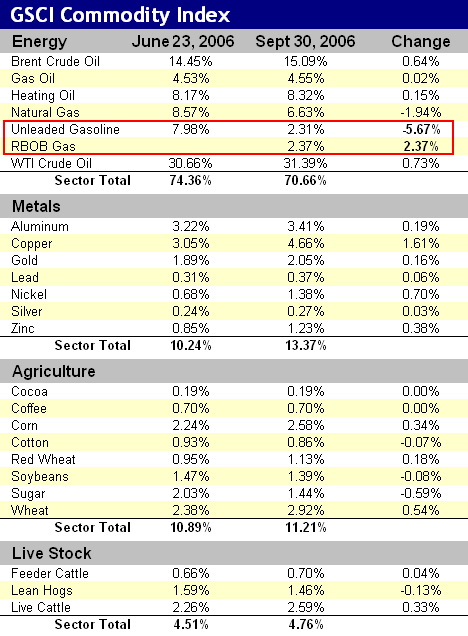
Having looked at this commodity index some time ago as part of the work done for the Iacono Research website, the weightings from late June were already available in spreadsheet form. A comparison between the composition from a few months ago to the most recent data available at the GSCI page of Goldman's website shows the following changes.
The Times article states that the adjustment prompted the sell-off of some $6 billion in unleaded gasoline futures contracts, some of these being replaced by Reformulated Gasoline Blendstock for Oxygen Blending ("RBOB") futures and, as shown in the chart above, the rest being distributed to other commodities. Note that there was a hefty decline in the natural gas weighting as well.

There have been many other factors at work contributing to plunging energy prices over the last two months - the calming of tensions in the Middle East, a mild hurricane season, and improving energy production around the world - but the August 9th date serves as the peak for nearly all energy products.

The plunge of unleaded gasoline prices around this time is clear in the chart below.
So, indulging some conspiratorial inklings just a bit further, a reasonable question to ask is whether there might be a relationship between falling gasoline prices and other energy prices. Were plunging gasoline prices just part of a broad energy price deline or did it serve as a catalyst?
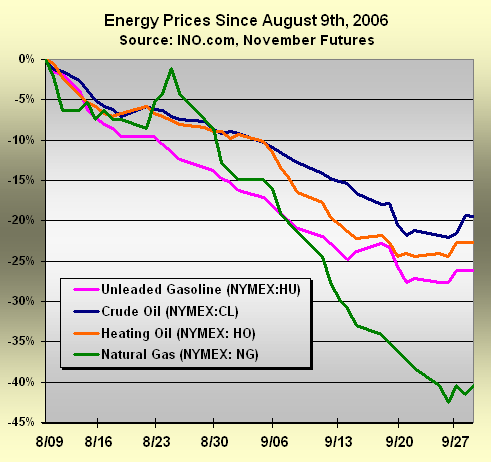
The price of heating oil, for example is often affected by the price of crude oil, and gasoline prices can impact how much traders will pay for other commodities.

As it turns out, the end of the first week in August marks a peak for almost all energy commodities - crude oil, heating oil, gasoline, and more. But one look at the chart below and it becomes clear which energy commodity led the others down. With the exception of a brief exchange with always-volatile natural gas shortly after August 9th, other energy prices appear to have been led down by the falling price of unleaded gasoline. It looks like a contagion in the graphic above, spread by unleaded gasoline and picked up by other energy commodities that were unable to fight off its effects.

Not until ten days before Amaranth Advisors fessed up to their bad energy bets on the weekend of September 17th and 18th did the plunge in natural gas prices surpass that of unleaded gas. Of course, owning near ten percent of all natural gas contracts just prior to that fateful weekend, the actions of Amaranth traders leading up to their confessional likely exacerbated this decline.

So, as far as conspiracy theories go, this is quite a good one. The motivation for the commodity index change and the impact on other energy prices will likely never be confirmed or corroborated, but it makes for an interesting story.

Make a little change that causes $6 billion in unleaded gasoline futures to be dumped onto the NYMEX, then watch prices tumble. Stand clear, watching for traders like Amaranth to implode, and get ready to mop up any other messes that arise during the process - all to relieve a little pain at the pump, prior to the polls opening.

Some at the White House may be patting themselves on the back figuring that the best thing they've done in years was to get Hank Paulson to take the job at Treasury.

It's good to have friends in high places.

Read more...

When Black and White Fail

Sunday, October 01, 2006

An indecipherable cartoon in this week's issue of The Economist demonstrates the difficulties that arise when only two colors are seen. It appears that some sort of flamethrower is being wielded in the last panel, but it is impossible to know with any certainty due to the limited amount of information conveyed in the black-and-white only drawing.

But, a flamethrower coming from out of the back of a fire truck carries little of the subtlety or irony to which readers of this magazine have grown accustomed on page 9 - surely there is something more.
Is there some detail that is being overlooked that would cause this drawing to rise to the level that has become the norm, or was this simply an off-week, where a straightforward, not-so-funny graphic was the best that could be mustered?

Read more...
IMAGE

  © Blogger template Newspaper by Ourblogtemplates.com 2008

Back to TOP