Wikinvest Wire

The Bush Economy

Tuesday, November 07, 2006

Now don't fret - there will be no political views proffered here today. But, as millions of Americans head to polling stations all across the land, it's difficult not to look at things a little differently on this day.

It's hard not to think about the impact that divided government might have on both the broad economy and government spending over the next two years, as it seems all but certain that control of the House of Representatives will be changing in January.

From the most recent issue of The Economist comes this king-size story of the past, present, and future of the Republican majority beginning and this account of spending largess with origins in the last memorable mid-term election in 1994.

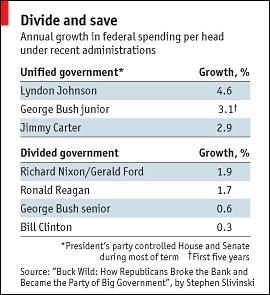
Twelve years ago, Newt Gingrich and his Republican footsoldiers swept to control of Congress by promising to slash federal spending. For a while, they kept that promise. Between 1995 and 2000, with a Republican Congress acting as a check on a Democratic president (and vice versa), real federal spending per head remained nearly frozen. When Mr Bush took office, however, Republican lawmakers were reluctant to restrain their own man. In Mr Bush's first five years real per head federal spending grew by 3.1% annually, making him the most fritter-happy president since Lyndon Johnson (see table). Under Mr Clinton, the number of federal employees shrank by 200,000 (excluding the armed forces and postal service). Under Mr Bush, it rose by 79,000.

William Niskanen, a former economic adviser to Ronald Reagan, speculates that divided government itself may be the key to fiscal restraint. Using data going back to Harry Truman's time, he found that real annual growth per head in federal spending averaged 1% under divided government and five times that under unified government.

With no hostile Congress to block him, Mr Bush has been free to follow his political instincts. There was once some ambiguity about what these were. When he first ran for president, he said he believed in limited government, and boasted that if his race with Al Gore were a spending contest, “I would come in second.” But he also distanced himself from Republicans in Congress by accusing them of “balanc[ing] their budget on the backs of the poor.”

Once in office, he appointed a budget director with a reputation for frugality, Mitch Daniels, who even tried—unsuccessfully—to make the phones at the Office of Management and Budget play the Rolling Stones' “You Can't Always Get What You Want” to callers on hold. But Mr Bush never gave Mr Daniels the latitude to make real cuts, because he was determined that everyone should get what he had promised them during his campaign.

Spending galore
The biggest handout was a prescription-drug entitlement for the elderly, known as Medicare Part D, which passed by a handful of votes in 2003. It addressed a real problem: some 22% of the elderly lacked drug coverage. But it did so in the costliest way imaginable. It is not means-tested, so old people who previously paid for their own drug coverage have an incentive to mooch off the taxpayer instead. It will cost an estimated $1.2 trillion over the first ten years—making it the biggest expansion of the welfare state since Mr Bush was dancing the Alligator at Yale.

The Bush Republicans passed the bill to woo the 40m elderly Americans, a group that seldom forgets to vote. Some were doubtless grateful, but since the plan started working this year, many have complained that it is confusing (which it is) and stingy (because it covers the first $2,250 of drug spending and anything over $5,100, but leaves a “doughnut hole” in the middle). Democrats, meanwhile, argue that the plan is too generous to drug companies. Voters seem to agree.
Remember the details of the Medicare bill back in 2003?
It came to a vote at 3 AM and after 45 minutes it was losing by four votes. Speaker Dennis Hastert and Majority Leader Tom Delay held the vote open for three hours while twisting a few arms, Rep. Nick Smith of Michigan claiming that campaign funds were offered in exchange for his vote, an account that he later recanted.

The cost estimate for the ten-year plan, initially pegged at $400 billion during Congressional debate, was revised to $534 billion after the bill was passed. Fiscally conservative Republicans may not have supported the bill with a higher estimate, one that government analyst Richard Foster apparently had at the ready but kept in his pocket for fear of losing his job.

The Economist reports the latest ten-year cost estimate as $1.2 trillion.

As for the performance U.S. economy under one-party rule, it all depends on who you ask. If you work on Wall Street, you'd probably say the economy has been good, but if you work on Main Street, you might have a differing opinion.

Despite economic statistics for which past presidents would give their eye teeth - an unemployment rate under five percent and both inflation and GDP growth near three percent - the booming economy has been a tough sell.
By some measures, the economy has been doing quite well under the Republicans. Productivity growth has been strong, unemployment is low and inflation modest. Although output growth is slowing as the housing market slumps, petrol prices have plunged in the past couple of months and the stock market is up.

Yet Americans are gloomy. Three-fifths of them tell pollsters that economic conditions in the country are getting worse, a much higher share than in 2004. Economists argue ferociously about how close this is to being true. The more dismal-minded ones point to average hourly wages, which rose by a slothful 0.6% annually between 2000 and 2006 once you adjust for inflation. Sunnier ones point out that if you include benefits, total hourly compensation rose by 1.3% a year over the same period. Yes, say the pessimists, but that is eaten up by soaring health-care costs. All right, say the optimists, let's look at consumption per head, which rose 17% in total between 2001 and the second quarter of 2006. Ah, say the doomsters, but that is because consumers are recklessly over-borrowing. No, say the optimists, it is because the Bush tax cuts left more money in their pockets.

Both sides make some valid points. But on balance the naysayers have the upper hand. The Bush economy has not felt great for most workers, for three reasons. First, at least until recently, workers' compensation has been surprisingly sluggish, while firms' profits are at a record high. Americans have kept up spending by borrowing, largely against the value of their houses. Their savings rate is now negative. Second, the gains of growth have been skewed to the highest earners. Rising income inequality means that average income can be growing smartly, even as most workers are not much better off. Third, as Jacob Hacker of Yale University points out, incomes are much more volatile than they were a generation ago. People may be better off, on average, but they worry more about losing their jobs, and with it their health insurance and their ability to pay their children's college fees. None of this helps the Republicans; polls show that Americans prefer the Democrats on every economic issue bar taxes.
The difficulty in convincing the electorate that the economy is indeed going gangbusters speaks volumes about the current condition. Either the economic indicators are broken or there is a lag between the time that people realize there is something wrong and for this reality to show up in the data.
The inflation indicator is clearly broken.

In recent years, many Americans have noticed how poorly the Consumer Price Index has tracked the price of things that they actually have to pay for. This was easy to overlook as long as home prices were included in the list of items that were going up in price, but with more and more homeowners realizing that their home really isn't an ATM machine that just keeps on giving, sentiment is shifting.

As for the employment picture, no one can really quarrel about job growth in recent years. The quality of the jobs is another matter - something that an increasing number of workers are also noticing, especially when meager pay increases of recent years are combined with rising prices.

Will divided government cure these economic ills? We are likely to find out soon enough.

Read more...

Too Low for Too Long

Monday, November 06, 2006

"I am not a trained economist and make no pretense whatsoever of being a formal practitioner of the dismal science. "

That's not something that was said around here. That's what Richard "eighth inning" Fisher, President and CEO of the Federal Reserve Bank of Dallas, had to say last week during a speech on the subject of Data Dependency.

He went on to explain how economics is not dismal at all and to describe the qualities that landed him the top post at one of the twelve Federal Reserve Banks.

To me, "dismal" is a misnomer; economics is a vibrant and exciting field of study, especially in a capitalist society where it best applies itself to the conundrums of capital markets and the intricacies of monetary policy.

I came to economics and the markets late in life. I started out as a midshipman at the Naval Academy, then migrated from learning to navigate the seas to navigating through the undergraduate basics of economics at Harvard. After a brief detour to Oxford—principally to find my wife and perfect my taste for good beer—it was onward to Stanford Business School, where I discovered what has become a lifelong passion, with its own branch of economics: decisionmaking under conditions of uncertainty.
For over a decade before I took up public service in 1997, I was able to profit from that passion as a hedge fund manager. Back in those days, the investors in funds actually made more than the managers of those funds—imagine that! Now I have the responsibility to apply what I have learned over the years in a different context—the making of monetary policy.
Mr. Fisher has always seemed a bit different than the other Fed heads, mostly as a result of saying things that others in his position would not dare. In mid-2005, he predicted the imminent cessation of rate hikes earning the moniker "eighth inning" for a baseball metaphor that proved far from the mark.

He was off by nine innings as it turned out (either that or he was counting on extra innings).

According to his bio, he founded Fisher Capital Management and a funds management firm, Fisher Ewing Partners, managing a fund called Value Partners that earned 24 percent per year under his watchful eye.

So he knows a thing or two about the real world and how imperfect it can be.

He also knows a thing or two about bad data, making headlines again last week when he criticized Alan Greenspan's interest rate policies of recent years, citing faulty inflation data.
A good central banker knows how costly imperfect data can be for the economy. This is especially true of inflation data. In late 2002 and early 2003, for example, core PCE measurements were indicating inflation rates that were crossing below the 1 percent "lower boundary." At the time, the economy was expanding in fits and starts. Given the incidence of negative shocks during the prior two years, the Fed was worried about the economy's ability to withstand another one. Determined to get growth going in this potentially deflationary environment, the FOMC adopted an easy policy and promised to keep rates low. A couple of years later, however, after the inflation numbers had undergone a few revisions, we learned that inflation had actually been a half point higher than first thought.

In retrospect, the real fed funds rate turned out to be lower than what was deemed appropriate at the time and was held lower longer that it should have been. In this case, poor data led to a policy action that amplified speculative activity in the housing and other markets. Today, as anybody not from the former planet of Pluto knows, the housing market is undergoing a substantial correction and inflicting real costs to millions of homeowners across the country. It is complicating the task of achieving our monetary objective of creating the conditions for sustainable non-inflationary growth.
Around here there is another word for what Alan Greenspan left behind - a "substantial correction" that is "inflicting real costs" is surely far too kind a characterization.

We'll see how it all works out.

As to the question of inflation data, it's not often that you hear someone from the Federal Reserve say that inflation is higher than their statistics indicate, but that's what Mr. Fisher said about the 2002-2003 period. Upward revisions of a half point in the core rate of inflation, years after the fact, have cast a different light on the condition of the economy at the time.

This was back when phrases like "an unwelcome fall in inflation" were frequently heard and everyone prayed that dreaded "deflation" would not take hold.

Heaven help us if American consumers would ever come to expect prices to fall.

This is a core principle of the world's largest retailer and the basis for the entire Chinese export economy, yet "deflation" is a dreaded evil in economic circles.

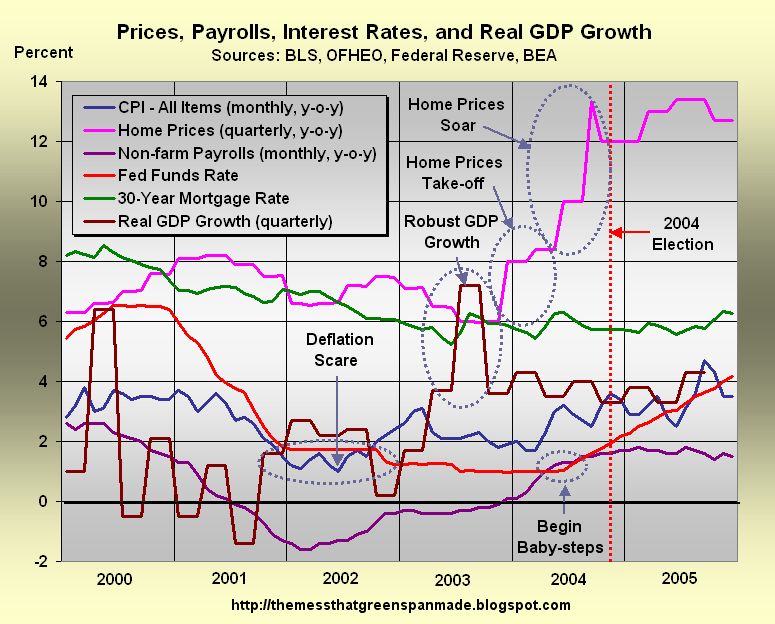
To help put that period into proper perspective, a chart from the Greenspan send-off provided here in January, Three Sins, One Gift - Sin #2 - Bending to the Will of Others, is reproduced below.

It's a rather busy chart, but one that nonetheless shows the myriad of factors that should have compelled the former Fed Chairman to ease up on the gas pedal a year or more before he did. There was an election coming up in 2004, and anyone with a conspiratorial bent would guess that all those visits to the White House in 2003 had something to do with the gas pedal getting stuck.


Click to enlarge

Beginning a sequence of quarter point rate hikes in June of 2004 has proved far too little, far too late - an error that was compounded by failing to provide any meaningful regulation of mortgage lending until just a month or so ago.

Greg Ip noted Mr. Fisher's speech in this story($) in the Wall Street Journal, taking the Dallas Fed President to task for breaking ranks by speaking out.
In an apparent and rare in-house critique, the president of the Federal Reserve Bank of Dallas said that because of faulty inflation data, the Fed kept interest rates too low for too long earlier this decade, fueling speculative housing activity.

A number of critics have said the Fed under former chairman Alan Greenspan kept monetary policy too easy from 2003 to 2004. But Richard Fisher's remarks to the New York Association for Business Economics yesterday mark the first time some Fed watchers could recall a sitting Fed policy maker making such comments.
...
Mr. Fisher, who took office in April last year, said in an interview that his speech wasn't meant to be a criticism of the decisions Mr. Greenspan and the FOMC made then. He said: "I wasn't at the table at the time -- it's easy to look at things with 20-20 hindsight. The point is we need to continue to improve our ability to develop and work with better data."

Jan Hatzius, chief U.S. economist at Goldman Sachs, called Mr. Fisher's remarks "pretty striking," while noting it is Mr. Fisher's style to be opinionated. He added that while he agrees the Fed's policy from 2002 to 2004 fueled speculative housing-bubble activity, it was still reasonable "knowing what you knew at the time. You take out some insurance against a really bad, low-probability outcome, and after the fact you regret having paid the insurance premium."
If it weren't for the wholly unsound practice of creating so much money out of thin air, deflation wouldn't be such a bad thing. In the days when money was backed by something more than a government's promise, deflation was the natural result of improved productivity - when production became more efficient, consumer prices went down.

Not a big deal.

Today, in a system that many characterize as "inflate or die", a generally falling price level can not be tolerated for fear of a calamitous outcome. Apparently the housing inflation that followed the bursting of the stock market bubble just a few years ago was the economy's latest reprieve.

With housing prices now spiraling downward, and the prospect of this spreading to the rest of the economy, the odds of new "deflation" warnings coming from the nation's central bankers increase by the day.

This is not a dismal science at all.

This is exciting - in the same sense that trying to catch a falling knife is exciting.

Read more...

The New NAR Ad Campaign

Sunday, November 05, 2006

After seeing the full-page layout in the local paper, the compulsion to analyze the individual points of the recent National Association of Realtors' ad was intense. But, after seeing that Barry Ritholtz of The Big Picture had already experienced the same desire and acted on it, there didn't seem to be much point to duplicating his effort.

See Analyzing "Why it's a great time to buy or sell a home".

Obviously, the best part of this ad is the quote from former Fed Chief Alan Greenspan, who contributes to the section with the heading Positive Outlook.

Former Federal Reserve Chair Alan Greenspan recently said that housing prospects are looking up. "Most of the negatives in housing are probably behind us. The fourth quarter should be reasonably good, certainly better than the third quarter."
It's hard to get too overwhelmed by the selection of words - "most", "probably", "should", "reasonably" - all within two short sentences.

Barry notes:
Is this the same former Fed Chief Greenspan who advised getting variable APRs at the precise low in interest rates?
If memory serves, at about the same time that Alan Greenspan was recommending variable rate mortgages, NAR chief economist David Lereah was making dismissive comments about people who don't have low variable rate loans - that they were not doing a very good job of managing their money, or something of that nature.

Here's what the ad looks like:

Here's what some Photoshop work from a Boston.com message board turns it into:


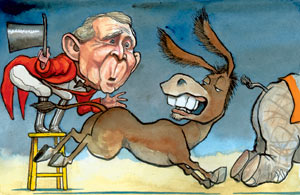
Last week's cartoon from The Economist:

Read more...

Friday Lite - Hummer Anniversary Edition

Friday, November 03, 2006

The labor report was released a short time ago and the news was good. Actually, the news was freakishly good, given the spate of other recent reports showing growing weakness in the economy and dire predictions of another recession.

If there's a slowdown ahead, the jobs market sure isn't playing along.

After finding almost a million new jobs as part of the annual benchmark revision just a month ago, there were more massive upward revisions to the August and September data - the total for these two months increased by almost 150,000 - to go along with the 92,000 new jobs created in October.

The October data had the following winners and losers by category:

  • -26,000 - Construction
  • -39,000 - Manufacturing
  • +43,000 - Professional and Business Services
  • +28,000 - Education and Health Services
  • +35,000 - Leisure and Hospitality
  • +34,000 - Government
Having been out and about in the last few weeks, the availability of food service jobs was pretty clear - nearly every coffee shop and burger joint had a Help Wanted sign in the window. With 26,700 new positions in Food Service and Drinking Places (love that category name) last month, a good number of these have likely come down.

With Professional and Business Services positions sprouting up all over the place, mostly temporary and consulting type help, no one's really taking notice of the exodus in the ranks of granite countertop installers - the number of residential specialty trade contractors fell by more than 30,000 last month.

The worst part of today's report is that the unemployment rate now sits at a freakishly low 4.4 percent.

What's bad about that number?

You're likely to hear it about a million times between now and next Tuesday.

Oh well, it's Friday.

Hummers! One Year Ago Today

One year ago today, things became hectic around here for a few days with the publication of a little story about Hummers. It started like this:
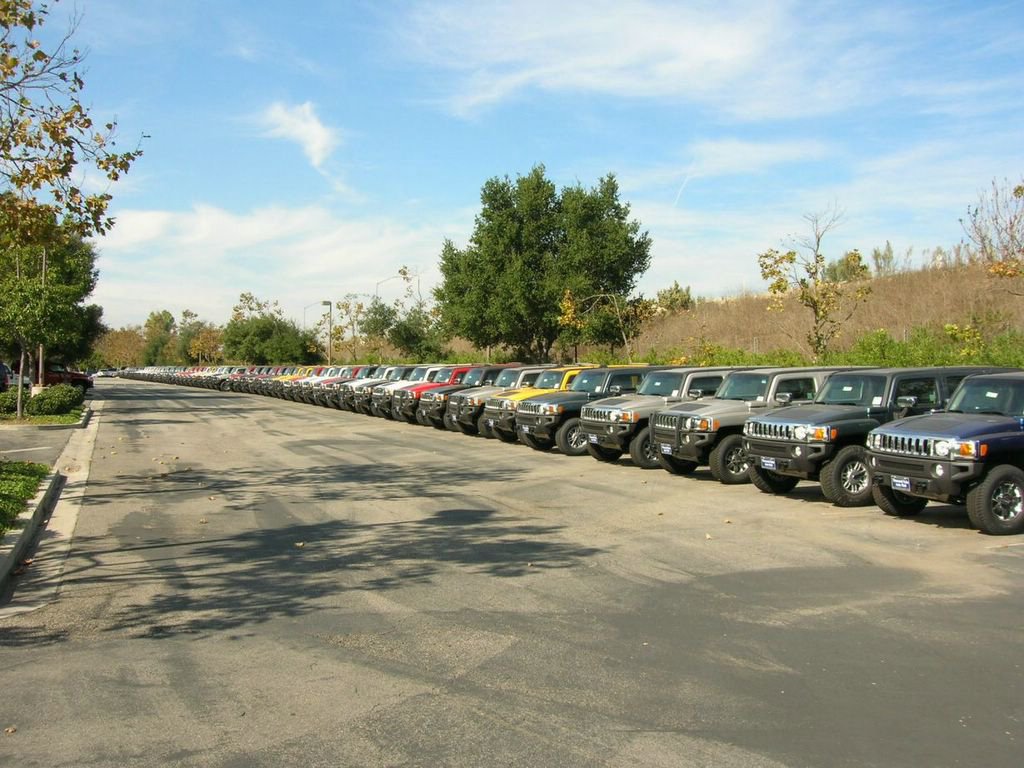
The word around town was that the Hummers weren't moving. It looked like high gas prices and a White House reversal on fuel conservation meant that fewer "W" bumper stickers would find their exposed sticky sides mating gloriously with the smooth rear bumper of an H2, somewhere between the tow loop and the access hole for a Class 3 hitch.
And here's the most popular of the six pictures that accompanied the story:

Click to enlarge ... now here, we will insist - click it and make it bigger
According to an online service that monitors traffic on blogs, on November 4th, 2005, this story was the most popular blog post in the country.

Every few months, usually after a glass of wine or two, this whole sequence of SUV silliness is reviewed and it always yields a chuckle or two. Here's the entire set:
Here's what it did to the 'ol Sitemeter stats. The Hummer spike will soon be absent from the last year's worth of site statistics, and having grown accustomed to seeing it there for so long, it will be missed.
The oddest part about the whole story is that, to this day, people still come to read it. A rough count of yesterday's traffic shows that about 60 people entered on this page. Sometimes, someone stumbles across it and posts a link on some other website apparently not knowing (or caring) that the story is almost a year old.

Hummers apparently still push the same buttons today as they did back then- people continue to leave comments and argue with each other.

Just two days ago a comment was left that began:
I would definitely say that you have hit a major point about the American gamut; culture, economy, society, with your article about GM's prized Hummer line.

In America we believe that we are superior in every way. That the vehicles we make are unsurpassed. Everyone else thinks we are gas guzzling ____ (you fill in the blank.)
And last month these two agreed to disagree:
Anonymous said...

Actually, yes, you do deserve to be treated like s**t.

You are needlessly aggravating our dependence on foreign oil and posing a safety hazard to drivers who can't see around you and vehicles you end up crushing.

Who am I? Someone who has little trouble carrying the exact same supplies and my children in my hybrid sedan.

Anonymous said...

Apparently you're also someone who thinks it's up to you to say what other people should or shouldn't do. You must be really important. I didn't see in that comment where that person said they bought their Hummer just for the purpose of hauling supplies.

You sound like a truly kind person. A real humanitarian.

Anonymous said...

I have a full size SUV. I drive a Denali and the reason why I like to drive a heavy duty vehicle is because...
Ahhh... memories.

For this occasion, the Hummer inventory could have been checked or maybe a phone call or visit to the Hummer dealer would have yielded an item of interest or two, but it hardly seems worth the effort.

Hummers are so 2005.

The Return of the Short Sale

From Boston comes this story of an increasing number of homeowners who find themselves owing the bank more money than their house is worth when they go to sell it. Lois Meisler of Asset Disposition Management (that must look nice on a business card) sees an opportunity:

While foreclosures are her bread and butter, Meisler sees major potential by specializing in short sales for home and condo owners trying to make the best of a losing hand. Meisler doesn’t buy suggestions from the real estate industry that prices and sales may have finally hit bottom. “The brokers are saying the market is turning when we have hit bottom. I don’t think so,” Meisler said.“We predict that short sales are going to become very popular.” A “short sale” is a process in which the lender agrees to accept less than the full amount of the loan.
The piece written here some time ago, The Return of the Short Sale, continues to be accessed with great frequency via search engines. Ms. Meisler is probably correct - this is just the beginning.

For Some Who Would Prefer to Stay Put ...

The numbers in this report are pretty sobering - while still not at historically high levels (except for Colorado), the trend in foreclosures is certainly pointing upward.
Foreclosures jumped 43 percent nationwide in the third quarter from a year ago, according to RealtyTrac Inc., providing further evidence that the housing market keeps slowing.

About 318,000 properties entered some form of foreclosure in the third quarter, up 17 percent from the second quarter, with sharp jumps in Nevada, Florida and Louisiana.
...
"The market currently is a little lower than expected as buyers try to time their entry," said David Lereah, the group's chief economist.
Why do they continue to quote David Lereah?

It's Grim's Turn

New Jersey blogger James Bednar recently showed up in the mainstream media with this story of what it's like for a 30-year old software weenie to be sitting on the outside looking in on what will likely be remembered as the biggest bubble of them all.
Bednar recently talked to Newhouse News Service writer Sam Ali about the housing market, why he created his blog and the challenges of growing stony coral in his basement.

My whole interest in real estate came after I got married and we started doing the same thing every other newly married couple does. We were renting an apartment and we would go out and try to look for a place and it was intimidating. This was in early 2005, during the frenzy of the bidding wars. We made a bid on two properties and, of course, we were outbid on both and it was just silly.
A very interesting read about the phenomenon that has come to dominate the lives of so many ordinary individuals who five years ago wouldn't have dreamt of doing what they are doing today. No, not flipping real estate - writing blogs.

James' blog can be found here.

Housing Deflation Search Update

It's been some time now since search results for the phrase "housing deflation" were last checked.

August results: 875 for Google, 251 for Yahoo!, and 339 for MSN Search.
Today's results: 951 for Google, 247 for Yahoo! and 360 for MSN Search.

It's still early.

August's Newest Democrat? Moi?

It's not clear how this untruth originated, but let the record show that your author is a die-hard independent who leans in only one direction - toward the bar while awaiting another drink.
The issue is, in a word, inflation. The Bush policy of buggering the dollar and exporting inflation is striking increased numbers of conservatives as crazy. Former conservatives like the blogger Tim Iacono are switching sides. Worldwide inflation promotes instability. As Stirling Newberry notes, Iran is paying less for more military might today than ever before, thanks entirely to Bush Administration policies.
Mercifully, Tuesday will soon be here.

Awakening From Its Slumber

The world's oldest money doesn't seem to be much impressed with the U.S. dollar in recent weeks, although this morning's freakishly good labor report has stemmed the tide (this chart is from yesterday).


Before the mauling of energy prices back in August, it had breached the $650 level on a couple of occasions - just watch what happens to the price of gold if oil prices go back up after the election.

Guessing the Price of Oil and Gold

Speaking of oil and gold, here's an update on the progress of oil and gold prices over the last two weeks along with last month's guesses for the year-end price. Remember that the lucky winner gets a free one-year subscription to Iacono Research.
If you just can't wait until the New Year to see what's over there (something to consider, given recent moves in uranium and precious metals), you can always request a free, no-obligation trial subscription by clicking here.

It's Borat!

Really, where would the world be without Borat?

Click to enlarge

More proof that, at least regarding our taste in entertainment, DEVO was right.

Read more...

China, Dollars, and Commodities

Thursday, November 02, 2006

The global view offered up in the pages of The Economist is a refreshing alternative to the news and opinion available from the mainstream media here in the U.S.

Such is the case in the most recent issue (which, sadly, is now more likely to arrive on Monday instead of Friday) where three stories tell of China's continuing impact on the world economy and their seemingly intractable problem of what to do will all those U.S. dollars piling up in their central bank vaults.

None of these articles require a subscription.

The first report describes their money woes, mentioning gold in a way that is not condescending and quoting Brad Setser of the increasingly popular (and increasingly bearish) office of Roubini Global Economics.

BY THE end of October China's foreign-exchange reserves are likely to top $1 trillion, twice their level two years ago and more than one-fifth of global reserves. This handsome sum would be enough to buy all the gold sitting in central banks' vaults (indeed, twice over) or almost all of London's residential property.

China's massive hoard is the result of its large current-account surplus, significant inward foreign direct investment, and big inflows of speculative capital over the past couple of years. In theory, flows of foreign money into China should push up the yuan, but China has resisted this, forcing the central bank to buy up the surplus foreign currency. The growth in reserves has slowed in recent months, but it is still averaging a hefty $16 billion a month.

China's official reserves already far exceed what is required to ensure financial stability. As a rule of thumb, a country needs enough foreign exchange to cover three months' imports or to settle its short-term foreign debt. China's reserves are equivalent to 15 months of imports and are six times bigger than its short-term debt. The explosion in reserves is also a headache for the central bank. It creates excess liquidity, which risks fuelling higher inflation, asset-price bubbles and imprudent bank lending.
...
How that money is invested has big implications for the world economy, not just for China. Brad Setser, head of global research at Roubini Global Economics, estimates that about 70% of it is invested in dollars, mainly Treasury securities. This has propped up the dollar and reduced American bond yields—by up to 1.5 percentage points according to some estimates. A big shift out of dollars could therefore push up bond yields and hence mortgage rates, damaging America's already crumbling housing market.
What to do with all that paper? Buy things.

The continuing relationship with nations in Africa as described in this story paints a picture of industrious, level-headed businessmen and government officials creating relationships and striking bargains with those who are rich in natural resources, yet needy in other areas.

Let's have a meeting.
Next week China will host more than 30 African leaders from the wrong continent in Beijing, offering them a pinch of debt relief, a splash of aid, plus further generous helpings of trade and investment. China already buys a tenth of sub-Saharan Africa's exports and owns almost $1.2 billion of direct investments in the region. A Chinese diaspora in Africa now numbers perhaps 80,000, including labourers and businessmen, who bring entrepreneurial wit and wisdom to places usually visited only by Land Cruisers from international aid agencies.

What is in it for China? It no longer wants Africa's hearts, minds or giraffes. Mostly, it just wants its oil, ores and timber—plus its backing at the United Nations. Thus, even as the Chinese win mining rights, repair railways and lay pipelines on the continent, Africa's governments are shuttering their embassies in Taiwan in deference to Beijing's one-China policy.
Well, with nearly a trillion U.S. dollars in their coffers, that $1.2 billion figure can easily be increased in a meaningful way.

More meeting details are found in this report.
The summit in Beijing is being greeted by Chinese officials and the country's state-run media with an effusion reminiscent of the cold-war era, when China cosied up to African countries as a way of demonstrating solidarity against (Western) colonialism and of outdoing its ideological rival, the Soviet Union. It supported African liberation movements in the 1950s and 1960s, and later built railways for the newly independent countries, educated their students and sent them doctors.

China's main aim then was to gain influence. Now China wants commodities more than influence. Its economy has grown by an average of 9% a year over the past ten years, and foreign trade has increased fivefold. It needs stuff of all sorts—minerals, farm products, timber and oil, oil, oil. China alone was responsible for 40% of the global increase in oil demand between 2000 and 2004.

The resulting commodity prices have been good for most of Africa. Higher prices combined with higher production have helped local economies. Sub-Saharan Africa's real GDP increased by an average of 4.4% in 2001-04, compared with 2.6% in the previous three years. Africa's economy grew by 5.5% in 2005 and is expected to do even better this year and next.

Which countries are the main beneficiaries? For copper and cobalt, China looks to the Democratic Republic of Congo and Zambia; for iron ore and platinum, South Africa. Gabon, Cameroon and Congo-Brazzaville supply it with timber. Several countries in west and central Africa send cotton to its textile factories.

Oil, however, is the biggest business. Nigeria, Africa's biggest oil-producer, has been getting lots of attention. CNOOC, a state-owned Chinese company, paid $2.7 billion in January to obtain a minority interest in a Nigerian oilfield, and China recently secured exploration rights in another four. In Angola, which has now overtaken Saudi Arabia as China's biggest single provider of oil, another Chinese company is a partner in several blocks. China has shown similar interest in other producers such as Sudan, Equatorial Guinea, Gabon and Congo-Brazzaville, which already sells a third of its output to Chinese refiners.
It's all about the acquisition of natural resources for a large and growing nation that has little of their own. The downside?
The love affair with China, however, may be sour as well as sweet. For countries that do not sit on oil or mineral deposits, higher commodity prices make life harder. Even for producers there are risks. A recent report by the World Bank argues that Africa's new trade with China and India opens the way for it to become a processor of commodities and a competitive supplier of cheap goods and services to Chinese and Indian consumers. But another report, from the OECD, a club of industrialised countries, argues that China's appetite for commodities may stifle producers' efforts to diversify their economies. Oil rigs and mines create few jobs, it points out, and tend to suck in resources from other industries. And if Africa is to escape its vulnerability to the capricious movements of world commodity prices, it must start to export more manufactures. On this the World Bank adds its own warning: China and India must end their escalating tariffs on Africa's main exports.
...
Some say China's involvement will erode efforts to promote openness and reduce corruption, especially in oil and mining. Nigeria insists that Chinese companies must respect its new anti-graft measures, and the latest bidding round for oil blocks in Angola has been the most open so far. In both countries it is unclear whether China's presence is making corruption better or worse. It is clear, though, that China is not interested in pressing African governments to hold elections or be more democratic in other ways. That helps to explain why China directs so much money towards Sudan, whose odious regime can count on China's support when resisting any UN military intervention in Darfur. China invested almost $150m in Sudan in 2004, three times as much as in any other single country. When American and Canadian oil companies packed their bags there, China quickly stepped in, drilling wells and building pipelines and roads. The Chinese are supposed to be building an armaments factory as well.
Comparing the global adventures of the world's current super-power with those of what many believe will be the world's next super-power really makes you stop and think.

Read more...

This is Tightening?

Wednesday, November 01, 2006

Much has been made of the "tightening" by central banks around the world, particularly the multi-year "baby-step" therapy applied to short-term interest rates here in the U.S.

This treatment was just concluded a few months ago under the watchful eye of Fed Chairman Ben Bernanke - the baby steps weren't the new Fed Chief's idea, but he is saddled with what they have produced.

~~~~~~~~~~~~~~~~~~~~~~~~~~~~Advertisement~~~~~~~~~~~~~~~~~~~~~~~~~~~

Wow! Silver, uranium, and now this morning gold looks to be headed toward an entirely different sort of price range for the entirely new month of November. Has the next leg up in the commodity super-cycle already begun?

Subscription Rates Are Going Up This Month!

The model portfolio at Iacono Research has been on a tear recently - the mix of more than 35 positions in commodities and related equities, all easily purchased from nearly any brokerage, is back above the +20 percent mark for the year, looking to head higher. For a free, no obligation two week trial, click here. For subscription details, go here.

~~~~~~~~~~~~~~~~~~~~~~~~~~~~~~~~~~~~~~~~~~~~~~~~~~~~~~~~~~~~~~~~~

Having wondered what effect these rising rates have had on the creation of both consumer debt and new money, the construction of a chart showing all three laid together is a task that has sat near the top of the To Do list around here for some time.

It can now be checked off.
Nearly all of this data is available at the Federal Reserve website. The only part for which one has to look elsewhere is the last six months of M3 Money Supply - the central bank stopped divulging this data earlier this year.

The latest M3 data is now available in reconstructed form at Now and Futures and John Williams' Shadow Government Statistics.

The trend is still up - surprise!

Household debt looks to be throttling back to a tepid sub-ten percent annualized growth rate - that might be expected after the orgy of borrowing since late 2002. Whether the recent pullback is a result of higher rates or sheer exhaustion by consumers is unknown.

Surely there are limits to what Americans can borrow and spend. Aren't there?

A Changing Relationship

Looking back a few decades at the relationship between short-term interest rates and the growth of money supply, one change jumps out at you. Up until the mid-1990s, the two were located in about the same area of the chart, often times crossing over each other.

That all stopped in the mid-1990s after the "productivity miracle", cheap energy, and other cheap imports allowed the two to become detached from each other. As shown in the chart above, there are now a good three to five percentage points, sometimes much more, between the two curves.

The most recent data puts money supply growth at near ten percent with short-term rates fixed at just over five percent.

Could that cause problems over the longer term?

More significantly though, the old relationship between higher short term rates and lower money growth seems to no longer be working. This was a consistent pattern up until the mid-1990s - when interest rates rose, money supply throttled back. When money supply growth slowed, falling short-term rates caused money supply growth to head back up (sometimes with a lengthy delay).

For the last ten years, and as shown clearly above for the new decade, higher interest rates seem to goad the money supply into growing faster until it declines for other reasons.

The Dissenter

Maybe Jeffrey Lacker at the Richmond Fed has seen a chart like the one above and walked away unimpressed with the effects of the rate hikes to date. Either that or he realizes that the Fed has to do a better job at appearing to "fight inflation", this being one of the more curious roles for a government agency - being responsible for combating something that they cause.

Mr. Lacker has been the sole dissenting vote at the last three Fed meetings, favoring a quarter-point rate hike while all other voting members opted for a pause aimed at refreshing an ailing housing market.

Like former Fed Chief Alan Greenspan, Mr. Lacker looks at some of the housing data and sees hope.

On Monday he said there were "tentative signs emerging that the housing market may be stabilizing." After looking at weekly mortgage applications and recent home sales data, he commented "We'll just have to see. It's very tentative."

What is decidedly not tentative is the booming new real estate sector of auctions. That is, selling real estate that has been turned back over to the bank and reduced in price for quick sale in former hotspots such as Colorado.

Everything Seems Different Now

With the bond market forecasting lower rates ahead and with the rise in short term rates failing to have the desired effect on credit creation and money growth, what's a central banker to do?

The old relationships no longer seem to apply.

If the intent of the last two and a half years of rate hikes has been to tighten things up here in the U.S. after the near death experience of the stock market melt-down that began in 2000, then something has gone horribly wrong.

The levers and knobs don't seem to work anymore.

This is tightening?

Read more...
IMAGE

  © Blogger template Newspaper by Ourblogtemplates.com 2008

Back to TOP