Wikinvest Wire

A Career Adjustment for Carlos

Wednesday, February 07, 2007

This story($) from the Wall Street Journal (no, mercifully, not the editorial page again) probably wouldn't be shared save for the related phone call received a short time ago.

Me: Hello.

Carlos: Hi, is Jennifer there?
Me: No, you have the wrong number.

Carlos: Well, maybe you can help me.
Me: Uh ...

Carlos: My name is Carlos and I'm with Century 21. We just listed a home in your neighborhood and I was wondering if you know of anyone who was in the market for a new home. We have a ...
Me: [Click]
Carlos should probably have read the article by Christopher Galler, a senior vice president of the Minnesota Association of Realtors, in which he suggested "career adjustment" as a reasonable alternative to annoying people over the phone.

It's all here in the WSJ story:
Seeking Alternative Careers
By JAMES R. HAGERTY and ANJALI ATHAVALEY

Selling homes has turned into a dog-eat-dog business, so Patrick Logue decided to work with some friendlier canines.

Mr. Logue quit his job as a real-estate agent near Fort Myers, Fla., in December. Then he set up shop as a franchisee of the dog-training chain Bark Busters. So far, he says, "I have zero regrets."

The long-awaited shakeout among real-estate agents is finally happening -- much to the relief of those who are sticking with the business and prefer a bit less competition.

When David Lereah, chief economist of the National Association of Realtors, addressed the group's convention in New Orleans in November, he got one of the biggest bursts of applause by predicting there would be fewer Realtors around in a year. Mr. Lereah said in an interview that he expects membership in the trade group to decrease by about 6% to 8% from the record of nearly 1.4 million reached in 2006.

The culling of agent ranks is a reaction to the downturn in housing that started around mid-2005. Sales of previously occupied homes last year declined 8% to 5.7 million, even as the number of agents continued to increase for the year as a whole.

Even before sales slowed, people in the industry said far too many agents were chasing too few deals. If hordes of inexperienced agents are scrapping for business, says Christopher Galler, a senior vice president of the Minnesota Association of Realtors, that can only lead to "a race to the bottom in fees."

More competition on commissions could strike many consumers as a good idea. Mr. Galler argues the result would be poor service. He says more productive agents, who complete 20 or more transactions per year, are better at solving problems than those who do only a few deals annually.

Last fall, Mr. Galler did something all but unthinkable for an official of an association that lives on members' fees: He wrote an article in a Realtor publication suggesting that some struggling agents should ponder whether it is time for a "career adjustment."
...
Mr. Logue, a 34-year-old former golf pro, became an agent for the Assist-2-Sell franchise chain in the Fort Myers area about three years ago. He says his commission income was nearly $100,000 in his first year and $180,000 in his second. Then it plunged to $40,000 last year. "Nothing was selling," he says.
Wow, what a career path - from golf pro to real estate agent to dog trainer.

Having known a few knuckle-head golf pros, it can be stated with a high degree of certainty that Patrick has no idea how silly he looks next to that dog in the Wall Street Journal.

And Carlos, in case you're reading this ... one word for you ... woof!

Read more...

Defining Income Too Narrowly

It's not clear how editorials like this one($) from the Wall Street Journal are helping the overly-indebted, savings-short, consumer culture of the current era.

At least not in the long run.

In the short run, commentary such as this probably soothes a few nerves as wage-earners work longer and harder while scurrying to and fro to collect unessential electronics goods and more nik naks to fill space in enormous homes, occasionally checking their credit limit to be sure they aren't embarrassed in the check-out line.

On the subject of a personal savings rate that plumbed new post-Great Depression lows in 2006 (-1.2 percent) after also ending 2005 in negative territory (-0.5 percent), this editorial not only misses the basic facts of the matter (two years of negative savings rate, not just one), but seeks to assuage fears that there is anything wrong.

This week's bad news is said to be the U.S. "savings rate," which according to the official measure was "negative" for a whole calendar year for the first time "since the Great Depression," as Martin Crutsinger of the Associated Press helpfully put it. Hooverville, here we come!

As a statistic, however, the official "savings rate" is nearly as useless a guide to prosperity as the trade deficit. In the government accounts, what is called the savings rate is literally income less consumption. But the government defines income too narrowly and consumption broadly. For example, "income" doesn't measure capital gains (whether realized or not), the rising value of your home, or even increases in your retirement accounts.

Think about how you calculate your own personal "savings rate." Do you merely add up what you make in salary in a year minus what you spend? Or do you sneak a peak at whether your IRA increased in value, or check the sale price your neighbor got on his home to figure out what you might be able to get for yours? By any normal definition, "savings" should include your increase in total assets -- in other words, your gains in overall wealth.

For our part, these columns long ago began to watch a far more instructive figure known as "household net worth." That number, released by the Federal Reserve, includes all assets (tangible and financial) held by individuals less their liabilities (mortgage and other debt). At the end of last year's third quarter, U.S. household net worth had climbed to $54.1 trillion. That was an increase of more than $3 trillion over the previous four quarters. Rest assured, that's a much higher figure than during "the Great Depression," AP notwithstanding.

None of this means we should be complacent about economic growth. There are two genuine clouds on the horizon -- namely, inflation risk and political risk. Inflation remains somewhat higher than is comfortable, and we still expect the Fed will consider further interest-rate hikes if today's weak dollar and soaring commodity prices lead to a jump in the official inflation indicators later this year. As for politics, the Democrats now running Congress explicitly reject the tax cuts and freer trade that have helped to propel the current prosperity. If history is any guide, sooner or later this is a recipe for trouble.
It seems that there is now an institutionalized belief by a large and influential group of economists, policy makers, and pundits that home equity and "savings" are one in the same.

In the highlighted phrase above,
By any normal definition, "savings" should include your increase in total assets...
a simple substitution yields,
By any normal definition, "savings" should include your home equity...
You don't normally see it put in these terms, but that's the message - it probably makes people feel good to realize that they've been able to "save" so much in recent years.

For most people, their home is their largest asset - in fact rising home values probably contribute to an even lower "personal savings rate" because homeowners believe that real estate is doing all the heavy lifting for them.

In the last few heady years of rising real estate prices, why would anyone cut back on spending to save another few thousand dollars a year out of their income when their home value was increasing at a rate of $50,000, $100,000, or more?

It is ironic, at the very least, that attempts to redefine a conventional measure such as the "personal savings rate" - after tax income less consumer expenditures - are the response when the result is unappealing.

But, such is the nature of money and finances in recent decades.

Whether it's inflation, the budget deficit, or the personal savings rate, when the traditional measure provides answers that you don't like, change the calculation.

Read more...

Goldman Dumps Commodity Index

Tuesday, February 06, 2007

Goldman Sachs announced (.pdf) earlier today that it was selling its commodity index to Standard and Poor's along with two other two equity index families.

Here's the press release:

NEW YORK, February 6, 2007 –Standard & Poor’s, a division of The McGraw-Hill Companies (NYSE: MHP), will acquire the market leading Goldman Sachs Commodity Index (“GSCI”) and two equity index families from the Goldman Sachs Group, Inc. (NYSE: GS), the two companies announced today.

Terms of the transaction were not disclosed.

The GSCI, created in 1991, currently includes 24 commodities and is designed to provide investors with a reliable and publicly available benchmark for investment performance in the commodity markets.

The clear commodity index leader, the GSCI has an estimated $60 billion in institutional investor funds tracking it, the majority of that coming through over-the-counter derivatives transactions.

After a brief transition period, the index will be renamed the S&P GSCI Commodity Index.

“We are excited that the world’s most popular commodity index will become part of the world’s premier index provider, Standard & Poor’s,” said Heather Shemilt, global head of Goldman Sachs’ commodity index business. “Goldman Sachs looks forward to continuing to work with institutional investors who want to gain exposure to the commodity asset class through index investing.”

“A well-diversified portfolio now routinely includes exposure to commodities, as investors seek ways to reduce risk, preserve capital and generate alpha,” says Robert Shakotko, Managing Director at Standard & Poor’s. “Standard & Poor’s acquisition of GSCI provides investors with additional tools for portfolio and risk management, while adding to the already potent lineup of S&P indices.”

Under the terms of the agreement, Standard & Poor’s will also acquire the Goldman Sachs Sector Indexes, diversified and broadly representative indexes for healthcare, financial institutions, utilities, consumer companies and cyclical industries; and, the Goldman Sachs Technology Index, a broad composite measure of US traded technology stocks and six technology subindexes.
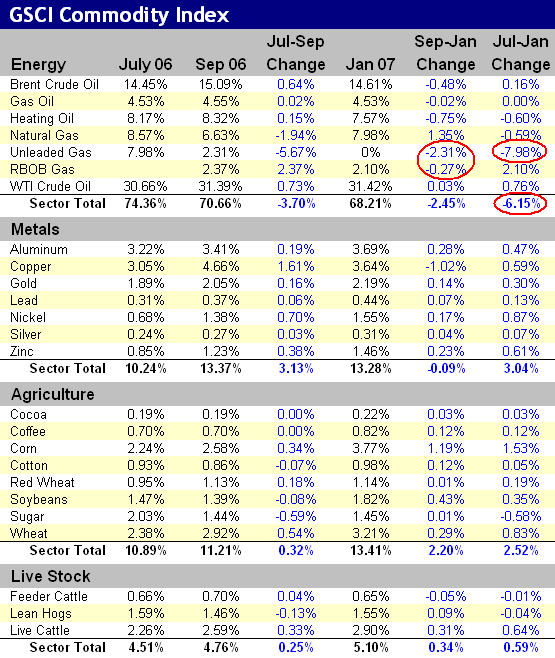
Recall that the changing composition of the world's most popular commodity index has been the subject of some debate over the last six months as the gasoline content was reduced from eight percent to two percent while broad energy prices tumbled.

Daniel Gross at Slate had a nice summary in The Oil Conspiracy last October.

Some detail on the recent history of the commodity index was provided here last month in The New GSCI and is shown again in the table below.
The question remains how an index that is supposed to be reweighted based on the "average quantity of production in the last five years of available data" would see such a precipitous decline in gasoline.

Apparently, that's now a question that Goldman Sachs will never have to answer.

Full disclosure: No position in any investment based on the GSCI at time of writing.

Read more...

A Story in Need of a Few Charts

When reading this BusinessWeek report about Santa Monica based mortgage lender FirstFed Financial (FED), it just screamed for some charts to go along with the words and numbers.

The company's stock has been soaring lately, up more than 30 percent since September, as investors speculate on its future. Some believe the company to be a takeover target, others feel that the housing market is poised for a rebound and their bottom line will improve, while short sellers bet that it will all come tumbling down around them.

Something is sure to happen soon at the boutique lender with the unique loan portfolio.

In the fourth quarter, mortgage originations plummeted by 66.8%, to $365 million—one of the steepest declines among all lenders. Cash from operating activities dropped into the red in the third quarter (the most recent data available), falling from $49 million in 2005 to negative $77.1 million a year later. Meanwhile, the number of problem loans more than quadrupled last year.

FirstFed's foundation could crack even further. The biggest problem: Its mortgage portfolio is packed with risky loans known as option ARMS. These adjustable-rate mortgages allow borrowers to make smaller monthly payments than they would normally owe by deferring the principal and adding the difference back to the balance. That may make a house more affordable at first. But when the balance hits a certain level, payments often jump significantly, and borrowers can run into major financial trouble.

FirstFed potentially faces darker days than peers who play in the same niche. For one thing, all of FirstFed's mortgages are for homes in California, where prices have cratered and foreclosures have skyrocketed. Also, 80% of its loans have little or no documentation to prove the borrower's income or assets, according to a recent company presentation. The bank uses credit scores to screen for elite borrowers.

But skeptics are starting to question the quality of FirstFed's earnings. The bulk of FirstFed's income is derived from noncash earnings, largely from the deferred principal on its option ARMs. That so-called negative amortization constituted $223.9 million, or 68.4%, of the bank's income before taxes in 2006, compared with 1.3% in 2004. In essence, FirstFed is booking profits on money it hasn't collected. The fear is that the bank will never collect, given the high delinquency and foreclosure rates in California. Says Frederick Cannon, managing director at Keefe, Bruyette & Woods Inc.: "The bearish view is that all the earnings are coming from money they didn't get yet."

FirstFed admits the environment is tougher today, but says its borrowers have stellar credit and can afford to keep up with the option ARMs' rising payments. Indeed, FirstFed's loan portfolio, with a higher credit quality and lower delinquency rate, is holding up better than those of larger competitors such as Countrywide Financial (CFC ) in Calabasas, Calif., and Washington Mutual (WM ) in Seattle. FirstFed CFO Douglas J. Goddard says the bank fully expects to collect on its loans. "In our nearly 25 years of offering this product, we have yet to find where payment shock' caused a default," he explains.

Still, given all the red flags, it's no wonder short-sellers have pounced. Some 40% of the company's 15.3 million shares have been sold short. That dynamic may have helped boost the stock. As it climbs, hedge funds and others rush to buy more shares to cover their money-losing short position, pushing the stock higher.

And as it goes up, the stock is attracting new buyers. "I constantly see momentum players buy financial companies because they hit some screen, but they don't really know what they own," says Richard Eckert, senior research analyst at ROTH Capital Partners in Newport Beach, Calif. "They are not distinguishing between cheap, and cheap for a reason."
With borrowers sporting higher credit scores, FirstFed Financial does not appear to be a sub-prime lender in the traditional sense - at least not yet.

Apparently catering to the market for which stated income and negative amortization loans were originally intended - small business owners or independent contractors with large but hard-to-document and/or unpredictable income - the company is faring better than most sub-prime lenders today.

Tomorrow, however, is an entirely different matter.

Their clientele likely includes the professional real estate speculator crowd that was in early on the California real estate craze - some of them have clearly lingered too long.

Not to be confused with your typical equity-rich Southern California homeowner who took the plunge with investment property in 2004 or 2005 after being convinced that real estate only goes up, this group of borrowers has probably been in the game for many years now and has done quite well.

Until now. Just like the craps tables at Vegas, it's hard to know when to stop.

While FirstFed Financial may not currently be a sub-prime lender, with four times the number of problem loans as a year ago sure to impact their customers' credit score, they may turn out to be one after-the-fact.

Full disclosure: No position in FED at time of writing.

Read more...

The Illusion of the American Dream

Monday, February 05, 2007

This story in the New York Times over the weekend hits on a number of hot button issues around here - debt, consumption, "prosperity" to name a few.

Someday things will likely turn full-circle in the U.S. and people will again live within their means, save the old-fashioned way, and learn anew the virtue of humility. Until then, we're in for:

Envy, Anxiety, Secrecy, Taboos: The Subject Must Be Money
By ALINA TUGEND

I’M as guilty as the next person. I’ve sat around with my pals wondering how a neighbor, a colleague, or, yes, a good friend, can possibly afford to put that huge addition on their house. Or take those many overseas vacations. Or pay for the private schools and the fancy summer camps and the second home.
Some people we just write off as trust fund babies or hedge fund zillionaires or lucky dogs who got into the stock market at the right time and cashed out.

But others are more perplexing. They look like us. They seem to come from roughly the same backgrounds as us. But they sure don’t act like us.

I don’t exactly envy them; I’m fairly satisfied with our lives. Oh, occasionally I wish we had that house on Martha’s Vineyard, or didn’t have to choose between remodeling the bathroom or taking a summer trip, but generally I know how fortunate we are.

But I do sometimes burn with curiosity about how they do it. And wish that talking about money was not so fraught in this society so I could just ask them to explain it.
They say that it's easier to talk about sex than to talk about money. Common wisdom is that money is one of the leading causes of divorce.

An afternoon talk show once had on a workaholic husband with his shopaholic wife. He was a doctor who worked so much that he was rarely around the family, so the wife began to spend money to get back at him. He had to work additional shifts to pay for her additional shopping, so he was around even less, and so she shopped even more. The cycle repeated a few times until they wound up on Dr. Phil.

At least they didn't go into debt - he was making hundreds of thousands of dollars a year, but she spent it all. For most, debt is a huge factor.
Sometimes it seems as if we must be doing something wrong because we can’t possibly afford what they can — even if we don’t want it.

The truth is, however, that we don’t know the truth, said Shira Boss, author of “Green With Envy: Why Keeping Up With the Joneses Is Keeping Us in Debt,” (Warner Books, 2006).

“The accessibility and availability of debt has created a fiction that wasn’t there 20 years ago,” Ms. Boss said. “We don’t have a grip on who can afford what. Your external lifestyle is a lot lower when you’re living within your means — you can see extravagance, but not financial security.

Ms. Schappell said that editing her book made her realize that “all the ready credit gives of the illusion of living the American dream.”

In the introduction to their book, Ms. Schappell and Ms. Offill note that “economists report that middle-class families are now carrying record levels of credit card debt, going without health insurance and filing for bankruptcy at several times the rate of the early 1980s.”

“Turns out those McMansions and shiny S.U.V.’s have us mortgaged up to our eyeballs, but until the wolf is truly at the door, you won’t find many of us admitting it.”
It's hard to believe that most people don't see this right in front of their eyes, but the allure of easy money is just too powerful a temptress.

Back in the 1980s, when credit cards first became popular, after individuals would spend up to the limit on their fist credit card, they would say, "I just spent $1,500 and it only costs me $25 a month". Naturally, it would take decades to pay off the debt at this rate, but that was unimportant compared to the feeling of "getting something for nothing". They soon got another credit card with another $1,500 credit line.

Since then, debt and consumption have escalated to a point that few could have imagined 20 years ago. Some blame Madison Avenue and our culture of consumption.
“I strongly disagree that it’s human nature,” said Allen D. Kanner, a psychologist and co-editor of “Psychology and Consumer Culture” (American Psychological Association, 2004). “Our nature is being molded pretty powerfully by the media. If we started a trend to extract marketing from our lives, it would go a long way to reducing money anxieties.” Mr. Kanner is also a co-founder of the nonprofit Campaign for a Commercial-Free Childhood (www.commercialfreechildhood.org).

Tim Kasser, an associate professor of psychology at Knox College in Galesburg, Ill., said the answer was to want less.

There is a small movement, he said, heir to many such groups in the past, called voluntary simplifiers who have chosen to make do with less. This doesn’t mean they live puritanical lives without modern conveniences, but rather they have consciously chosen to make less money and work fewer hours to spend more time with families and friends.

A study in 2005 of 200 “voluntary simplifiers” in 48 states compared with 200 similar people in the same geographical areas who lived regular lives found that the simplifiers were happier according to a variety of criteria, said Professor Kasser, author of “The High Price of Materialism” (MIT Press 2002). (Details about the movement can be found at www.simpleliving.net.)
If the "voluntary simplifier" movement catches on, that could wreck the whole economy. Our finely tuned financial system is now squarely founded on the expectation that people (and government) will continue to borrow and spend without concern for the long-term consequences.

Somehow, it seems that the simplification won't come voluntarily for most Americans.

Read more...

The IMF and The Economist

Sunday, February 04, 2007

An economist at The Economist weighed in on the subject of the IMF's budgetary problems with this story($) in the current issue.

It appears that the situation is dire - fittings and fixtures in complete disarray.

Putting the IMF's own house in order
THE financial missionaries of the IMF unpack their suitcases in some of the finest hotels in the world, but their offices in Washington, DC, are in need of refurbishment. An overhaul of the fund's fittings and fixtures was stopped halfway recently, leaving its interior stuck between the 1970s and a sleeker, modern era.

This is just one sign of the IMF's straitened circumstances. This fiscal year it must endure a freeze, in real terms, in its $980m budget for staff, travel and other administrative costs. By 2010 it projects a budget shortfall of about $370m a year. Last May the fund's managing director, Rodrigo de Rato, invited eight “eminent persons”, led by Andrew Crockett, former head of the Bank of International Settlements, to dream up new ways to fund the fund. On January 31st they offered their answers.
...
What should the new TMF do? Mr Crockett's committee thinks three fingers will more or less suffice to plug the dyke. First, the fund has squirreled away almost $9 billion of reserves, set aside when business was booming. It should invest these reserves “slightly less conservatively”, Mr Crockett says, thereby raising an extra $45m a year. Second, instead of waiting for a crisis before tapping the hard-currency quotas promised by member governments, it should dip into them as a matter of course, investing the proceeds in safe securities and creaming off a slice of the returns for itself. If it invested $30 billion of its quotas, it could raise another $300m.

The third proposal is likely to be the most controversial. The IMF has long sat on a pot of gold: 3,217 tonnes of it, the third-biggest official hoard in the world. Mr Crockett thinks it should sell about 400 tonnes, which would raise about $6.6 billion. This would not disturb the gold market, he says, as long as central banks agree to cut their own bullion sales. With the money it raises, the fund could set up an endowment and live off the income, envisaged at $195m a year in real terms.

The fund cannot sell its gold without a vote of approval from an 85% majority of its board. America thus holds a veto, and its Congress may not be sympathetic to such schemes. Governments gave gold to the fund in the first place to underpin its lending, not to pay its salaries. If it no longer needs the bullion, perhaps it should repatriate some to its members. And if it needs money for an endowment, it should ask for one directly: as a gift from its members, accounted for in their budgets.
The suggestion offered here last Friday still seems to be the most sensible approach to filling the funding gap - just sell enough gold to make ends meet for 2007, then revisit the situation next year.

If gold goes up like it has in recent years, they'll come out way ahead.

ooo

This week's BusinessWeek cartoon - a definite improvement.


Read more...

The Week's Economic Reports

Saturday, February 03, 2007

Following is a summary of last week's economic reports. Surprisingly strong GDP growth, steady employment gains, and a weakening manufacturing sector highlighted a busy week of news on the economy. For the week, the S&P 500 Index rose 1.8 percent to 1,448 and the yield of the 10-year U.S. Treasury note fell 5 basis points to 4.83 percent.


Consumer Confidence: Confirming the multi-year high reported by the University of Michigan two weeks ago, the Conference Board's consumer sentiment indicator reached a 56-month high, rising to 110.3 in January. The optimism was driven mainly by the present outlook for labor market conditions, where, the "jobs hard to get" category fell from 21.3 percent to 19.7 percent and the "jobs plentiful" category rose from 26.6 percent to 29.9 percent. The labor report on Friday confirmed this rosy outlook.

Gross Domestic Product: Exceeding expectations, the advance estimate of fourth quarter real GDP rose to an annualized rate of 3.5 percent from the 2.0 percent pace seen in the third quarter. This is the first of three readings for Q4 GDP - the preliminary estimate will be released at the end of February, followed by the final reading at the end of March. Based on this first measure of fourth quarter growth, real GDP rose 3.4 percent for the year 2006.

An annualized 4.4 percent increase in personal consumption drove total output higher, however, the bottom line benefited greatly from lower inflation readings during the quarter. The GDP price index fell to an annualized rate of 1.5 percent from 1.9 percent in the third quarter, largely a result of lower energy prices.

Residential investment continued to be a drag, falling at a rate of 19.2 percent following a decline of 18.7 percent in the third quarter, however, at less than six percent of total output, this large drop had only a minor impact on overall economic growth.

Increased government spending, up 3.4 percent, along with a narrowing trade deficit (again aided by falling oil prices) helped to boost GDP. Recall that net imports are subtracted from GDP, so the reduction in the trade deficit to $581.4 from $628.8 in the third quarter contributed to the better than expected total.

The advance estimate is subject to sometimes large revisions and the final tally will not be known for two more months, but it seems clear at this point that the combination of lower energy prices and a confident consumer are driving this traditional measure of economic growth to levels that many would not have envisioned just six or eight months ago.

Whether this will continue or not is an entirely different question - it all seems to hinge on energy prices. When energy prices go up, both inflation and the trade deficit go up, consumers pull back on spending due to higher energy costs and a falling sentiment, and economic growth slows. When energy prices go down, the opposite happens. If energy prices remain contained in 2007, don't be surprised to see continued strong economic growth at least for the first part of the year. So far, weakness in housing has not materially affected the outlook of consumers.

Chicago PMI: The Chicago purchasing managers' index fell to 48.8 in January from 51.6 in December, largely a result of a sharp decline in new orders. Readings below 50 indicate contraction for this measure of manufacturing activity for the Chicago area - this is the first sub-50 reading since April of 2003.

Construction Spending: Construction spending fell 0.4 percent in December after an upwardly revised 0.1 percent increase in November. Once again, private residential construction led the overall index lower, falling 1.6 percent in December after a decline of 1.4 percent in November, paced by slowing activity in the construction of single-family housing.

ISM Manufacturing Index: The Institute for Supply Management's manufacturing index fell to 49.3 in January after a reading of 51.4 in December. This is the second time in the last three months that a sub-50 level has been reported, an indication of contraction in manufacturing activity in the U.S. as a whole. After peaking in early 2004 the pace at which manufacturing has expanded had steadily declined until November of last year when outright contraction was indicated as the index registered 49.5, the first sub-50 reading since April of 2003.

Personal Income and Spending: The savings rate for all of 2006 dipped to a 74-year low registering -1.2 percent, indicating that consumers spent all of their after tax income and either tapped savings or added debt to fund the additional purchases. The 2006 level was the lowest since the depths of The Great Depression in 1933, when the savings rate registered -1.5 percent, and comes after a level of -0.4 percent during 2005.

The details of the December report show robust spending (up 0.7 percent), healthy income growth (up 0.5 percent), and moderate inflation (up 0.4 percent). For the year, personal income was up 5.9 percent while spending rose 6.0 percent - a number of other factors account for the much larger negative savings rate of -1.2 percent than that indicated by simply subtracting the annual change in spending from the annual change in income.

Pending Home Sales: The National Association of Realtors reported a higher than expected 4.9 percent increase in pending home sales for December. This was the largest monthly increase since March of 2004, however this report comes during an unusually warm December in what is a very slow time of the year for real estate sales and should not be interpreted as confirmation of a housing rebound. Nothing of substance regarding the condition of the nation's real estate market will be learned until March or April due to seasonal factors that render the winter data almost meaningless.

Labor Report: Nonfarm payrolls increased by 111,000 in January following upwardly revised gains of 206,000 in December (from 167,000) and 196,000 in November (from 154,000). Once again, the revisions from prior months are of roughly the same magnitude as the new data, making the most recent data all the more difficult to interpret.

The unemployment rate rose slightly, from 4.5 percent in December to 4.6 percent in January, and remains at what is essentially full-employment. Both wages and the average workweek contracted slightly.

Gains in nonfarm payrolls were led by Education and Health Care (up 31,000), Professional and Business Services (up 25,000), Leisure and Hospitality (up 23,000), and Construction (up 22,000). A total of 11,000 positions were lost in residential construction, however, this was easily offset by 27,000 new jobs in the nonresidential building. Manufacturing employment declined by 16,000.

The report also included benchmark revisions for the birth-death adjustment model going back to April of 2005 - a total upward revision of 754,000 jobs has now been added to the Bureau of Labor Statistics (BLS) database showing an average of almost 200,000 new jobs per month over the last three years.
It is hard to argue with the statistics from the BLS as there are no real indicators to contradict their reports. Unlike inflation, where the "man on the street" would more likely differ with the government's account of rising prices, jobs appear to be plentiful in most parts of the country as confirmed by numerous consumer confidence surveys and anecdotal evidence. Whether the available jobs pay enough over the long-run to support rising prices is another matter.

Consumer Sentiment: Consumer sentiment has rebounded rapidly in the last few months, since energy prices came down and the mid-term elections were held. The final January reading of 96.9 from the University of Michigan was up from December's 91.7 and confirms a similar good mood amongst consumers as reported on Tuesday by the Conference Board.

Factory Orders: Factory orders exceeded expectations rising 2.4 percent in December after a 0.9 percent gain in November. The increase was driven largely by orders for civilian aircraft and energy prices that rose during the reporting period.

FOMC Meeting: The Federal Reserve's Federal Open Market Committee left short-term interest rates unchanged at 5.25 percent on Wednesday in a unanimous vote (Richmond Fed President Jeffery Lacker, who had dissented during the last three meetings, is no longer a voting member of the policy setting committee). While maintaining the same hawkish statement "The Committee judges that some inflation risks remain", the balance of the policy statement indicated that inflation had "improved modestly" and that "tentative stabilization" was seen in the housing market. Equity and commodity markets interpreted this as an indication that the Fed may stand pat on interest rates for the remainder of the year.

Summary: The mood of the Federal Reserve, as evidenced by their policy statement, along with reportedly low inflation and solid GDP growth have made the term "Goldilocks" one of the most widely used words in the financial world in recent months. The usage may have hit new all-time highs last week.

It's hard to disagree with that assessment given the raft of good economic reports over the last three months. An emboldened consumer and a steady jobs market make for a robust economy as long as energy prices stay low, the housing market does not crash, and the manufacturing sector does not slow dramatically. That appears to be the case so far.

The Week Ahead

This week will be relatively light for economic news. The Institute for Supply Management's non-manufacturing index will be reported on Monday, consumer credit and productivity costs on Wednesday, and wholesale trade on Thursday.

Charts courtesy of The Wall Street Journal and Northern Trust.

Read more...

Snot First into the Ground

Friday, February 02, 2007

Such was the characterization of hedge fund Red Kite's Friday afternoon by a commenter on the previous post. It's hard to disagree with that assessment.

A short time ago, The Wall Street Journal reported($) that another hedge fund is likely to go belly-up in the very near future.

Red Kite Management Ltd.'s $1 billion metals-trading hedge fund, a highflier that racked up gains last year, has suffered losses so far in 2007. Now Red Kite is asking its investors to give it more notice before they withdraw from the fund.

As of Jan. 24, the London-based firm was down about 20% for the year, according to an unofficial estimate that the fund provided to one investor. It was Red Kite's worst one-month performance in at least a year, according to an investor who has seen the firm's results.

That is a turnaround from gains of more than 190% for at least one of the firm's hedge funds last year betting on various metals.
Management at Red Kite declined to comment on the developments. Bloomberg has some more details here indicating losses of 27 percent so far this year.

It doesn't look good. What are the odds that the responsible trader is in his thirties like Brian Hunter at Amaranth last year?

Anyway, elsewhere, it was another interesting week in the world of hard assets. The model portfolio monitor directly to the right has stuck its head up above the zero mark for the year - four solid weeks of gains following a week one meltdown did the trick.

Oil is in the news again - it looks like we'll see $60 before long.
Oil stocks did well as Exxon Mobil reported earnings for 2006 - about $108 million a day or $39.5 billion for the full year. Lots of companies would be happy with $108 million for an entire year.
Gold tested $650 and retreated for the second time in the last two weeks - the third time's the charm. Don't worry about the IMF gold sales - they'll probably never happen, and if they do, China, Russia, the UAE, Argentina, and other central banks of resource-rich countries will be lining up to trade U.S. dollars for the shiny metal bars.
The gold miners continue to be stuck in the mud - there will likely be a slingshot effect if gold and silver really get going in 2007.
And the dollar just hangs in there - looking quite good in comparison to the Yen lately. Those Japanese central bankers have got to be the worst in the world.
On a completely unrelated note, Punxsutawney Phil says, "Expect an early spring".

Ned: Phil? Phil Connors? Phil Connors, I thought that was you!
Phil: Hi, thanks for watching.
[Starts to walk away]
Ned: Hey now, don't you tell me you don't remember me 'cause I sure as heckfire remember you.
Phil: Not a chance.
Ned: Ned... Ryerson. "Needlenose Ned"? "Ned the Head"? C'mon, buddy. Case Western High. I did the whistling belly-button trick at the high school talent show? Bing. Ned Ryerson, got the shingles real bad senior year, almost didn't graduate? Bing, again. Ned Ryerson, I dated your sister Mary Pat a couple of times until you told me not to anymore? Well?
Phil: Ned Ryerson?
Ned: BING!
Phil: Bing.

Read more...

The IMF and their Gold

The IMF is talking about selling some of their gold again. It seems they've been having some problems squaring the books lately and think that they'd be better off trading in some of their gold stock for stocks in companies or some other investment - something that earns a "return".

In yesterday's Wall Street Journal it was reported($) that a blue-ribbon panel recommended the move after it became clear that interest payments the organization receives on loans to developing countries were declining rapidly. The panels members included none other than former Federal Reserve Chairman Alan Greenspan and Zhou Xiaochuan, governor of the People's Bank of China.

The IMF normally finances itself by charging interest on bailout loans. But with the global economy expanding at a fast clip, many borrowing nations are paying off their IMF loans early in order to clean up their balance sheets. Ecuadorian Finance Minister Ricardo Patino told reporters yesterday that his country would pay off its remaining IMF debts and tolerate no further IMF "demands on economic policy."

The drop-off in lending means the IMF will face a $400 million hole in its $1 billion annual administrative budget by 2010 unless it cuts spending or raises new revenue. The IMF also has $9 billion in reserves, and 3,217 metric tons of gold stores. The panel urged the IMF to sell off 400 metric tons of gold, invest the proceeds and spend the interest earnings, estimated at $195 million a year.
Let's do the math on this.

One metric ton equals 2,205 pounds x 16 14.583 ounces/pound or 35,280 32, 155 ounces. So, for various spot prices for gold, the following value per ton can be calculated:
  • Dec 29, 2005: $513 per ounce - $18.1 $16.5 million per ton
  • Dec 28, 2006: $632 per ounce - $22.3 $20.3 million per ton
  • Feb 01, 2007: $656 per ounce - $23.1 $21.1 million per ton
Selling 400 tons yesterday would have netted $9.2 $8.4 billion, however, the figure quoted in the report cited a value of $6.6 billion which works out to a gold price of about $470. Also, earning $195 million per year on the proceeds of $6.6 billion is a return of only 2.9 percent.

Does anyone at the IMF have a calculator or read the newspaper?

Interestingly, for all their cash flow problems, the IMF is doing quite well with their current asset allocation - they might want to reconsider the panel's recommendation.

They have $9 billion in cash reserves to go along with a total of 3,217 metric tons of gold stores. At yesterday's price, that puts the value of the gold currently "on the books" at the IMF (i.e., recorded as assets independent of whether the physical metal has been leased out) at about $74 $68 billion.

In fact, if all the metal is still in their vault, for the year 2006 they made a cool $13.5 $12.4 billion on that dusty pile of gold bars.

Maybe they should reconsider the plan to unload 400 metric tons. If 2007 is anything like the last five years, gold will rise in value by 15 or 20 percent, so that 400 tons of gold stock they're getting ready to unload would rise in value between $1 and $2 billion in 2007 alone -more than enough to offset the reported $400 million to $1 billion budget problem.

Here's a better idea - just sell enough gold to make ends meet for 2007, then revisit the situation next year. Twenty or thirty tons ought to do it - this is a much more prudent way to square the books.

You'll be glad you did.

China's $1 Trillion in Paper Reserves

Of course China may not like that idea too much - they might be eyeing that upcoming sale thinking that they could increase the percent of gold their central bank holds as reserves - they've got way too much in paper assets at the moment.

In the table below, you can see what would happen if China bought all of the IMF's proposed gold sale of 400 tons - not much. As a percent of total reserves, that would be an increase from 1.2 percent to 2 percent - just a drop in the bucket.

They're probably thinking about a number closer to five or ten percent anyway - ten percent would be another 4,000 tons. Where's that going to come from?
And then there's the Russian central bank that has been talking about moving to a five or ten percent allocation of gold held as reserves. That would be a thousand tons more, not to mention the oil exporters in the Middle East who are having similar thoughts.

Since the European banks have balked at selling gold lately, unloading only 350 tons of the 500 tons allocated under the Washington Agreement last year, this could present a real supply/demand problem.

Hmmm...

Read more...

Three Sins, One Gift - The Gift

Thursday, February 01, 2007

[This is the final installment in the series "Three Sins, One Gift" originally published one year and one day ago when Alan Greenspan retired as Federal Reserve Chairman.]

The Gift - Hastening the Demise of Fiat Money

Throughout history monetary systems have come and gone, though few people have understood what money is or how it works.

Through the ages, most people have been content to labor at their chosen craft in exchange for seashells, pieces of eight, or slips of printed paper, with the expectation that sometime in the future, these items could be traded for other goods such as food, clothing, or shelter.

Money is, and always has been, a medium of exchange - a way for people to trade their labor, or the fruits of their labor, for other goods that they want or need.

To most people, it's as simple as that.

A Store of Value

But, money is also a store of value. This characteristic is important because individuals may opt to save some of the money they earn in order to use it some time in the future. Workers have an expectation that money earned today will have a similar value in the future - that it will purchase similar goods in similar quantities.

How well a particular form of money serves as a store of value is related to the supply of money - how fast the supply of money increases.

Money maintains its purchasing power best when it is limited in supply.

This is basic economics - supply and demand. If, over time, money is created at an ever-increasing rate, there will be much more of it in circulation. Significantly more money competing for roughly the same amount of goods causes prices to rise and the money loses value.

But, forms of money that are limited in supply are often times impractical as a medium of exchange. One solution to this problem has been to use paper money "backed" by some item that is limited in supply. In this case, money consists of two parts - one that is easily exchanged and one that stores value.

For much of recent history, paper money has represented precious metal. The paper money could be exchanged with others to facilitate trade, and it could be redeemed on demand for the precious metal that backed it.

Paper money could be created only to the extent that precious metal existed and the amount of paper money in circulation was effectively limited.

Severing the Link

Since 1971 when Nixon closed the "gold window", there has been no link between paper money (or its electronic equivalent) and anything that is limited in supply.

The world now operates under a pure fiat money system where paper money is "backed" by nothing other than faith in the government that issues it. That is, faith in the government, the central bank, and regulatory agencies to limit the amount of money being created, lest it lose that very important quality as a store of value.

Throughout history, no system of fiat money has endured the test of time. There have been numerous examples, most notably in 18th century France leading up to the French Revolution.

The reason? It is too easy to create fiat money.

Governments create money to solve problems - wars, natural disasters, poverty, re-election. When money can be created "out of thin air" there is seemingly no limit to how much money can be created or how many problems can be solved.

Governments like to solve problems.

The world's money handlers profit by creating money to lend to businesses and individuals. When money, in the form of credit, can be created "out of thin air", there is seemingly no limit to the prosperity that can be fostered or the money that can be made.

Money handlers like to make money.

No one has benefited more from today's fiat money system than governments and the financial industry. Governments have borrowed and spent to please their constituents, and the world's money handlers have grown wealthy as few can imagine.

Not a Panacea

But, over time, fiat money proves it is not the great panacea that people at first think it is. In the broad sweep of history, its effects, though initially welcomed and embraced as hope for a new era of prosperity, prove fleeting.

Ultimately, despite what the government and the money handlers tell them, people come to realize that their money is losing its value at a quickening pace. It is losing value because too much of it has been created.

The words of the government issuing the money begin to ring hollow and the riches of the money handlers become far too egregious.

This realization comes to different people in different ways.

The poor usually suffer first and most, as they experience difficulty making ends meet. Their money no longer purchases what it once did. The poor have little understanding of history's broad sweeps, what money is, or what money once was. They know little of storing value.

Those in the middle may have prospered by participating in the speculative games offered up by the money handlers. Throughout history, rising asset prices fueled by the extraordinary creation of money and credit have provided the opportunity for ordinary individuals to obtain great wealth and notoriety.

Eventually, they too come to realize that their money has lost value and the lifestyle to which they have become accustomed can no longer be supported.

But, as in nearly all eras, the money handlers prosper more than all others. Those at the top - the business elite, the bankers, the peddlers of influence - they reap the benefits that fiat money provides, most of them knowing well its dark secrets and sordid past.

At some point in time, with a populace accustomed to ever-increasing prosperity and hope, fiat money fails to deliver.

The seams begin to bulge and the system becomes increasingly strained as ever-increasing amounts of fiat money must be poured into the economy to maintain its momentum.

The public becomes disillusioned, realizing they have been duped into behaving in ways that their forefathers would ridicule. Their profligate ways - lifestyles which don't square with incomes - give way to the harsh, cold reality that there is no free lunch and there are no easy riches.

They realize the government has mismanaged the nation's affairs, that the money handlers have once again benefited handsomely, and then there is unrest.

One thing leads to another, and one more fiat money system comes to an end.

The Greenspan Era

As the most powerful central banker in the world for nearly two decades, Alan Greenspan has done more than any other individual to increase the supply of money and credit in a world full of fiat money.

He has done more than anyone else to perpetuate the belief that creating money "out of thin air" can solve problems and that enriching the money handlers can benefit society.

He is, today, regarded by some as the greatest central banker of all time. But, the history books for this era have not yet been written - time has not yet passed judgment on his deeds.

Through the ages, man's tools and devices have changed, but his basic desires and weaknesses have remained. He is easily misled to believe things that he wants to believe, and the same hard lessons are re-learned over and over as the memories of previous generations fade.

In recent years, Alan Greenspan has provided much for people to believe in and many reasons to forget the past.

Because fiat money twists and distorts, changing how needs and wants are perceived and satisfied, the common man's reasoning ability is easily overwhelmed by the illusion of prosperity.

Alan Greenspan has done much to alter perceptions and maintain illusions.

The Gift

Ultimately, all fiat money systems are doomed. After all, politicians and money handlers are human, and when provided access to easy money to solve problems or garner profits, they will use it in ever increasing amounts until crisis ensues.

The fiat money system that Alan Greenspan inherited from Paul Volcker in 1987 was, however, a strange anomaly. It held promise. Its life expectancy had been extended through a stern paternal instinct and the meting of "tough love" during a tumultuous transition after breaking free from its gold tether sixteen years prior.

After punishing interest rates and much anguish, the system had been righted.

It appeared that the fiat money of the late 1980s would endure for generations - such a good job had Mr. Volcker done in quelling animal spirits and lowering expectations.

But those who had studied history knew that this would be a cruel joke to play on Mankind. The world's strongest economy, about to vanquish the evil Red Menace and stand alone in the world, operating with paper money backed only by promises?

Had Alan Greenspan meted pain as his predecessor did, administered "tough love" instead of appeasement, things may have turned out differently.

But that was not his style.

Whether intentional or by happenstance, whether inspired by Ayn Rand and an Objectivist self interest, motivated by his early years as a gold bug, or driven by a simple desire to be popular, Alan Greenspan's actions have resulted in drawing nearer the end of another era of fiat money.

Alan Greenspan's gift to the world was to squash the hope that Paul Volcker's actions had augured - to bring nearer that eventuality that can not be avoided, and which should not be put off. For Man is Man - his tools have far outpaced his ability to reason and he is not suited for a world of pure fiat money.

No one knows what tomorrow will bring, but all signs indicate that the future of fiat money will not be one of enduring value. A generation of relative stability has begat instability.

Eventually, the current system of fiat money will give way to a new system, and this process has been by hastened by Alan Greenspan.

This was Alan Greenspan's gift.

Read more...

The Bernanke Era - One Year In

One year ago today, in a low-key ceremony in the Federal Reserve Building in Washington D.C., Ben Bernanke was sworn in as Chairman of the Board of Governors of the Federal Reserve System.

He followed in the footsteps of long-time Fed chairman Alan Greenspan, who stepped down after 18 years at the helm, leaving behind what many considered to be a troubled economy.

Following the bursting of the stock market bubble in 2000, interest rates had been dropped to multi-generational lows while mortgage lenders and Wall Street firms were given free rein to "get creative". What ensued was a real estate bubble of epic proportions where home prices became far detached from traditional valuation measures such as rents and income.

The economy once again boomed and interest rates were gradually raised starting in 2004, but the long sequence of "baby steps" had not yet come to a conclusion as the Greenspan era came to an end.

Signs of distress in the housing market were abundant one year ago. Sales volume had begun to decline and inventories were building.

Notably, The Economist magazine portrayed the Greenspan to Bernanke transition as two runners in a relay race, one runner handing a stick of dynamite labeled "Economy" to the other as the fuse burned brightly. Such was the concern that a faltering U.S. housing market in early 2006 might undo the economy.

The Pause that Refreshed

While many urged him to suspend the interest rate raising cycle, the new Fed Chief went on to raise short-term interest rates three more times in 2006 - in March, May, and June - before finally leaving rates unchanged in August. Many pondered the fate of both the housing market and the stock market following the "pause".

Precedent seemed to suggest that equities were more likely to fare poorly after a series of interest rate hikes. The Dow Jones Industrial Average went on to make new all-time highs as 2006 drew to a close.

Some feared that short-term interest rates had already been raised too high to support the continued use of popular adjustable rate mortgages. While housing showed increasing signs of strain, subprime lenders began to fail at an alarming rate and builders slashed both payrolls and home prices as sales volume continued to decline.

In many once-hot areas, home prices declined 10 percent or more and pundits feared a slowdown in consumer spending - the life-blood of the American economy.

Despite a few weak retail sales reports and slowing third quarter GDP growth, consumer spending was resilient. Yesterday, the first look at fourth quarter GDP showed a healthy 3.5 percent annualized rate of growth.

The labor market has remained steady. Though many disparage the quality of the jobs being created, few contest the quantity (though massive revisions by the Bureau of Labor Statistics make the data increasingly difficult to interpret).

And after a summer of rising consumer prices, with headline inflation at four percent and the core rate of inflation (excluding food and energy) close to three percent, energy prices fell dramatically. The summer hurricane season had been a flop, the winter started out unusually warm, and both hedge funds and investors began to look elsewhere after the bloom came off of the commodity boom.

One year in, Ben Bernanke has seen inflation quelled,
labor markets steadied, and growth rebound in spite of a housing market that now shows "tentative signs" of recovery. More importantly, equity markets are again soaring.

Overall, it's been a very good year for Mr. Bernanke - based on a review of nearly any economic measure, few would complain about the job that he's done.

Aside from a housing market slowdown that may last much longer than he thinks and an increasingly likely fat tail financial event that should be causing him a few restless nights, there appear to be just two nagging problems with the Bernanke era after one year.

Making Ends Meet

First, while expressing concern on a number of occasions about wage inequality - the extent to which the recent prosperity has not benefited the working class - the new Fed chairman appears to be turning a blind eye to the plight of the fixed income crowd.

He is apparently unaware that seniors and others who are dependent upon cost of living increases are slowly being squeezed by the rising cost of life's essentials - utilities, food, and medical care. These individuals have not benefited from low prices for imported goods from Asia, one of the keys to the current era of reportedly low inflation.

His recent commentary before the Senate Banking Committee when sanctioning the use of an alternate inflation gauge to reduce the long-term cost of entitlements showed a lack of understanding of what faces many retirees these days.

Social security is not his problem to fix and by offering aid in this manner, he appears to be bending to political will already. Surely he can't believe that for retirees, "true" inflation is a full percentage point lower than the official figure from the Bureau of Labor Statistics, currently at 2.5 percent.

A Democratically controlled Congress may begin to question what "true" inflation really is.

The Barbarous Relic

The second nagging problem during the new Fed chairman's first year is the price of gold. While the Bernanke era officially began exactly one year ago, many would argue that it began when his nomination arrived in the Senate in October of 2005, just after Hurricanes Katrina and Rita hit the Gulf Coast.

Since that time, in less than a year and a half, the price of gold has risen 40 percent.

While annual gains of 20 percent or more were seen in 2002 and 2003, very few people noticed or cared. Fast-forward to 2005 and 2006, and central banks around the world are talking about buying gold rather than selling it and Wall Street firms continue to come up with more ways to make it easier for retail investors to buy the metal.
A rapidly rising gold price that appears ready to head even higher (maybe very soon) should give most any central banker reason to worry.

What does it say about the stewardship of the government's money if nature's money outpaces its returns by a wide margin year after year?

The May 2006 event can be written off as a bout of speculative fever - an anomaly - but if new highs are made this year along with a third consecutive 20+ percent annual increase in price, what does that really say about the job being done at the Federal Reserve?

By standard economic measures, it's hard to find fault with Ben Bernanke's first year.

When looking elsewhere, the story is a bit different.

Read more...
IMAGE

  © Blogger template Newspaper by Ourblogtemplates.com 2008

Back to TOP