Wikinvest Wire

Time is Running Out

Saturday, November 18, 2006

Like a pre-Thanksgiving sale (if there is such a thing), the introductory offer at the companion investment website Iacono Research ends today.

(Actually, the sign-up page probably won't be changed until sometime late tomorrow as it's been a while since the original page, with the original prices, was updated - if memory serves, this was a fairly complicated process last time.)

With gains at 21 percent for the year, after what many have termed the "bursting" of a commodity bubble, there are few complaints regarding performance. The only gripe that could be offered is that companies in the model portfolio are increasingly the subject of acquisition by other, much larger companies.

As this results in higher share prices, it does have an upside.

A couple of commodity super-cycle articles have appeared in recent days.

From StockInterview comes Commodity Super Cycle to Last Several Decades, an interview (naturally) with David Fuller that includes one of the more interesting charts that help put the events of the last few years in better perspective.
It would appear that adjusted for inflation, the commodity prices of the last few years haven't been all that high at all.

The argument for "several decades" seems a bit much. Many commodity investors would be happy with another five or six years, but the 3.5 billion people aspiring to a middle-class lifestyle in Asia could drive demand for quite some time.

Also, Jim Puplava of Financial Sense Online has penned Commodities: Boom or Bust? a new entry in his Captain's Log series.


There are a good number of charts and graphs along with details of a 16 page report from Cambridge Energy Research Associates intended to debunk the claims of peak oil theorists.
The report can be purchased for $1,000, and according to Jim, is underwhelming.

As for overall thoughts on the commodity boom, bubble, or bust, he begins:

The American economy has been called a bubble economy. We have bubbles everywhere you look — from real estate and mortgages to bonds and consumption. There are many on Wall Street who believe that commodities have become an asset bubble as well. Oil prices have risen from $20 a barrel to today’s prices of close to $60. Copper prices have gone from $.60 to over $3.00. Some would argue that base metal prices don’t reflect the economics of production and are due for a sharp fall. In the short term, prices may decline based on investor perceptions. However, the bubble theory for commodity prices doesn’t hold up on closer scrutiny. Unlike real estate or tech stocks, there aren’t large stockpiles of supply and Larry Lawnmower and John Q aren’t buying commodities as they did in the late 1970s. And unlike most asset bubbles, there aren’t any signs of excess supply and the public hasn’t come on aboard.

Talk to your neighbor. Is he buying sugar futures, cashing in the family silverware, or hoarding bullion coins? I doubt it. He may own an oil stock or two, but it is doubtful he is invested in commodities in the same way he owned tech stocks in 1999. He may have mortgaged the family castle to the hilt, but I don’t believe he is day trading currencies or commodities. The only participants in this commodity bull market have been institutions like hedge funds and pension funds. Because the commodity markets are infinitesimally small in comparison to the financial markets, any influx of funds—albeit a hedge fund or pension fund—has a large impact on such a small market. Therefore by leveraging or concentrating its investment, any institution of size can have a huge impact on a commodity's price whether sugar, copper, or natural gas. Money coming in drives prices up precipitously and conversely in the opposite direction when hot money exits a trade.
At the dentist the other day, the subject of investing came up as one of the assistants was lamenting the postponement of their retirement plans due to college tuition and other rising costs. After learning of what goes on at the investment site, she asked what areas are good to invest in.

"Natural resources" came the reply.

"Oh, you mean like the new liquid natural gas terminal their trying to put in? Is that why my gas bill is so high? I don't even use much gas."

People are catching on, but as Jim Puplava observes, the general public has not yet discovered commodities as an investment.

When they do, that's when the fun really begins.

Read more...

Friday Lite

Friday, November 17, 2006

Yesterday's report on consumer prices showed that the unrelenting fight the Federal Reserve has waged against inflation is finally paying off in some very tangible ways. Oh yeah, energy prices that plunged 20 percent or more have helped too.

Overall consumer prices fell a half percent in October now showing a year-over-year change of a harmless +1.3 percent. Core inflation, excluding food and energy, rose just 0.1 percent for the month, now standing at 2.7 percent from year ago levels.
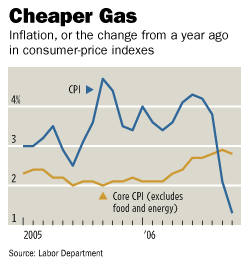
Some had doubted the inflation fighting mettle of the Bernanke Fed, but once the rug had been pulled out from under commodity futures back in August, there was little hope that the price indexes would show anything other than feeble ones and twos by this time of year, a few negative numbers thrown in for good measure.

Everyone can now breath a sigh of relief.

Everyone, that is, except for those recently attending their employer's open enrollment info-sessions where they learned of the new 2007 health care costs.

It's a good thing that gasoline prices have gone down - that'll leave a little left over for those heftier co-pays. Insurance premiums went up about ten percent this year - down from increases in the low teens in recent years, so by government accounting standards, that would be the equivalent of a two or three percent cut in health care cost (increases).

This subject was looked at here in great detail a year ago. Medical expenses were found to be under-reported in the government's gauge of consumer prices - surprise! A quick look through last year's posts on the subject shows they are still germane:

It's still not clear how a family earning the median income of around $47,000 can afford the health care bill for a family of four.

It's also not clear how the U.S. consumer could ever cope if cheap Asian imports became less cheap after currencies adjusted to "market rates" (see Purchasing Power Parity).

Oh well, it's Friday.

Milton Friedman, Nobel Prize Winning Economist Dies

The passing of Milton Friedman comes at a critical time for economists, given recent changes to the reporting of monetary aggregates and differing schools of thought regarding the role of money in formulating monetary policy.

A report from Bloomberg puts the matter succinctly.
With his trademark pronouncement that inflation was "always and everywhere a monetary phenomenon'' Friedman was among the Fed's most vocal critics as inflation accelerated through the 1960s and 1970s. He said the central bank failed to control the supply of money, should be stripped of its autonomy and forced to focus on keeping money supply growth steady at about 3 percent.
There is more than a little irony in the selection of an American Eagle gold coin on his Wikiquotes page representing free markets and liberty.
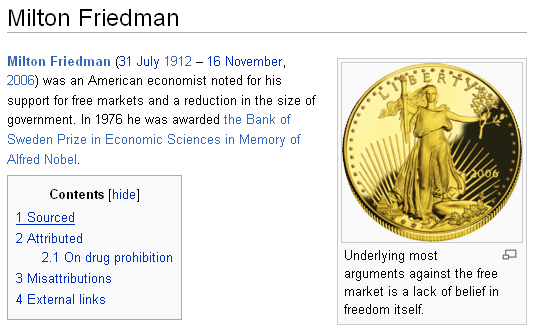
According to Wikipedia, Friedman was a libertarian philosophically, but a Republican for the sake of "expediency", supporting various libertarian policies that would be out-of-step with the Republican party today.

White Elephants and Killer Bees

There are plenty of people who still hang on every word that the former Fed chairman utters. This interview with Alan Greenspan from earlier in the week reveals the former Fed Chief is brimming with confidence.
Economic white elephant—housing
We swiftly moved to the one economic white elephant—housing. Although it's "too soon to say" if we're close to the bottom of the housing bust, Greenspan doesn't predict a rapid decline. I did get the sense that he was back-pedaling a bit from his well-quoted view recently that housing may have hit bottom. In fact, I reminded him that his "irrational exuberance" comment in 1996 came over three years prior to the market's ultimate top in 2000. In his well-crafted reply, he suggested, "This is not the bottom, but the worst is behind us." My skepticism about a muted impact of housing on the broad economy is well-documented, so I wasn't fully in agreement when he went on to say that housing market activity is likely no longer to be a drag on overall economic growth as unsold inventories clear out and stabilize against sales levels.

I followed up by asking about the rash of non-traditional mortgages that characterized this housing boom/bust. He replied that those "flaky" exotic mortgages, which allowed consumers to purchase homes more expensive than they could afford, will be financially devastating for those families holding them, but will have little impact on the macro economy. Again, I hope he's right, but I have my doubts.

Pollinating bees
But, exotic isn't all bad in the mind of the Maestro, as he's often been called. Greenspan called exotic derivatives, and their hedge fund architects, "pollinating bees" and "extraordinarily important" to a complex global economy, since their high rates of return help stabilize the entire economic system and offset our meager savings rate.
He also dismissed comments by Dallas Fed President Richard Fisher about short-term interest rates being held too low a few years back, contributing to speculation in the housing market - the former Fed chair credited global financial conditions for the housing boom.

You know the reasoning - the Berlin Wall came down, long-term interest rates fell, and everyone got rich in stocks and real estate.

The End of Low Prices

In the weeks ahead you'll hear little of the promotion that has been standard fare this week. With the six month anniversary and a price increase slated for this weekend (inflation, 'ya know), it was deemed best to err on the side of overdoing it rather than having the numerous mentions escape the notice of readers of the blog.

The Iacono Research website is still open to the public - username: IR, password: isopen.

In addition to the current subscription rate, a lifetime rate guarantee will be in effect for new subscribers joining by the end of the day on Saturday along with a 60-day risk free money-back guarantee that is part of the standard subscription agreement.

Guesses for Oil and Gold

If you made a guess at the year-end price of oil and gold you can have a look here to see how you're doing. The lucky winner gets a free subscription to ... oh, enough of that. The average guess is somewhere around $65 and $650 - current prices are still far away from those marks.
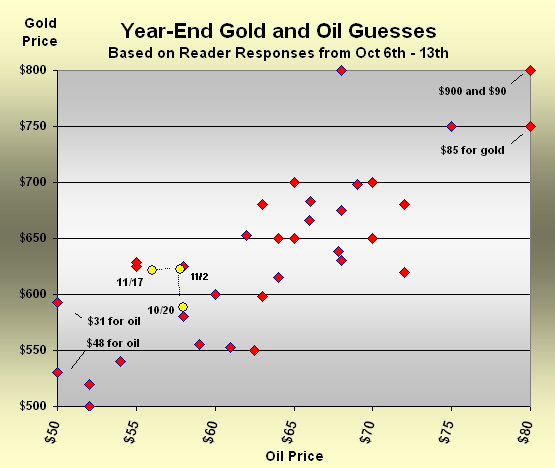

From the look of yesterday's price movement for oil, a couple of those off-the-chart (literally) guesses at the bottom left seem less improbable than they did earlier this week.

The yellow dot feels like it wants to move up, whether or not it moves to the right by the time the New Year arrives is another matter. Six more weeks to go.

Quotable?

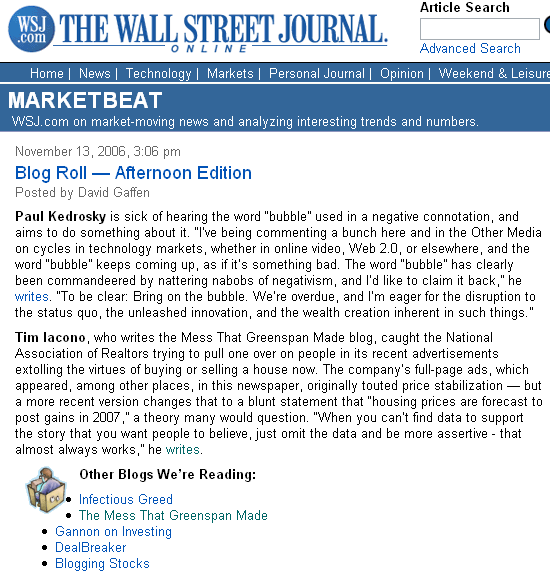
David Gaffen, who writes MarketBeat over at the Wall Street Journal, must be commended for his sharp eye. In a story that was otherwise just full of TV transcripts, there was apparently something original worthy of mention as shown below. Seeking Alpha and Yahoo! Finance published the story as well - the original version is here.
My personal favorite of the week showed up at The Big Picture in this week's edition of Bloggers' Take. In response to the question "What should the Fed be focused on? Inflation? Slowing growth? Neither?" the following was submitted:
The Fed? Do they even matter anymore? Didn't Hank Paulson at Treasury grab hold of the steering wheel a couple months back and relegate Fed Chief Ben Bernanke to the back seat with one of those Playskool steering wheels?
The imagery this invokes still elicits a chuckle here, even after two days.

What If?

For a number of years now, the housing boom in the U.K. has been ahead of the one in the U.S. by roughly nine months. After not falling in a jumbled heap on the floor during 2006, and with the central bank even feeling the need to raise interest rates due, in part, to a resurgent housing boom, this report shows that concern has reappeared.
Banks in the UK have been ordered by financial regulators to assess how they would cope in the event of house prices crashing by 40 per cent.

The instruction to include a housing slump scenario in their stress-testing models comes after the Financial Services Authority found that some banks were failing to include gloomy enough assumptions in their modelling.

The FSA said yesterday that an “appropriate” benchmark was to assume property prices fell by 40 per cent and that 35 per cent of mortgages in default ended with homes being re-possessed. It stressed that this was not a forecast but a “severe but plausible scenario” and one that banks should examine when deciding how robust their balance sheets were.
Well, as long as it's not a forecast.

Let's Hope He Doesn't Have a Blog

The Australians watching this event probably made sure the reporter from the Associated Press knew that the gentleman catching the grapes in his mouth was not a local.

An American man caught 116 tossed grapes in his mouth in three minutes in what he hopes will become a new Guinness World Record, his publicity team said Thursday.

Steve "the Grape Guy" Spalding, 44, of Dallas, Texas also set a personal record for endurance grape catching, using his mouth to catch 1,203 grapes thrown from a distance of 15 feet over half an hour, according to publicist Deanna Brown.

No Guinness World Records officials were present at Spalding's grape-gobbling attempt, carried out Thursday in Australia overlooking Sydney's iconic Opera House.
If Steve seems a bit odd, what must it be like to be on his "publicity team"?

Read more...

Junior Mining Stocks on the Move

Thursday, November 16, 2006

Much has happened in recent weeks in the junior mining sector. You wouldn't know it by watching the business news, that is, unless you live in Canada.

One look at ROB TV and you get the clear impression that our neighbors to the north have a much greater appreciation for things that have to be dug out of the ground than we do on the other side of the Canadian border. Of course, if their expertise were in financial instruments that can be created with much less effort, ROB TV might look a lot more like CNBC.

~~~~~~~~~~~~~~~~~~~~~~~~~~~~Advertisement~~~~~~~~~~~~~~~~~~~~~~~~~~~

As discussed in Tuesday's "The End of Low Prices", the introductory subscription rates at the companion investment website Iacono Research will expire on Saturday. The subscribers' area of the website is open to the public until then - just use the following:

Username: IR, Password: isopen

For a free, no obligation two-week trial, click here. For subscription details, go here. All subscribers joining by November 18th will receive a lifetime rate guarantee.

~~~~~~~~~~~~~~~~~~~~~~~~~~~~~~~~~~~~~~~~~~~~~~~~~~~~~~~~~~~~~~~~~

While investors in the U.S. tune in to CNBC to hear the latest recommendations from Jim Cramer, the former hedge fund manager and host of Mad Money, those with a better appreciation for the rising value of precious metals watch closely as small mining exploration companies vie for attention on Canadian stock exchanges and the AMEX.

Though more likely to tout Krispy Kreme (NYSE: KKD) and Panera Bread (NasdaqGS: PNRA), Cramer has been one of the more bullish Wall Street types regarding the natural resource sector, having previously recommended the purchase of several miners, notably Yamana (NYSE: AUY) and the first subject of discussion here today - Crystallex.

Crystallex International (AMEX: KRY, Toronto: KRY.TO)

Toronto-based Crystallex reported financial results for the third quarter yesterday and shareholders reacted to the news that the long sought after permit for the Las Cristinas mine in Venezuela might be a little closer to reality than last month (or last year for that matter).

In what has turned into one of the world's longest running sagas of waiting for a foreign government to grant final approval in the form of environmental permits, long-suffering Crystallex shareholders appear increasingly likely to be rewarded one of these days.

Those fearing that the government of Venezuelan President Hugo Chavez may renege on assurances already offered should be cautious, but if trading yesterday is any indication, optimism is once again high.
Cramer failed to mention the developments at Crystallex in yesterday's lightning round. As shown in the chart below, back in April when the miner was first brought to the attention of Cramer Nation, share prices doubled before getting whacked - a big Boo-Yah greeting, as it were.
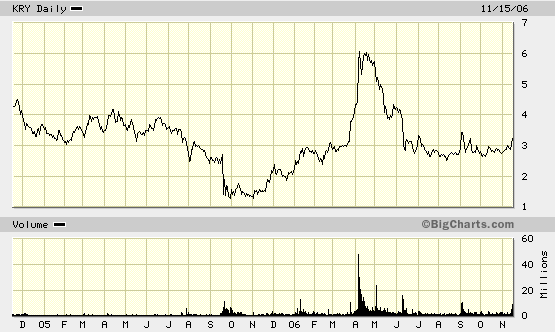
Yesterday's 14 percent gain pales in comparison to the "Cramer Effect" in April, but the company is one step closer to beginning construction of a mine at one of the world's largest gold deposits.

With permit in hand, one or more buyers may suddenly materialize.

Kimber Resources (AMEX: KBX, Toronto: KBX.TO)

The big move with Kimber Resources came a couple weeks ago when a dispute between company management and major shareholder Jim Puplava, president of Puplava Financial Services Inc., was amicably resolved. The Vancouver-based gold and silver mining exploration company with operations in the Sierra Madre region of Mexico had been floundering for much of the summer with one misstep after another.

On the first of the month, with news that the proxy battle had been called off and a shakeup in the board was imminent, shares rose 12 percent and have continued upward.
Like many other natural resource companies, the May highs are still far away, but with the addition of new directors including Larry Bell, Dr. Leanne Baker, and Dr. Keith Barron of Aurelian Resources (TSX: ARU.V) notoriety, the company should be back on track shortly with work on the pre-feasibility report for the Carmen deposit.
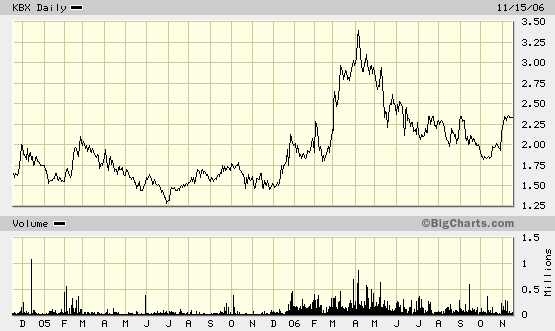
Like a number of other small Canadian mining companies, Kimber moved to the AMEX in December 2005, to be greeted with a volume and price surge that lasted for six months. If you had owned this as an over-the-counter stock in the U.S., you would have been greeted with a pleasant surprise with the added attention that began as the holiday season was in full swing last year.
Clearly the increased attention has subsided, but a new board along with resilient metal prices could make for another exciting holiday period.
Jim Puplava has been doing fine work for many years now with, among other things, a weekend radio program at Financial Sense Online that has an audience of tens of thousands around the world.

AfriOre Ltd. (OTC: AFOFF.PK, Toronto: AFO.TO)

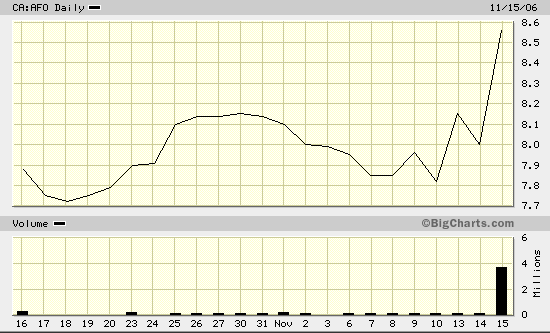
This is the story of a mining stock that has been on the move for a couple years now, but, for all intents and purposes, stopped moving yesterday. Most Americans have likely never heard of platinum miner AfriOre Ltd., and after the news of a friendly all-cash offer from British-based Lonmin PLC, they probably never will. AfriOre management has already agreed to the half-billion dollar deal and will be formally recommending it to shareholders.

The offer of CA$8.75 (approximately USD$7.74) represents a premium of 14.3% based on the 30 day volume-weighted average trading price of AfriOre's shares.
Based in the British Virgin Islands, the company has done a remarkable job advancing their Akanani platinum project in South Africa. You'd hardly think that they were in the mining business by looking at the spring 2006 section in the chart below.
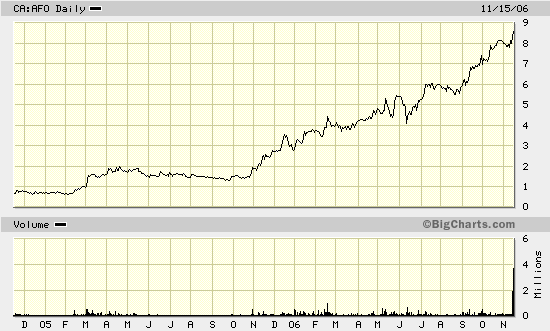
Without a Canadian brokerage account, the only way you could have purchased shares of this company in the U.S. would have been over-the-counter, something that most U.S. investors avoid without even the slightest consideration. Apparently they fear that the price will collapse on the day after their trade settles like so many of those stocks that show up as spam in their in box.
While not an Aurelian-like chart, what you see above is nonetheless an exceptionally good example of what can happen with the right 80 cent stock (even less in mid-2004), and a little "outside-the-country" thinking.
Disclosure

Crystallex International, Kimber Resources, and AfriOre Ltd are currently owned by the author and included in the model portfolio at Iacono Research, along with many other small exploration companies. Unfortunately, Aurelian Resources is not one of them.

Read more...

Changing the Scale

Wednesday, November 15, 2006

Dataquick reported that Southern California real estate sales for the month of October were the slowest in ten years. As anyone who bought or sold real estate in 1996 will tell you, that year about marked the bottom of the last cycle after home prices had peaked in 1990-1991.

What are the odds that the similar sales volume marks a similar bottom today?

It depends who you talk to.

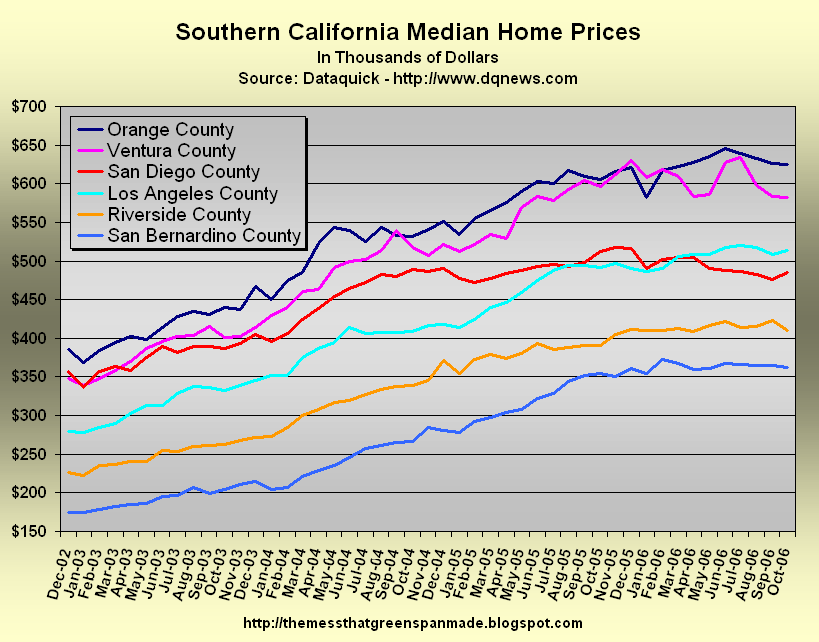
Overall median prices for Southern California are still rising at about two percent a year, but one look at the leveling off process in the chart below and it's clear the days of heady appreciation are over.

Click to enlarge

Prices in Ventura County have been volatile but, nonetheless, fifteen months ago the median price was higher than it was last month. In San Diego, more than two years of price history can be traversed with higher median prices still seen. The other counties seem almost suspended in air in the chart above as time marches on.

Some quibble about the meaning or the importance of median prices, saying that median prices paint a misleading picture or obscure underlying trends. But, median prices are the most widely used of all home price measures and, regardless of their shortcomings, tell a story worth listening to.

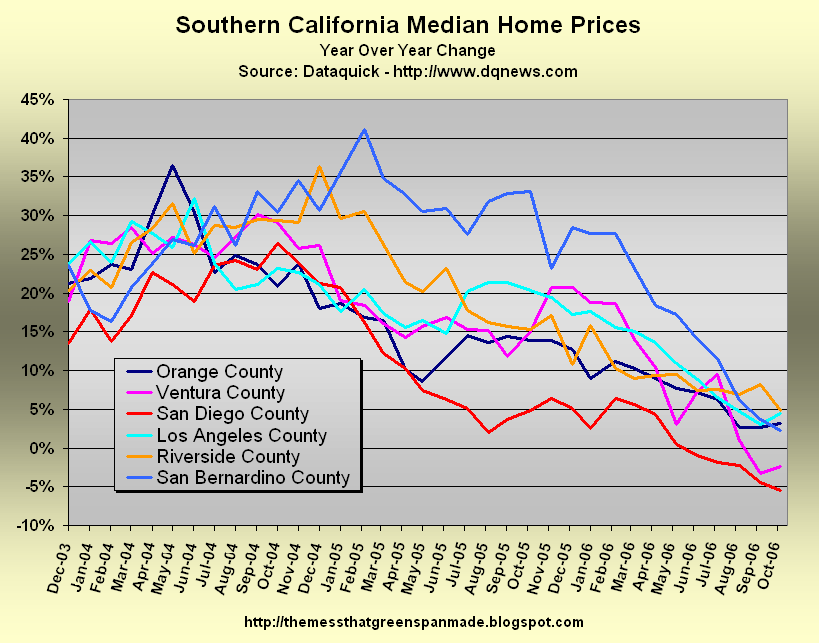
The scale on the year-over-year price chart below had to be adjusted again with the most recent data. After meandering between plus one and plus five percent annual appreciation for much of the last year, then passing through zero in May, the red line representing San Diego County has now broken below the minus five percent level, necessitating the change in scale.

There are a couple of tough months for comparison coming up for San Diego - as seen in the first chart above, November and December of 2005 were the price peaks.

Click to enlarge

Ventura County is in negative year-over-year territory for the second month in a row. It too will have a series of tough comparisons coming up as prices peaked there (here, actually) in December of 2005, then went on to make new highs in the new year. This data series if volatile, in part due to it being the lowest in sales volume of all the counties, but prices are down more than eight percent from recent peaks.

The data for sales volume continues to provide intrigue.

As shown in the shaded areas in the chart below, the last three months of the year precede the two slowest months for sales in January and February. After a November dip and a December spike, as new homeowners rush to get into their new digs for the holidays, sales volume plunges in the new year.

For the four counties shown below, sales volume totals for October are now at or below the level normally seen in January and February. If the magnitude of the December-January plunge this year is anything like it has been in past years, it could be a cold winter for home sellers in this part of the country despite the normally balmy weather.

Click to enlarge

DataQuick President Marshall "almost all, if not all, of those gains are here to stay" Prentice once again had a few thoughts regarding the most recent statistics:
It's harder to buy a home if you think it might go down in value than it is if you're convinced it's going up. Buyers are taking their time, trying to wait out the uncertainty in a market that is rebalancing itself. Additionally, many potential buyers are in the move-up category, and they have their own home they need to sell.
Maybe it wouldn't be so difficult to make buying decisions in the current real estate climate if prices hadn't gotten so high. Despite the emphasis on low monthly payments in recent years, when buying a house began to feel a lot like buying a car, some people are beginning to pay attention to the price they are paying.

And as for buyers waiting out uncertainty "in a market that is rebalancing itself" this completely misses a major point regarding the proper functioning of markets - would-be buyers who are not buying are an integral part of the market.

The number of buyers is integral to setting prices - markets don't "rebalance" themselves.

Read more...

The End of Low Prices

Tuesday, November 14, 2006

The title of today's post applies to two items that are of great interest here - both of them are sure to cost more in the future, however, the timing of the price increase for one is far more certain than the other.

This week marks the six month anniversary of the launch of the companion investment website Iacono Research and an end to the "Introductory Offer" that has been advertised in the right side-bar for months now.

This is the one where the timing of the price increase is certain.

Where the end of low prices is uncertain is in commodities - the subject of the work done at the website. For those paying close attention, the long-term direction of prices for items such as oil and precious metals is quite certain - if for no other reason than that they are denominated in U.S. Dollars - the timing however, is more difficult to assess.

Subscription rates will be going up this weekend, but before they do, the members-only area of the website is being opened up to the general public - a FREE WEEK for everybody.

(Actually, it will only be five days, but who's really counting?)

For access to the Subscribers area, just use the following:

  • Username: exp1119
  • Password: fpwrnhzc
Be sure to have a look at the Model Portfolio and the Weekend Update Archive.

For those of you who feel that typing in the username and password requires way too much effort, here's an excerpt from the most recent Weekend Update where the performance of two categories within the model portfolio was reviewed.
Gold and Silver Bullion and Shares of Mining Companies

The more exciting parts of the model portfolio this year have been the Gold and Silver Bullion and Shares of Mining Companies categories. Factoring in the sales from April, gains in the mining shares stand at 42 percent for the year while the total value of gold and silver bullion has risen 32 percent. The launch of the website in May coincided with a correction from highs that have yet to be recaptured - this is all part and parcel of investing in this sector. I truly believe that we really haven't seen anything yet - what's coming in the years ahead in these two categories will surprise many, many people, making them wonder why on earth they agonized over a $50 drop in the price of gold when it could still be purchased for less than $700.

After having peaked at $720, then retreating to near $550, and now standing about midway between these two levels, gold is growing in appeal as investors around the world realize that the high prices of earlier this year have not collapsed like share prices for dot-com stocks just a few years ago.

It is now accepted wisdom to have about 10 percent of an investment portfolio in precious metals - mostly for "insurance" they say. I read this all the time now and this is much different than the conventional wisdom of just a couple years ago.

Many first time investors had their fingers burned during the events of May and June earlier this year, but they are sure to be coming back for more as precious metal prices continue to show strength and the rest of the world realizes that they "need" gold. I hear many stories of people who bought gold earlier in the year and then sold during the panic of May or June and who are now back in. Having experienced this myself years ago, I know what this is like and it is very much part of the process of "growing acceptance" by the investment public.

This is likely to happen in waves in the years ahead where those people who bought their first gold or mining stocks this year will hold firm during the next correction while a whole new group of first time investors fight the human emotional responses of "fight or flight", choosing "flight" in the wake of the first big pull back they experience with "skin in the game".

Silver has had a similar but much wilder ride than gold this year and its weight in the model portfolio has been slowly creeping up to a point where it is almost at par with gold. The ratio at the beginning of the year was 1.34-to-1 (gold to silver) while this now stands at 1.11-to-1, evidence of the strength of silver, albeit with even more volatility.

The price of silver has showed tremendous strength in recent weeks, likely a sign of things to come.

As for shares of companies mining precious metals, the journey has been bumpier than that of gold and in many cases disappointingly so. If investors were only to own the larger mining companies, they are surely displeased at this juncture as shown in the chart below where the price of the gold and silver ETFs (GLD and SLV - blue and red) appear alongside the Gold Bugs Index of unhedged gold miners (^HUI - green) and the Philadelphia Gold and Silver Index (^XAU - gold).

Click to enlarge

Note that the silver price in the chart above would have a completely different look if an entire year of data were available for the ETF. Having risen almost 50 percent for the year, the complete data set for silver would push the high end of the scale much higher and the red line would ride on top of all the others. I thought it was helpful to show it in the chart above anyway, as it represents the unfortunate experience of many whose first silver purchases were via the new ETF that launched on the last day of April, just prior to the May sell off.

Again, it's that timing thing and the difficulty of entering positions.

But back to the gold stocks as represented by the indexes in the chart above, I must say I was a bit surprised to see the end points for both of the indexes - plus 12 percent and plus two percent hardly seems worth the effort of going against a crowd that is still largely unaware of this investment sector.

The good news however, is that the Shares of Mining Companies category in the model portfolio has had a completely different experience this year - at plus 42 percent, far better than these indexes of larger mining companies.

There are two simple reasons for the difference in performance:

a) smaller companies
b) taking profits in April

Larger gold mining companies are having a tough time of it lately because they are subject to the same valuation metrics by which any other company is judged. The actual business of mining precious metals is just not that profitable these days due to high material and energy costs in this capital intensive business. Time after time, reports are heard of feasibility studies completed just a year or two ago that have to be updated because costs have risen 25 percent.

By contrast, smaller exploration companies are low-budget operations that are much more difficult to value, continually in need of new financing in a manner not very different than internet startups of a decade ago. Think of how IBM did back in the 1990s versus newcomers like Yahoo! and Cisco. Similar to internet startups, once a mining exploration company can prove that it has something that is likely to be profitable in the future (i.e., a property with proven resources where it would be feasible to construct a mine that could be operated at a profit), they are more likely to be acquired by a larger company than to actually commence mine construction themselves.

As the price of gold heads higher, large mining companies will become more profitable and share prices will rise dramatically as a result of new money flowing into this "safer" part of the gold mining sector first, however, the economics of mining must change in order for this to happen. Either the miners must be able to sell gold at higher prices or their operating costs must go down. Until then, the best performing mining stocks are more likely to be exploration companies.

It is important to note that the effect of higher metal prices on share prices can already be seen, to some degree at least, with silver producers over the last month or so. One look at the recent share price of Silver Wheaton (SLW) demonstrates what higher prices can do for the bottom line and hence investor enthusiasm (granted, the unique Silver Wheaton business model helps tremendously).

The second major factor contributing to the good performance of the stocks in the Shares of Mining Companies category is that profits were taken in April. As shown on the Portfolio page under Closed Positions, more than half of the total gains for this category are a result of these sales. Again, selling into strength and buying on weakness are critical aspects to getting the most out of a portfolio, though it's also hard to argue with a more passive approach where returns are still very substantial.

For example, just holding a precious metals mutual fund such as Fidelity Select Gold (FSAGX), now up 22 percent on the year, would make a lot of sense for someone who doesn't want the bother, the risk, or the excitement of the junior mining sector. Note that a mutual fund such as this one holds many of the "juniors", hence the reason for outperforming the indexes shown above - the key difference is that they hold enough of them to make the risk/reward equation a bit less daunting than for someone buying individual stocks for themselves.

Overall, it's hard to find fault with these two categories in the model portfolio. I sometimes wonder if it wouldn't be better to just put everything into precious metals and related equities, but then I'm reminded of 2004 when this sector languished and other commodities and related equities soared.
Although things are a bit different in other parts of the world, precious metals are still not widely accepted as an investment class here in the U.S. Awareness has been raised in recent years, especially after the events of earlier this year, but it's going to take a little while for the general investing public to come to the party.

That's when it will really get good.

Read more...

The NAR Has Much More Work to Do

Monday, November 13, 2006

The National Association of Realtors really has their work cut out for them in trying to convince the public that now really is a good time to buy or sell a house.

Notwithstanding the flawed logic that there could be a simultaneous advantage for both parties in the same transaction, there are larger problems with making their case - a case that the mainstream media and much of the public aren't buying.

Recall this full-page ad that has now appeared on two consecutive Sundays in major newspapers and notice the area circled in red.
Shown above is the original version of the ad from last Sunday's paper indicating a 4.3 percent increase in pending home sales for the month of August. The NAR released new data for pending home sales in September indicating a decline of 1.1 percent (July sales were down a whopping 7 percent), so the ad required an update.


Here's the original text from the ad above:

PRICES OVERALL HAVE STABILIZED

Contracts for home sales in August are up 4.3 percent and the outlook is for home prices to increase next year.
Here's the new text:
HOUSING PRICES WILL POST GAINS IN 2007

Housing prices are forecast to post gains in 2007, surpassing median home sales values in 2006.
When you can't find data to support the story that you want people to believe, just omit the data and be more assertive - that almost always works.

Can you imagine the meeting where the ad was changed? Maybe it went something like this:
Realtor: We can't use the pending home sales data because that turned negative in September and we've already promised the New York Times that we would update the ad.

Adman: So what do we do?

Realtor: Just say that prices are going to go up.

Adman: Shouldn't we cite some source of data to back up that claim?

Realtor: No. And while you're at it, that heading that says prices have stabilized? Change that to say that housing prices are going up next year.

Adman: Shouldn't you say that housing prices are forecast to go up or that the outlook is for higher prices?

Realtor: No, just say that prices are going up.

Adman: Are you sure.

Realtor: Just do it.
The mainstream media seems to be catching on. There have been fewer and fewer interviews with realtors in the increasing number of stories about the current housing slowdown.

Nightline, Homes for Sale, and Cupcakes

This segment on last Friday's ABC Nightline makes it clear that things have changed dramatically for home sellers.
Martin Bashir: We begin tonight in the world or real estate where anyone heading out to an open house this weekend is probably expecting to find a bargain. That's because the real estate market is sinking by the month. The median price of a new home sold in September dropped by almost ten percent a year - that's the largest decline in 36 years.

And perhaps the clearest sign that the market isn't what it used to be are the lengths that some people are going to just to get the properties off their hands. ABC's Heather Nauert reports from Los Angeles with a new installment of our series: Realty Check: Surviving the Slowdown.

Heather Nauert: Look no further than all those For Sale signs for a literal sign that more and more homes are hitting the market. Nationwide, there are a jaw-dropping one million more houses for sale today than there were last year. Luring a buyer isn't easy anymore which means if you want a good price for your house, you're going to have to work for it.

Homeowners and homebuilders are pulling out all the stops offering give-backs and give-always, doing whatever it takes to sell that house.

The first sales gimmick - let them eat cupcakes.

Meet Cindy Schwanke who's been trying to sell her suburban Los Angeles home for nearly nine months.

Cindy Schwanke: We never really thought we'd have a problem selling. The neighbors have never had a problem selling, our relatives have never had a problem selling their homes, so we didn't anticipate this at all.

Nauert: To make matters worse, Cindy and her family have already bought a new house. They're now paying two mortgages. So last summer she quit her job as a pastry chief to devote all her time to marketing her old house where she is armed with desserts, ready to snare a prospective buyer.

Schwanke: I try to bring people in. I bake cupcakes for them. I offer them water. I do whatever I can to make it a pleasant experience for them.

Nauert: But in many cases, cupcakes alone won't cut it. Here on the West Coast, home sales have plummeted over the last two years. Even worse, many buyers who bought homes are now backing out of their contracts.
The piece goes on to detail three other "gimmicks" - slashing prices, giving gifts, and creative marketing. Now slashing prices isn't a "gimmick" at all. Slashing prices is what happens in a market economy when prices have been bid too high.

A pretty simple concept.

Gifts and creative marketing certainly fall into the "gimmick" category, though the families of actors that homebuilder Centex employs to make model houses look lived would be more properly classified as a "creepy gimmick".

It's not clear how prospective homebuyers are responding to this - the homebuilder representative says it's working just wonderfully - but it would seem as likely to scare people away as to make them feel more "at home".

It was just creepy watching a family of five paid actors singing Happy Birthday on cue as prospective buyers walked through the front door.

Just creepy.

To end the segment, the dour Mr. Bashir informed the viewing audience that Ms. Schwanke had indeed sold her home - for $100,00 less than she first listed it.

Cashin' In on Real Estate

Based on the prognostications offered up on Saturday during the Fox News business infotainment program Cashin' In, Ms. Schwanke may look back on her home sale in 2006 wondering why she was complaining to Nightline.
Terry Keenan: The boom hasn't gone bust but there's no denying a slowdown in the once sizzling housing market. But could homes be worth less in November of 2008 than right now? Wayne, that's two years away, what do you think?

Wayne Rogers: Well, as I said, there are three phases - the absorption rate slows down, then you have a price correction phase, and finally a foreclosure phase before this all turns around.

Right now, we're just in the beginning of the price correction phase, and we see it in the homebuilders like D.R. Horton and Toll Brothers which have slowed down enormously and they get higher cancellation rates. So, it's not going to be until the end of 2008 before we see a real turn around.

Dagan McDowell: These prices won't even bottom in some of these once really hot areas until 2008, 2009 even. It could go on even longer than that - places in California, in Las Vegas, and you can be sure that this hangover is going to play into the election two years from now.
...
Keenan: There's a lot of pain out there Adam, but it hasn't trickled into consumer spending which is still strong despite all the naysayers.

Adam Lashinsky: That's right Terry, because largely the price correction that Wayne talked about at the outset is a correction in the housing stocks. There hasn't been as big a correction in housing prices themselves, and I think that's yet to come. That's why you haven't seen it in the economy.

I think people who think we've bottomed already - that's just wishful thinking. Everything everyone's been saying so far is exactly why this probably will go on longer than the wishful thinking people say it will.

Keenan: Well, it was a very long boom. Does that mean it will be a very long bust Gary?

Gary Kaltbaum: Terry, in my study of these cycles, it's not months, it's years. I think we are in the early innings and anybody who calls the bottom right now - it is wishful thinking. I heard Alan Greenspan came out and called the bottom - that means that it's definitely not the bottom, and I tell you, 2008 is being a little too positive. The last time we had a big downturn, we were talking about a decade, which would be normal after the big move up.

Keenan: A decade? Jonas?

Jonas Max Ferris: First of all, you can't have crashes in real estate. They had one in Japan in the 80s, they had one here in America in the 1920s. This time we might get a slow train wreck because interest rates are remaining low, but I definitely think that in '08 we'll have lower prices. In urban areas down 40 percent. Nationally, probably just 10 to 20 percent by '08. It's going to weigh on the election.
This being Fox News, one could speculate on the motivation for asking about home prices at the time of the next election in 2008 (Democrats have been warned here about trying to "fix" the housing bubble - they're more likely to get blamed for it if they attempt such a thing), but nonetheless, this was a very negative crowd.

It's funny how you never heard anyone talking about the duration of the housing downturn until housing actually turned down.

Was the National Association of Realtors watching?

Dunno.

If they were, they must now realize how much more work they have to do if the public is to believe that housing prices are headed back up next year.

Read more...

A New Woodward Book?

Sunday, November 12, 2006

The criticism of former Federal Reserve Chairman Alan Greenspan increases by the day - that probably has a lot to do with the fact that he keeps flapping his gums, telling anyone who will listen that things are going to turn out just fine.

He reportedly gets paid handsomely for this - nice work if you can get it.

The latest retort comes from Rachel Beck at the Associated Press who, in this story from last week, notes the poor track record of the man Bob Woodward called "Maestro".

Financial markets have to quit hanging on Alan Greenspan's every word. That's because the former Federal Reserve chairman's economic forecasting skills aren't always right.

A review of some important events in recent economic history - such as the dot-com implosion in 2000 or the 1990 recession - shows that Greenspan has had some big misses.

Two years ago, for example, he said that the jump in oil prices was a "transitory" factor boosting inflationary pressures. Crude oil was trading at $40 a barrel at that time; today, prices are around $60 a barrel, and that's down from a high topping $78 a barrel over the summer.

Of course, all economists get things wrong, but when others do, the entire financial world isn't listening.

Greenspan left the helm of Fed in January after an 18-year tenure, and now runs a consulting firm that bears his name. He has continued voicing his views on the economy, and while they don't offer direct insight into the Fed's monetary policies, his comments still carry weight.

That's why so much attention has been paid to his recent upbeat assessment of the economy. Greenspan told attendees Monday at an economic conference that the "worst is behind us" in the economic impact of the housing slump. He also said strong profit margins and capital spending are good signs of what's potentially to come.

"The economy is obviously going through a significant slowing period, which as best I can tell is more than likely temporary," Greenspan said during a question and answer session at the annual Charles Schwab Impact conference in Washington.
Current Fed Chairman Ben Bernanke must love hearing reports like this - the calming tone of words like "as best I can tell" and "more than likely temporary" is classic Greenspeak.

Formulating the nation's monetary policy must be hard enough given the mess that was left behind, but to have the master bubble-blower hanging around the football field, yelling from behind the fence like a senior who graduated last year and just misses the game so - this must be annoying for the new quarteback.

Not more than a month or so ago, the former Fed chair's comments were misinterpreted as a forecast for the future path of short-term interest rates in the U.S.

He's probably just trying to help, but hasn't he already done enough?

Why should anyone listen to him anyway?
But before anyone hangs their hopes on Greenspan's predictions that better times could be ahead, the economics team at Merrill Lynch took note of some of his forecasting fumbles from the past.

Greenspan told his Fed colleagues on the Aug. 21, 1990, Federal Open Market Committee meeting, where interest rate policy is set, that a recession wasn't likely in the cards.

"I think there are several things we can stipulate with some degree of certainty; namely, that those who argue that we are already in a recession I think are reasonably certain to be wrong ... ," Greenspan said.

But as Merrill chief North American economist David Rosenberg notes, it would later be known that the recession had started in July of that year.

Then there was a March 6, 2000 speech, which came just as the unprecedented bull market was peaking. Greenspan said the fact that "the capital spending boom is still going strong indicates that businesses continue to find a wide array of potential high rate-of-return, productivity-enhancing investments. And I see nothing to suggest that these opportunities will peter out any time soon."

"But peter out they did," Rosenberg said in a note to clients. "Tech capex went from a 20 percent year-on-year growth rate at the time of the speech to zero a year later; the Nasdaq (composite index) collapsed by 60 percent."

It's too soon to tell if Greenspan is getting it right or wrong this time around. But it's pretty clear his rosy outlook is not shared by executives of homebuilders.
...
A year from now, maybe things will really be looking up, and Greenspan's view eventually will be correct. But from the way things seem now, betting on Greenspan's outlook would be risky.
With Bob Woodward's recent penchant for revisiting past subjects in a later, much more critical light, he might want to take a drive around the greater Washington D.C. area, noting all the For Sale signs, then have another chat with the retired Fed chairman.

Maybe interviewing a few of the home sellers would be helpful, to see if per chance any of them took the now famous advice from the former central banker to add an adjustable rate loan to their debt load back in 2003 - loans that are now resetting to much higher rates.

Maybe Mr. Woodward could come up with a new and different theme for a new book ... let's see, what might he call it?

Read more...
IMAGE

  © Blogger template Newspaper by Ourblogtemplates.com 2008

Back to TOP