
Wikinvest Wire

Size is in the Eye of the Beholder

Wednesday, January 24, 2007

This story was on the front page of Yahoo! News for much of the morning. If you think the real estate market has been crazy stateside, have a look at the new heights of absurdity currently being scaled as part of the resurgent housing boom in the U.K.

Location, location, location. Almost anywhere else, the tiny dilapidated studio wouldn't attract much more than mice. But this is London and the 77-square-foot former storage room — slightly bigger than a prison cell and without electricity — is going for $335,000.

The closet-sized space in the exclusive Knightsbridge neighborhood may be only "about the size of a ship's galley, said real estate agent Andrew Scott, who's handling the sale. "But it's permanently anchored to one of the wealthiest neighborhoods in the world."

At more than $4,340 a square foot, the mortgage buys a spot within walking distance of tony stores like Harrods and London's iconic Hyde Park. Originally conceived as a maid's room, the apartment at 18 Cadogan Place hasn't been used for years and is littered with trash bags and crumbling paint.

A coffin-sized shower is en suite, and storage is provided by a shallow closet and 10-inch-deep shelves cut into the wall. Two hot plates and a small sink make up the kitchen. Two dirty windows allow light to filter into the basement room, and the fire escape could conceivably double as a shared patio.

With no electricity or heating, Scott said it would cost an additional $59,000 to make the room habitable.

"It is an investment," he said, as he stretched his arms the width of the room, laying his palms flat on opposite sides of the wall.

The sale of this dark, mildewy room illustrates the astronomical rise in property values across London, which in the past year has seen average residential property prices increase 22.4 percent, to about $703,000, according to figures released Monday by Rightmove, which tracks the British property market.
Prices in London's most desirable neighborhoods have grown even faster, with average house prices in the borough of Kensington and Chelsea — where Cadogan Place is located — rising 61.8 percent over the past year to a jaw-dropping $2.2 million.

Ultra high-end property prices in London are the most expensive in the world, with some recent sales hitting $5,900 per square foot — making the Cadogan Place studio a bargain by comparison, according to research published last year by CB Richard Ellis Group Inc.

Similar properties in New York can go for about $5,300 per square foot, while those in Hong Kong sell at around $3,950 per square foot.

Scott said he already had three offers on the property, which might go to auction. Size, he added, is in the "eye of the beholder."

"If you thought of this as the cabin on a boat, you'd say, 'It's pretty spacious,' " Scott said.
It's funny how the mainstream media reports this sort of thing in such a casual manner - as if the thought of paying well north of a quarter of a million dollars for a glorified prison cell is more amusing than disturbing.

Maybe it's just me.

Read more...

The Last to Know

One more indication of how the real estate market is different than the stock market showed up in two recent stories from California, one of the nation's formerly hot housing markets that has turned decidedly lukewarm over the last year or so.

Unlike stocks in 2000, when, a few months after the peak nearly everyone could look and see that the tide had turned, today, more than a year after prices peaked in much of the state, the outlook for many has not yet changed.

According to this report in the Press Telegram in Long Beach the other day, the number of realtors in California is now at an all-time high.

When talking on the phone with Tom Pool you can almost envision some spooked character in a B-movie waiting out a zombie invasion in a boarded house.

"Our licensee population is still going up, even though we're in a transitioning market," the California Department of Real Estate spokesman said.

It may sound ghastly, but for the last year people continued to mob the real estate industry despite the market downturn.

About one in 70 Californians is now a licensed Realtor.

As of December there were more than 521,000 licensed Realtors in California, according to the DRE, which issues licenses.

That's an all-time high. The previous high was during the end of the last real estate boom in the early 1990s, when there were 375,000 licensed agents in California.

Before the most recent housing market surge, the number of licensees had dipped to 297,000 by 1998, according to the DRE. The historical level is 300,000.

But when the housing market began to take off around 2000, so did interest in residential real estate.

As of this time last year the number of licensees topped 470,000. In the past year, after the market turned south, more than 50,000 people earned their licenses.
Donald Trump and his ilk can be thanked for much of the continuing interest in real estate careers during a period when the word "transition" fails to properly characterize the events on the ground.

Contrast the previous report with this story in today's LA Times and you'll see there's a great disconnect between the mood of many Californians and the latest market data.
The number of Californians defaulting on their mortgage loans is rising rapidly, according to figures released Tuesday, providing striking evidence that more people are at risk of losing their homes.

Default notices jumped 145% in the last three months of 2006, accelerating a trend that began in late 2005 as home sales started to cool.

It was the largest number of default notices in any three-month period since 1998.
Analysts said the increase was not worrisome — yet. But if the number continues to escalate, it could drag down home values in certain communities, they warned.

"So far, this isn't alarming," said John Karevoll, chief analyst at DataQuick Information Systems, which compiled the data. But if default notices "keep going up at this rate, it could get nasty fast," he added.
The slope of that curve should be very alarming. That's the whole purpose of an alarm - to warn you in advance that something bad may be about to happen. To say, "So far, this isn't that bad" would have been far more accurate.

While the number of default notices per quarter is still not far away from the historical average, looking even better in percentage terms when factoring in the population growth over the last ten years, the pace at which they are accelerating amid flat home prices (according to the official statistics) should be great cause for concern.

What should be extremely alarming is that during the fourth quarter of 2006, there was a 595 percent increase in the number of homes that actually went into foreclosure versus a year ago.

Most homes that enter preforeclosure (the initial notice of default when the owner falls behind on their mortgage payments) never enter foreclosure proceedings either because the borrower catches up on their payments or sells the place. With so many new homeowners putting little or no money down and expecting rising prices to cure any financial ills, the situation has changed dramatically.

In fact, a year ago, foreclosures as a percent of preforeclosures were only 6 percent.

A year later, this has risen to 16 percent!

Little of this seems to have affected the outlook of those aspiring to real estate careers. The combination of ever-upbeat real estate industry professionals and a mood that is very slow to change should make the reversion of the California real estate market to more realistic fundamentals a long, drawn out affair.

Read more...

The State of The Onion

Tuesday, January 23, 2007

Online parody newspaper The Onion used to be a regular stop along the way through a very long list of bookmarks around here - if not daily, then weekly. For some reason, it's lost much of its appeal - it must be hard to write satire that is consistently good.

They seem to come out with their best stuff in the beginning of the year as evidenced by this classic from a few years back - F**k Everything, We're Doing Five Blades (this seems even funnier now).

In preparation for this evening's State of the Union speech, a quick visit seemed in order.

WASHINGTON, DC—President Bush announced in a hastily arranged press conference Monday that he wanted to make the entire country "as presentable as possible" for visiting Chinese President Hu Jintao, who was scheduled to arrive for a five-day state visit in a matter of hours.
"I knew he was coming, but I didn't realize he was coming today—just look at this place," said a visibly flustered Bush, as he and his Secret Service detail hurriedly picked up trash along Interstate 66 near Arlington, VA. "We got the area around the [National] Mall spotless, but now it just makes the rest of the city look worse. There are homeless people cluttering up our streets—and not just here, but in Denver and San Francisco, too."

"It's humiliating how much we let this place go," Bush added.

Bush said he blocked out all of Saturday afternoon "to get our great nation looking halfway decent" before Hu's visit, but he soon became overwhelmed as he realized how much more needed to be done.

"The more I try to straighten up, the more problems I find," Bush said. "Look at all this sprawl around Chicago and Atlanta. What a disaster! Well, they have approximately four hours to pick it up. Hu's landing at Andrews Air Force Base at six."
Yes, it's hard to write good satire consistently - pictures help. Hu's coming to town?

BETHESDA, MD—According to sources at the Allstate Insurance Company, CIA Director Michael Hayden purchased nuclear-attack insurance Wednesday, paying a $100,000 monthly premium for his homes in suburban Washington, Pittsburgh, and near Cheyenne Mountain, CO.

"It's a typical nuclear policy that protects the insured from damages caused by fallout—pretty straightforward, though at that monthly rate, I don't usually sell too many of them," said Bethesda, MD–based Allstate agent Gary Rutter, adding that Hayden paid for the first premium with a certified bank check to guarantee that the policy would take effect no later than next Monday.

"After he purchased the insurance, he asked again if everything was set for Monday. I assured him it was, and then he left." Insurance agents throughout the D.C. area reported selling 35 such policies in the last week, all to high-ranking government officials.
Getting a little better...

That's always a safe bet - Rumsfeld with no story to muck things up. What more do you really need after a picture like this?
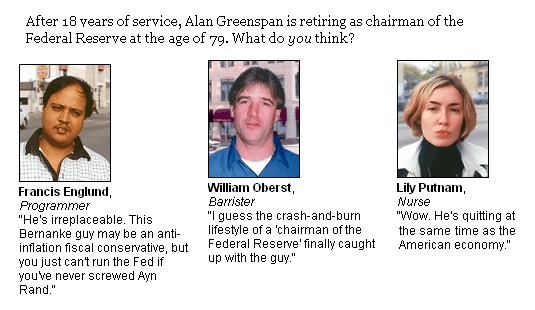
Coming up on the one-year anniversary of a seminal event in the world of monetary policy, it should be clear why The Onion first drew favor here some time ago.

Since then, little has measured up.

Read more...

Double Down or Walk Away?

Yesterday's Bloomberg story Goldman, Deutsche Bank Say Double Down on Commodities makes you wonder whether commodity markets in 2007 are going to be even wilder than in 2006.

(Hey, if the mainstream media can use this gambling analogy for troop levels in Iraq, why not with commodities too - actually, the "All In" Saturday Night Live skit was probably closer to the mark for Iraq.)

From the looks of precious metal prices this morning, 2007 may indeed be far more exciting than last year (and unfortunately, the same is probably true for the Middle East.)
Saijel Kishan and Tan Hwee Ann of Bloomberg write:
Anyone who followed the advice of Goldman Sachs Group Inc. last year and invested $10 million in the Goldman Sachs Commodity Index would have lost 15 percent, or $1.5 million.

Like so many of Wall Street's best and brightest, Goldman, the biggest securities firm by market value, says it wasn't wrong, just early, and to expect an 8.1 percent return in 2007.

"The long-term secular story is very much intact,'' Jeff Currie, global head of commodities research at New York-based Goldman, told customers in London earlier this month. That's the same outlook provided 13 months ago by Arun Assumall, the firm's London-based head of commodities sales.

Like Goldman, Deutsche Bank AG isn't discouraging anyone from doubling down in what increasingly looks like a bear market. Germany's largest bank in September said oil will trade between $60 and $70 a barrel this year, well above the $49.90 fetched last week. Barclays Capital, the securities unit of the U.K.'s No. 3 bank, said four months ago crude won't drop below $60.
The story goes on to present a fairly balanced view of what to expect in the new year. The short answer? Who the heck knows? You'll get as many predictions for $40 oil as you will for $65 oil, though the calls for $500 gold are few and far between - given the continuing problems with the U.S. dollar, higher precious metal prices seem certain.

The year 2007 is still so young - still feeling its way along.

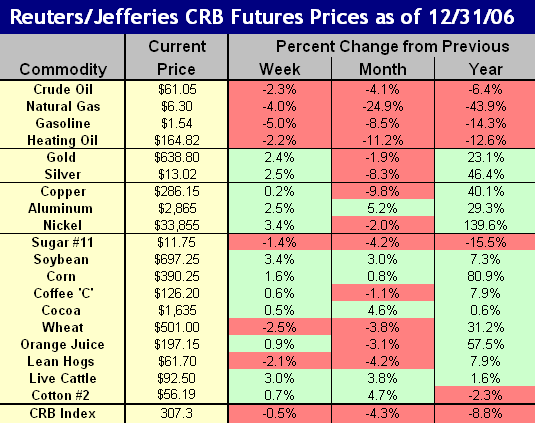
As for 2006, depending on which measure you look at, it was either horrible or not so bad - here's a look at what the major commodity indexes did:
  • Goldman Sachs GSCI -15%
  • Reuters/Jefferies CRB Index -9%
  • Dow Jones AIG Index -3%
  • Rogers' Raw Material Fund +3%
[Note that these are approximations based on currently available data - a more definitive performance comparison will be published here sometime in the near future.]

Naturally, the two indexes at the top of the list that have higher energy weights fared the worst - that should be clear by looking at the table below. It was a very bad year for energy prices, unless of course your primary interest in the cost of energy is the price at the pump and your monthly heating bill - then it was a good year.
You don't hear too much about all the items that show green in the right-most column above. A portfolio of metals and agricultural commodities would have done quite well last year - just stashing a few gold and silver coins would have put you way ahead of the crowd.

Though the price increase was impressive, hoarding five-cent slugs for their melt value is still impractical for the ordinary investor. Despite the 38% gain that would result in recapturing the 25 percent nickel content, at 5 grams apiece, the volume and weight add up much too quickly.

Corn, OJ, and wheat saw hefty increases. The desire for alternative energy and undue congressional influence have turned Midwest corn farming into a high-stakes, high-yield business. They're talking about housing booms in the Great Plains as a result of an expected mass migration to deal with the continuing surge in demand.

It's too bad that corn is a horrible source for ethanol - that's what passes for forward looking energy policy in this country today.

Overall, 2006 continues to be portrayed as a very bad year for commodity investors, but when you look at all that green in the table, maybe it wasn't so bad after all.

So, double down or walk away?

Maybe just make sure those gold and silver coins are well hidden and add a few to the pile while you're at it (on second thought, maybe add a few handfuls to the pile).

Read more...

Lots of Income, Little Common Sense

Monday, January 22, 2007

There would be much less cynicism around here if there were fewer people in the world like this couple who took time out of their busy day to write this note to LA Times personal finance columnist Liz Pulliam Weston.

Dear Liz: We recently realized we needed to stop our spending ways and would like to know the best way out of debt.

Our income, which has fluctuated between $190,000 to $250,000 a year, is being eaten up by payments on $68,000 in credit card debt, so we're not saving anything for retirement or our two kids' tuition.

We're thinking about refinancing our second mortgage or tapping our 401(k)s to pay off the debt. Additionally, we hold some company stock outside our retirement plans on which we could clear, after taxes, approximately $60,000.

What would be the best way to pay down all of this debt? We know we must tap into at least two sources.

Answer: Actually, you should tap into one source — selling the company stock — and avoid the two other sources as if your financial life depended on it. Because it probably does.

The problem with tapping home equity is that you're squandering a source of long-term wealth to pay off a bunch of short-term spending.

Most people who pay off credit cards with home equity loans wind up racking up more credit card debt because they don't fix the overspending that caused the debt in the first place.

Taking out 401(k) loans is also fraught with peril. If you lose your job, you typically have to pay the loan back quickly or risk having to pay taxes and penalties on the balance you owe.

You're extremely lucky to have an asset — the stock — that you can sell to pay off the vast majority of this debt. Then you can concentrate on paying the rest out of your substantial income.

That's a far better solution than putting any of your other, more important assets at risk through unwise, and unnecessary, loans.

Given your income and a concerted effort, you could eliminate this debt in a few months.

The discipline you'll use to do so will help you get the rest of your financial life in shape, and the money you'll free up by reducing your spending can be used to get your retirement savings started. Once you're on track there, you can start saving for your kids' future education.

People with far lower incomes have dug themselves out of bigger holes. There's no excuse for you not to take care of this debt — and fast.
It's tough to get by these days when your household income is only a quarter-million dollars.

Do you think their employers would have second thoughts about these two during their yearly performance reviews if they were to learn of this letter, "Geez, we're paying you over a hundred grand a year and you've got $68,000 in credit card debt in addition to a second mortgage...and you're writing to a newspaper because you've just now figured out that you have a problem?"

This is such a 21st century phenomenon.

Someone transported to the present from just a few decades ago would be astounded by this note - not so much by the dollar amounts (which really are a little mind-boggling) but by the casual nature of it all, "Hey honey, let's write a letter to Liz and see what she thinks we should do".

We really do live in an era where people have no fear of debt.

Since Ronald Reagan was in the White House an entire generation has become accustomed to and, in fact, embraced debt as a way of life at all levels - indivuals, business, and governement.

What could possibly go wrong when much of the Western World thinks this way?

It's hard not to be cynical.

Read more...

Awash with Growth?

There is something about Art Samberg and his comments during the recent Barrons' Roundtable (as excerpted in last week's The Asset Shufflers) that continues to linger - like part of a fennel seed wedged between two molars simultaneously providing slight discomfort and delicious taste.

Of the many memorable words that were spoken by Mr. Samberg during the discussion, today, there are but a few to be briefly pored over:

The world is awash with growth. It is awash with liquidity, and our markets can clear liquidity better than any others.
Was that a sort of Freudian slip?

Are growth and liquidity really interchangeable as it would appear above or was this a tacit admission that they are very different, though sometimes appearing to be the same?

This seems to be integral to the recent phenomenon of what some call uber-liquidity and its role in the global economic boom of recent years - a world of excessive money creation and credit expansion where caution is thrown to the wind, ordinary people become speculators, and the asset shufflers whistle as they shuffle to the bank.

The discomfort that this idea creates is brought to light in this recent story from the Financial Times:
The unease bubbling in today's brave new financial world
By Gillian Tett

Last week I received an e-mail that made chilling reading. The author claimed to be a senior banker with strong feelings about a column I wrote last week, suggesting that the explosion in structured finance could be exacerbating the current exuberance of the credit markets, by creating additional leverage.

"Hi Gillian," the message went. "I have been working in the leveraged credit and distressed debt sector for 20 years . . . and I have never seen anything quite like what is currently going on. Market participants have lost all memory of what risk is and are behaving as if the so-called wall of liquidity will last indefinitely and that volatility is a thing of the past.
"I don't think there has ever been a time in history when such a large proportion of the riskiest credit assets have been owned by such financially weak institutions . . . with very limited capacity to withstand adverse credit events and market downturns.

"I am not sure what is worse, talking to market players who generally believe that 'this time it's different', or to more seasoned players who . . . privately acknowledge that there is a bubble waiting to burst but . . . hope problems will not arise until after the next bonus round."

He then relates the case of a typical hedge fund, two times levered. That looks modest until you realise it is partly backed by fund of funds' money (which is three times levered) and investing in deeply subordinated tranches of collateralised debt obligations, which are nine times levered. "Thus every €1m of CDO bonds [acquired] is effectively supported by less than €20,000 of end investors' capital - a 2% price decline in the CDO paper wipes out the capital supporting it.

"The degree of leverage at work . . . is quite frankly frightening," he concludes. "Very few hedge funds I talk to have got a prayer in the next downturn. Even more worryingly, most of them don't even expect one."
There appear to be two possibilities to help explain the unease clearly expressed by the anonymous senior banker writing to the Times and shared by many others who observe financial markets from afar.

The first possibility is that we have truly entered an era where the combination of diversified risk and advancements in financial engineering have made the world so fundamentally different that some observers are uncomfortable with the change.

The second possibility is that it really isn't different this time - that excessive money creation and credit expansion have only produced a condition of super liquidity that is currently masquerading as economic growth.

It's all semantics and interpretation anyway - that is until something bad happens and the assignment of blame becomes important.

Whatever unease Mr. Samberg's unconscious mind may have been expressing when he commented on growth and liquidity, it probably won't affect his next bonus.

The one after that?

Maybe.

Read more...

Da Bears and Da CPI

Sunday, January 21, 2007

Sometimes it really is hard to argue with at least one type of quality adjustment that the Bureau of Labor Statistics performs when preparing the Consumer Price Index - the quality of television sets has certainly improved over the last ten years while prices have continued to go down.

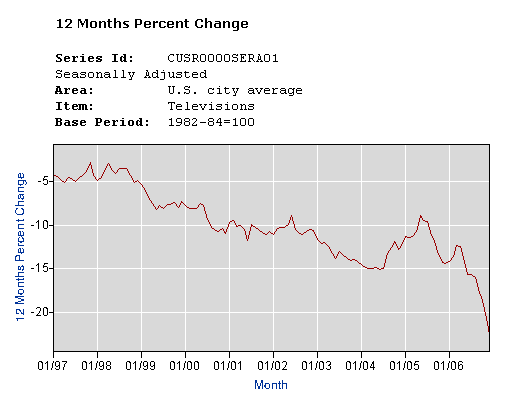
It's not clear when first looking at the chart below whether the combination of lower prices and more features is accurately reflected there. Those are some pretty steep yearly declines in "quality-adjusted" prices - especially in the last year.
Going back to the mid 1990s, "quality-adjusted" prices have fallen by more than two-thirds.
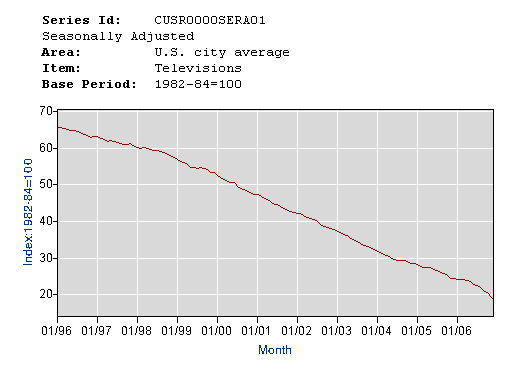
Is that a fair way to measure prices? What if you had a 27 inch set in 1996 and just wanted to buy a new 27 inch set ten years later?

It's hard to imagine that the new price would be one-third the old price, but you'd get a flat screen, maybe a few more jacks on the back, and probably a few other extras, but the price wouldn't have dropped this much.
Well, watching the Bears beat the Saints on a big HDTV with a DVR that allows the viewer to effectively watch the game in less than an hour - that makes a pretty convincing case that at least some of the quality adjustments are very real.

How do you measure the quality improvement of the 30-second advance where you can watch a three and a half hour football game in about 45 minutes, zipping through all of the huddles and most all the commercials, pausing only occasionally to catch a new Bud Lite ad?

Our mid-1990s, 150 lb 35 inch TV now sits in the spare room awaiting its fate while the new, embarrassingly large bigscreen HDTV occupies its old spot - a big, beautiful picture that really can't be compared with what it replaced.

Yet the BLS has found a way to factor that into the change in prices that consumers pay.

Does anyone really need a TV or a digital video recorder that is this good?

That's probably the wrong question to ask.

Read more...
IMAGE

  © Blogger template Newspaper by Ourblogtemplates.com 2008

Back to TOP
