Wikinvest Wire

Jobs, Commodities, and Black Holes

Friday, April 07, 2006

Another week, another multi-decade high for gold, silver, and other metals, and thousands and thousands more homeowners begin noticing rising commodity prices and either flat or falling housing prices. Where will it all lead? We'll know much more by the end of the summer - the direction is clear, the degree seems to be the only question.

The Jobs Report

The jobs report came in at 211,000 this morning. Construction and manufacturing were about a wash, while the big gains came in Retail Trade: General Merchandise with 26.3K new jobs and Leisure and Hospitality: Food Service and Drinking Places with another 33.1K.

The much-touted 52K new positions in the Professional and Business Services category breaks down like this:

  • +3.0K - Legal services
  • -0.4K - Accounting and bookkeeping services
  • +6.6K - Architectural and engineering services
  • +3.6K - Computer systems design and related services
  • +4.5K - Management and technical consulting services
  • -1.1K - Management of companies and enterprises
  • 11.7K - Administrative and support services less employment svcs
  • 20.0K - Employment services and temporary help
  • +1.9K - Business support services
  • +8.6K - Services to buildings and dwellings
  • +1.4K - Waste management and remediation services
  • -8.2K - Other professional and business services
Sorry, but when looked at in total, this has the distinct feel of a peaking housing market, with a home equity withdrawal enabled shopping spree that has yet to peak, along with the effects of Gulf Coast rebuilding.

Silver and Gold

The trepidation that many people feel today when looking at charts like these and considering dipping a toe into the precious metals market should be evaluated in light of the very real possibility that they'll look back at $12 silver and $600 gold in a few years and realize that today's prices were a bargain.
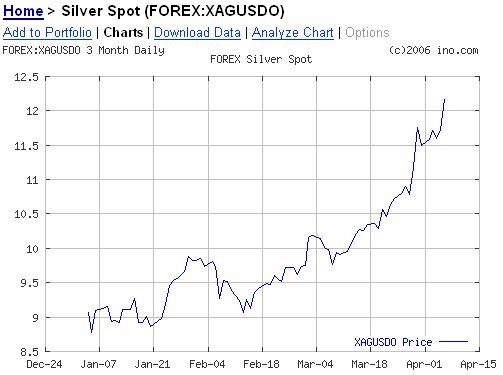
On CNBC the other day, when asked about the long overdue correction in the gold price, Ron Insana pointed to the months of February and March and replied, "We just had a correction". The questioner got that "deer in the headlights" look.
The funny thing about gold and gold stocks is that you just can't ignore them forever, unless of course you're an economist. The Wall Street Journal Online had this on their front page yesterday. Is "Go Figure" a title that is used frequently at the WSJ or does the choice of words reflect disbelief and/or denial on the part of the writer?
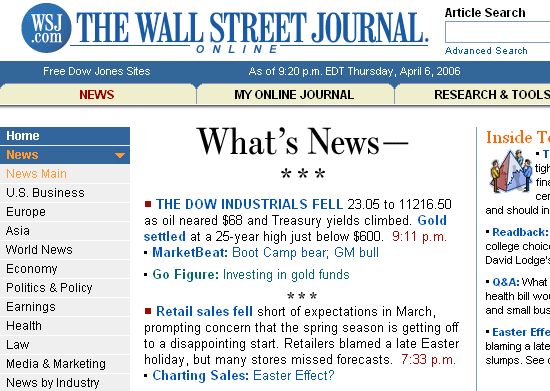
There's no denying cold hard numbers like these - actually, you can have a lot of fun if you "Go Figure" with these rates of returns.
They say to be careful not to chase performance - well, maybe it's OK to chase performance a little bit.

In a continuing sign that the mainstream financial media still doesn't know quite what to make of the whole commodities craze, this CNN/Money writer weighs in:
Analysts caution, however, that investing in gold can be a risky move, one that's usually handled by traders who've built up years of experience understanding metals markets.
...
Few investment vehicles have seen as much shakeup over the past 25 years as gold. In 1980, it touched $873 an ounce after rampant inflation engulfed the nation, but then plunged to a low of $254.80 in August 1999.

And these huge long-term swings are now being complemented by larger day-to-day shifts.

"We're seeing price swings that we haven't seen in decades. We used to see a $6 range in gold over a week, and now we see it in a single day," said Quinn. "The gold market is really going to be in play over the course of the year."

For investors, that means that they should be prepared for the possibility of major short-term losses.

"Not everybody could handle losing 40 percent in one year," said Wallace. "Most people probably don't need an investment in precious metal funds."
When CNN/Money and other mainstream financial media writers are almost unanimously bullish on commodities, then you'll know that the peak is past. That point is still years away.

Dusting off the SUV Fill-Up Index

It's been just over six months since our SUV Fill-Up Index was last updated. From what they've been saying about filling up your tank next month, it's probably a good idea to be ready for an update - continuing a promise made to update it with every ten cent rise in the price of regular gasoline.

In fact with what they've been saying about this hurricane season, it might be a good idea to keep this chart at the ready all summer long.
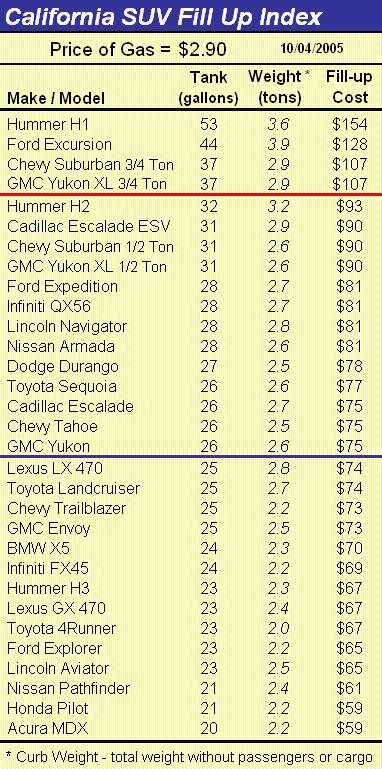
The new Cadillac Escalades that are seen in these parts have that distinctive "upgrade" look to them - tinted windows and expensive tires and rims to go along with the temporary plates. Buying one of these must be a lot like buying a new home these days - the manufacturer/builder is loading them up with extras to move the inventory while starry-eyed consumers continue to sign on the dotted line without thinking beyond the next three months.

Has anyone seen the new oil ETF?

It was supposed to start trading on the AMEX under the ticker symbol USO, but there's been no sign of it. What's happening? Surely an oil ETF can kick-start oil prices a bit after an unusually warm winter has lulled much of the Northern Hemisphere into thinking that last year's energy shock was an aberation.

Those Crafty Chinese

Just like when the Chinese yuan rose abruptly prior to the arrival of Lindsey Graham and Chuck Schumer in Beijing to discuss trade relations and currency flexibility, the arrival of Chinese Vice Premier Wu Yi next week in Washington followed by Chinese President Hu Jintao's visit later in the month is being preceded by a spate of positive news regarding our Asian trading partners.
While it's nice that they're purchasing planes from Boeing and other high-tech gear, you have to wonder what percentage of the goods they buy as part of this goodwill gesture will ultimately be disassembled and evaluated by their industrious engineers and businessmen, eager to expand into new markets.

New Investment Website

Since the hints have been dropped with increasing frequency as of late, it seems prudent to satisfy a bit of reader curiosity by divulging today that your humble scribe will be launching an investment website in a few weeks or so. It has been in development for months now - it is a pay-site (with special pricing for regular readers) and it's based on commodities (there should be no surprise there).

After tallying the first quarter results for the model portfolio, the excitement is difficult to contain - even with two of the five categories flat, the overall return was just over 18 percent for the first three months of the year, with another few percent gain this week.

Surely this pace can't be maintained. Or, can it?

Subsequent announcements prior to the big launch will be contained in these Friday posts - the current plan is to offer a multi-day free pass to the subscribers section just prior to the official launch. Stay tuned.

Bloglines

It's about time someone said something about Bloglines. There are likely other services out there that do the same thing at the same cost (free), but there seems little reason to look for them. Bloglines has been the preferred RSS aggregator here for some time now, and it's hard to imagine not having it.

For those of you who have never tried something like this, you are encouraged to check it out. If you get information from many different sources that supply RSS feeds, this is a very, very convenient way to manage all that information. Here's a screen shot to give you an idea how it works.

When it finds a new item, the source turns bold and the number of items is displayed in parentheses. When you click on one of the sources, it displays all unread items in the window on the right including links to individual posts or to the main page of the source.

When you click on a different source, it assumes that you've read the ones that you just left, so it deletes them. You can save individual items or you can just tell it to re-display all items for the last 24 hours, 48 hours, or longer time periods, and it will go get them for you.

The best part about the whole thing is that you never have to go to the source to see if there's anything new. All new posts show up in your Bloglines account within an hour or two, sometimes a little bit longer, making it easy to skim a ton of material in a short amount of time.

Black Holes

In what may be part of an ongoing attempt to explain how the massive U.S. trade deficit is in fact part of a near-perfectly balanced current account with the rest of the world, comes this report about dark matter from Yahoo! via Space.com.
Two supermassive black holes have been found to be spiraling toward a merger, astronomers said today.

The collision will create a single super-supermassive black hole capable of swallowing material equal to billions of stars, the researchers said.

Mergers between black holes are thought to be one way they grow. A handful of similar setups have been observed in which black holes appear inevitably on a merger course. This pair, at the center of a galaxy cluster called Abell 400, was known to be close but their fate hadn't been determined.

"The question was: Is this pair of supermassive black holes an old married couple, or just strangers passing in the night?" said Craig Sarazin of the University of Virginia. "We now know that they are coupled, but more like the mating of black widow spiders. One of the black holes invariably will eat the other."
Two super massive black holes spiraling toward each other. Hmmm...

Western consumption and Asian manufacturing. Old married couples, strangers passing in the night, or mating black widow spiders?

Read more...

Fed Transcripts from 2000

Thursday, April 06, 2006

From the Associate Press via MSNBC comes this report about Federal Reserve meeting transcripts from the year 2000 that were just released on Tuesday after the required five years of ageing. An interesting year to be sure, the Dow peaked in January while the S&P500 and Nasdaq reached their all-time highs in March.

GDP was all over the place from the fourth quarter of 1999 until a year later - annualized growth rates came in at 7.3, 1.0, 6.4, and -0.5 during this period, but the Fed went ahead with their rate hikes.

Even with the market beginning to falter in early 2000, the Fed stuck to its campaign to push interest rates higher to slow economic growth as a way to keep inflation under control.

The Fed, which had begun pushing rates higher in June 1999, continued that campaign with three more rate increases in 2000, including a final half-point boost that left the federal funds rate at a nine-year high of 6.5 percent.

That final rate hike at the May 16, 2000, Fed meeting has been controversial, with some economists arguing that the central bank overdid the tightening just as the economy was about to slow sharply.

While some Fed policy-makers argued at the time for a quarter-point move rather than the more aggressive half-point increase, Greenspan pushed for the bolder action, the transcripts indicate.

"I believe the risks in moving 50 basis points today are not very large because I think the underlying momentum of the economy remains very strong," he said.

However, while the economy was growing rapidly in the spring quarter, it slowed abruptly in the summer of 2000.

The central bank made no further changes in rates after May and by December policymakers were debating whether the economy had slowed so sharply that rate cuts were warranted.
That doesn't sound like the same "baby steps" Greenspan that most of us know and love from his ultra-low rates and laissez-faire approach to regulating lenders in the aftermath of the technology implosion. Clearly the underlying momentum was not nearly as strong as the former Fed Chairman seemed to think it was in 2000.

And inflation? It was only two or three percent at the time, according to the statisticians at the Bureau of Labor Statistics. Just the idea of a half percent rate hike sounds so unusual after the last five years.

What was he thinking?


It seems there was a good deal of confusion during the second half of the year about whether to hold rates steady or begin bringing them back down.

Early in the year, the Nasdaq had fallen from 5000 down to around 3200 and then bounced back up to over 4000. But, by the end of the summer, the free-fall had resumed and by the end of the year, the index settled in at about half of its earlier high, and still no rate cuts.
William Poole, the president of the St. Louis Federal Reserve Bank, likened the Fed's efforts in managing the economy to a recent experience in a Boeing Co. flight simulator simulating the landing of an F-18 on the deck of an aircraft carrier.

"That means finding oneself wobbling first one way and then the other way. And I think we have some of the same concerns about monetary policy. We don't want to overreact," he said.

Greenspan prompted laughter by asking, "Did you land or didn't you land?"

He persuaded the FOMC members to delay a rate cut at the December meeting but alerted them to be near their telephones, saying he might schedule an emergency inter-meeting conference call in early January if the economy continued to weaken.

The Fed ended up cutting rates by a half point on Jan. 3, 2001, after a telephone conference call, returning the funds rate to 6 percent, where it had been before the half-point increase the previous May.

The Jan. 3 rate cut was the first of an extended series of rate cuts as the central bank worked to counteract a series of economic blows including the collapse of stock prices, the beginning of a recession in March 2001 and the impact of the September 2001 terrorist attacks.
Within a year, the Fed Funds rate went from 6.5 percent down to 1.75 percent and it wasn't until three years later that it rose back above 2 percent.

Somehow a similar pattern seems to be developing here in 2006. GDP has been erratic the last couple quarters with a strong and weak quarter to close out 2005, robust first quarter estimates, and slowing projected for later in the year.

The tightening is continuing longer than most analysts anticipated, and while it's hard to imagine that Ben Bernanke has a half point rate hike up his sleeve, if the dollar tumbles and gold continues its ascent unabated, which with each passing day seems more and more likely, you never know what might happen.

One thing is sure, half point rate cuts shouldn't be a problem for the new Fed Chairman.

After all, isn't that what American central bankers live for? To cut rates? To come in and save the day when the world needs to be saved? To mop up in the aftermath of another bubble, having given it one last jab with a pin?

Read more...

Debunking the Dismal Duo

Wednesday, April 05, 2006

So, the one economist says to the other, "Honey, how do you estimate the fundamental value of a Southern California house?" While it is not known what the response was, or in fact who asked the question, Pomona College economics professors Gary and Margaret Hwang Smith later purchased a $950,000 Southern California property and labored to produce a sixty page report to convince themselves and the rest of the world that they were not the greater fools about whom housing naysayers have spoken so often in recent years.

No, the Smiths are not the greater fools, they are the greatest fools - they should have known better.

But, then again, they are economists.

After getting so far into the production of a detailed report that actually contains a good deal of very interesting data about the buy/rent calculation that prospective owners/renters should consider, they just didn't know when to stop.

Lights were flashing and alarms were sounding, but they either didn't notice or were too determined to complete an analysis that supported the real estate purchase decision that they had already made.

They just didn't know when to stop poking at their financial calculators in search of net present value, investment rate of return, and discount dividend, and instead just use a little common sense.

What they ended up with was something that Richard Peach, Vice President of the Federal Reserve Bank in New York deemed "an important paper".

An important paper indeed.

A paper that provides yet another marker for the great American housing bubble that will only be appreciated for its profundity with the passage of time. It is best captured by a single sentence:

Housing prices in all of these areas can be justified by plausible, if perhaps somewhat optimistic, assumptions about the future growth of rent and prices.
Ahhh ... memories of 2000, when at the height of the tech bubble there where still those who insisted on twisting and contorting bits of data to justify that which they must know in their gut is just wrong.

Data Please

A few pencils have been sharpened, the cat has been put out, the doors have been secured, and we're ready to roll. Here are the links:
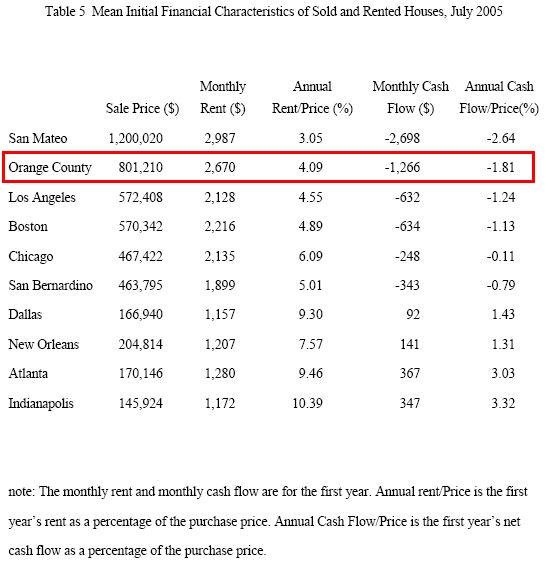
Skipping directly to Table 5 in the back of the report we find first year figures for a number of sold and rented home pairs in different parts of the country. The Smith's task was to find near-identical homes in the same neighborhood, one just sold and one rented, that could be used to calculate the investment rate of return for the home that was just sold were it to be rented at the same rate.

By calculating the rate of return, they figured they could determine if the sale price was too high, too low or just right.

The example that we'll use to test the Smith's handiwork comes from Orange County, California, the world-wide headquarters of sub-prime lending, where according to the last report from DataQuick, a median priced home fetches about $600,000.

The subject home sale from 2005 was for $801,210 and the rental equivalent brought in $2,670 per month. As indicated in the table, after all the calculations were done, the monthly cash flow starts out as minus $1,266 per month - nonetheless, the Smith's concluded that, at $801,201, the price was just about right.


We'll assume everything up to this point is hunky-dory and work from here. The idea here is that even though you're starting with a negative cash flow, things will go up over time, and as long as you come out with a six percent return on your investment, then the purchase price was right at the time of the sale.

In this case, 20 percent of the purchase price is about $160,000, and six percent of that is just under $10,000 a year. Figuring that the $1,266 per month in Table 5 works out to over $15,000 in the hole for an entire year, the first year looks to be a real loser.

But Things Change

The Smiths figured that rent and maintenance go up three percent a year (expenses start at an annual rate of one percent of the purchase price), and taxes go up two or three percent per year depending upon where you live. Most importantly however, the value of the home increases at a rate of three percent, which doesn't seem like much at first, but you'll soon see how important this seemingly innocuous three percent rise really is.

These were the only changes identified in the report - rent, maintenance, taxes, and the value of the home which is sold at the end of the ten year period.

As shown in the top portion of the table below, given the starting monthly deficit along with the changes to rent, maintenance, and taxes, after ten years, this rental is still losing almost $1,000 a month. It is only with the tiny three percent per year appreciation that this deal makes any sense - that three percent increase on a $800,000 property results in a gain of over a quarter of a million dollars.

That's how the Smiths figured the $800K was the right value - because in ten years, they figured the house would be worth over a million dollars.


Click to enlarge

Note that there are many simplifying assumptions made in the table above. The disparity of losing almost $130,000 on the rental side of the deal while gaining over $280,000 on the appreciation won't be affected in a material way by properly accounting for taxes, the time value of money, or other details.

Also note that the rental net value is calculated based on the starting monthly cash flow, then figuring the changes to that cash flow based on changes to rent, maintenance, and taxes.

The point here is that the expected appreciation of this property is the dominant factor in the calculation that results in a fair valuation - something that is not mentioned in the study itself. One has to dig into the details of the report to learn this.

It's Just Three Percent

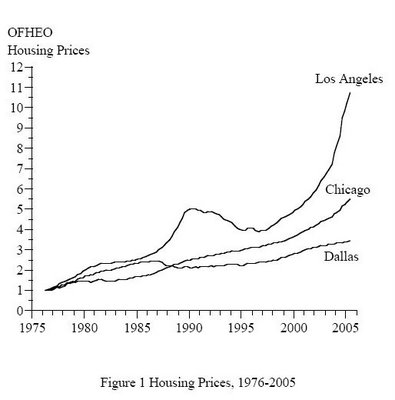
So, is three percent a reasonable annual increase to expect of Southern California real estate? It all depends on the timing. Veteran real estate investors would probably look at the chart below, which was included in the report, and think that maybe the timing isn't so good right now.

After rising at near 20 percent a year for the last five years, what would make anyone think that home prices will now rise at an average of three percent for the next decade? Without the appreciation, this investment is a big loser, and if prices reverse, as they did in the 1990s, then things could really get ugly.
This is the fundamental flaw in this valuation methodology, which, by the way, overestimated the value of a Diamand Bar, California home by 24 percent when applied by a New York Times reporter in the second link above.

Like many economists, the Smiths fail to realize that we are living in a bubble economy where nearly all the things they learned in school no longer apply. They are likely teaching a whole new generation of future economists all the things that no longer apply.

Economists!

P.S. (The Smiths moonlight as certified financial planners - their website is www.smithfinancialplace.com should you wish to have them help you with your own buy/rent decision or other personal investments.)

Read more...

Contango and Backwardation

Tuesday, April 04, 2006

For an increasing number of individuals and institutions, their reaction to the introduction of a new commodity ETF (exchange traded fund) is as simple as this - see it, buy it. The commodity markets, once only accessible through futures trading, have become available to institutional investors as well as individuals through a growing number of ETF offerings.

This got started in a big way back in 2004 with the introduction of the gold ETFs streetTRACKS Gold Shares (GLD) and iShares COMEX Gold Trust (IAU), which have been wildly popular.

Prior to that time, there were funds from Pimco (PCRCX) and Oppenheimer (QRAAX) that invested in commodity derivatives linked to one of the many commodity indices and these have been popular as well.

However, recently, there have been difficulties with contango and backwardation.

Now, these are unfamiliar terms here as well, but think of contango and backwardation today as being like "stock options" and "IPOs" back in 1995 or like mortgage backed securities in 2001 - an essential part of the infrastructure for the next bubble.

You see, the bubble economies of the world, most notably the one here in the U.S., are entering a new phase. While bankers and politicians would have you believe that a few adjustments here and a few tweaks there will be all that is necessary to correct any disruptions that arise, and that things are generally progressing swimmingly, the truth is that there is a lot of paper money in this world looking for a place to land.

Lately, with the help of new products from Wall Street, a lot of this money has been landing in the commodity markets causing something of a disruption in the normal price-setting mechanisms.

This report in the Financial Times describes how the popularity of commodity funds linked to index funds has been causing such problems.

The commodity price boom of the past three years has aroused investor attention on an unprecedented scale, with most investors placing their funds into passively managed commodity indices.

About $80bn is estimated to be in funds tracking the main commodity indices – the Goldman Sachs Commodity Index, AIG-Dow Jones, the Reuters/Jefferies CRB index and the Deutsche Bank Commodity Index – up from $15bn three years ago.

This has been spurred by record-breaking runs for oil prices, natural gas, copper and zinc, together with long-term highs for gold, sugar, aluminium and silver.

The funds tied to commodity indices swamp the estimated $10bn that pension and mutual funds have allocated to actively managed commodity hedge funds.

More funds may be on the way: consultants such as Mercer and Watson Wyatt are advising UK pension funds to allocate more money to commodity funds.

Yet fund managers and analysts are concerned that the index funds may eventually be a victim of their own success: the weight of money they have funnelled into commodity markets has contributed to severe price distortions.

The GSCI has risen 160 per cent in the past five years, buoyed by strong gains in commodity prices. However, commodity index levels are based not only on price movements of the underlying commodity futures, but on the rolling yield.

Most nearby dated futures contracts expire each month so investors have to sell the contract that is coming up to expiry and purchase the next deliverable monthly contract. The difference between the sale and purchase is known as the rolling yield. This has mainly been positive in the past four years, a situation known as backwardation.

However, with more money flowing into commodity indices, the yield is turning negative, creating what traders know as a contango. Here, nearby prices are below those of contracts for later delivery.

A contango can be a sign of temporary surplus in physical commodity markets, and it encourages inventory building.

However, crude oil futures markets have been in contango for the past 12 months, as the oil price has hit record highs and remained close to $60 a barrel, reflecting market worries about the security of future supplies rather than about oversupply.

The contango in the crude futures markets, West Texas Intermediate and Brent, have a big impact on the commodity indices. Together they represent 45 per cent of the GSCI. Other energy futures are in contango: heating oil, US natural gas, UK gasoil as well as other commodities including gold, wheat and coffee. In all, commodities representing more than two-thirds of the GSCI weighting are in contango.

Michael Lewis, head of commodities research at Deutsche Bank, said both the GSCI and AIG-Dow Jones index were down 5 per cent so far this year, entirely due to the negative roll yield. Mr Lewis said last year’s 40 per cent gain in WTI and Brent prices outweighed the 20 per cent negative roll yield.

With the WTI in contango until June next year, commodity indices will be relying on future positive performances from commodity prices that are already at or near record levels. “Oil prices would have to reach $77 in order for the energy component of the GSCI to break even,” said Mr Lewis.

David Mooney, portfolio manager at NewFinance Capital, a fund of commodities funds, said the contango in oil was a result of new money going into the crude futures market.

“These commodity indices are a one-way bet. They are long only and do not offer the flexibility that more active commodity funds can offer,” said Mr Mooney.

Douglas Hepworth, director of research at Gresham Investment Management in New York, said more worrying was the predictability surrounding the funds’ rolling of their exposure from the nearby futures contract into the next. Funds tracking the GSCI roll their contracts from the fifth to the ninth business day of each month.

“The whole market knows when these guys are going to switch, so they position themselves to take advantage,” said Mr Hepworth. He said this can often result in the commodity index funds facing a steeper contango on the WTI come the roll date, which reduces fund returns.

Mr Hepworth said this was the key issue for commodity indices, which otherwise provide investors with a broad exposure to the commodity markets.

Some pension fund managers are already looking elsewhere to place their money. Last week, J. Sainsbury, the UK supermarket chain, said it planned to invest 5 per cent of the company’s pension fund into commodities, but would place the money in actively managed funds rather than funds tracking indices.

“The passive approach to commodities was a no-brainer for the last four years, but today investors need to be more selective and active when they invest in commodities,” said Mr Lewis.
Having read this a few times now, it's still not clear what contango and backwardation are, but there will be plenty of time to learn - commodity investing for the masses is just getting started.

The new oil ETF (USO) purportedly launched yesterday, the silver ETF (SLV) is set for introduction sometime this week or next, and more commodity funds should be arriving shortly to join the recently introduced Deutsche Bank Commodity Index Tracking Fund (DBC).

Where is all this headed?

Most likely upward. Anyone with any money and at least half a brain must realize by now that the ratio of money to "things" has been increasing at a rapid pace in recent years. With housing cooling and stock markets trying to charge ahead, but hesitating with every step, it is natural to seek out an investment class which has not been inflated lately.

Some would say that a commodities bubble is already here - more likely the pump is just getting warmed up.

Read more...

Denver - Disturbing and Sad

Monday, April 03, 2006

Over the course of the last few months, housing and its bubble/no bubble/soufflé debate has lost much of its appeal as a subject of discussion in these pages. With the exception of an upcoming critique of an astonishingly inept study published by two Pomona economists in which it is argued that current real estate prices are safe and sane, housing commentary here will be limited in the weeks and months to come.

The reasons?

First, there are many other areas of the economy that are now far more interesting than housing (and profitable, as you'll find out in a few weeks). But, more importantly, housing is beginning to turn into a sad story. What was disconcerting in 2005 is now disturbing. A subject that once seemed to beg for ridicule, now seems more deserving of pity.

Which brings us to Denver, Colorado.


For many years the Denver real estate market has been out of sync with the rest of the country. They were talking about foreclosures there three years ago, but in the last couple years, the local housing market had found new life. That seems to have changed now - rising foreclosure rates and strapped homeowners struggling to make their payments are once again in the news, the wheels perhaps falling off for good this time around.

As this report from the Rocky Mountain News describes, foreclosure rates have now risen to levels that are, well, disturbing.

Rising interest rates, a glut of unsold homes on the market and falling home prices in some submarkets drove up Denver-area real estate foreclosures by more than 30 percent in the first quarter of this year compared with the first three months of 2005.

The jump to 4,764 foreclosures compared with 3,624 in the first three months of 2005 took some experts by surprise. Public trustee offices in Adams, Arapahoe, Boulder, Broomfield, Denver, Douglas and Jefferson counties estimated the number of foreclosures they expect to open this month.

"That is disturbing," said economist Patty Silverstein of the soaring number of foreclosures.

"We still expected to see increases in 2006, but this is larger than what I would have expected. At this point in our economic recovery, we would have expected to have seen a smaller increase in foreclosures," said Silverstein, principal of Development Research Partners.

She said that a main culprit appears to be interest-only and other variable-rate loans that homeowners have taken out in huge numbers in recent years to reduce their monthly mortgage payments.

"A lot of people have taken out these different types of mortgage products during the past couple of years, and now people are discovering that their payments are starting to ratchet upward with rising interest rates," Silverstein said.
Do 'ya think?

You have to wonder why newspaper reporters even bother asking economists about housing. With a few notable exceptions, their views seem to be so misguided and/or naive that they are almost completely devoid of worth - as genuinely surprised as they seem to be about certain recent events, you get the impression that they never go outside.

Maybe they should spend an afternoon in a sub-prime lender's office and listen in on a few lender-borrower conversations to get a better feel for the situation on the ground.

Have they not noticed the glut of for sale signs? What does a comment or two from an economist add to an article such as this anyway?

Later in the story, pragmatic realtor Sean Healey relates how inventory is growing at 2.5 percent a week (doubling every six months) and how the current market situation is a "blood bath" and a "path of devastation" where, in some areas, real estate values are down more than 15 percent from the levels of just a couple years ago.

Then another economist offers an opinion.
Economist Tucker Hart Adams said that foreclosures are a lagging indicator and will continue to rise even as the economy gets back on its feet.

"I don't know if they're going to continue to rise by 30 percent, but they are going to continue to rise," Adams said.

She said she recently was a guest on Healey's radio show and received a call from a woman who said she and her husband have good-paying jobs but are in danger of losing their home because they had borrowed all of the equity from the house and their credit cards are maxed out.

She wanted advice from Adams.

"I guess you just have to spend less on everything else" in order to keep the house, Adams said.
Foreclosures as a lagging indicator in that once this economy really takes off again, then everyone will be able to make their payments again and everyone will live happily ever after? According to this economist, the worst of the foreclosures will soon be behind us.

So just spend a little less on gasoline, heating, and medical care and this will all work out.

Do 'ya think?

It almost seems that the reporter is mocking the economists here by forming something of a real estate reality sandwich - two befuddled economists on either side of a gloom-and-doom-spewing realtor who actually drives around neighborhoods and talks to people. But that is not likely the case.

In the off chance that this was the writer's intent, he should be commended for his sly sense of humor and subtle manner, both of which were surely lost on 99.99 percent of his readers.

It's All About Making the Payments

So, back to the subject of the article - there was a 31 percent year-over-year increase in Denver area foreclosures for the first quarter of 2006. A total of 4764 for the three-month period.

Just how significant is that?

In a story from December of last year it was learned that the worst year ever for Denver area foreclosures was in 1988 when a total of 17,122 were recorded, partly a result of a collapsing local energy industry and related job losses.

Naturally, that number should be weighed against a population base which was smaller than today's, but nonetheless, the 4764 first quarter figure does yield an annualized rate of over 19,000, up from over 14,000 for all of 2005.

Given the current outlook from Ben Bernanke and company at the Federal Reserve, there is no interest rate relief anywhere in sight, so whatever happens to those three percent ARMs that seemed like such a good idea a few years ago, the new payment schedule is not going to be well received.

Could the foreclosure rate moderate in the quarters ahead? Anything's possible, but it is as likely to worsen as it is to improve, given current trends. The possibility of the 1988 record being shattered in a very big way is very real - one of the few things that might save the day is if California homeowners cash out and relocate en masse to the Rocky Mountain state where their windfall can help to bid prices back up for a while.

But that's not likely to happen.

One of the problems with the Denver area seems to be that so many homeowners have already borrowed nearly every penny against their homes that lax lending standards will currently allow. Even Ditech.com's offer of borrowing 125 percent of the value of your home does little good if you had purchased with no money down two years ago and home values decline.

Maybe a 150 percent lending program will be initiated. Or, better yet, 200 percent.

The now famous Alan Greenspan "home equity cushion" theory is being put to the test in Denver. As you'll recall, the former Fed Chairman opined last year that things won't get too bad too quickly because so many homeowners have such sizeable "equity cushions".

While that may be true in California and many other coastal areas, it is not true in Colorado. And,
that's what's both disturbing and sad. The poor saps in Denver didn't see it coming. The magic elixir, the free lunch, the perpetual motion machine, the asset bubble that kept giving and giving - the housing ATM is faltering and people are dealing with it as best they can.

It's not pretty.

Years ago, they would not have been able to get themselves into a mess like this.

There is little sympathy for real estate speculators having difficulty adjusting to the 2006 realities - they deserve what they get. But, the slightly below average Joe who is just trying to raise a family like his parents did, and was swept up in the easy money, lax lending, real estate craze of the last few years - it just doesn't seem right.

People are not that smart. To some degree, they must be protected from their own bad judgment. That was how real estate lending worked up until a few years ago - then all the rules changed and people are just starting to realize that they really didn't understand what it was they were being allowed to do.

Everyone else was doing it. It worked so well for a while.

Maybe its time to remove The Rocky Mountain News from the list of bookmarks that is already way too long and way too full of disturbing and sad sources of news.

Read more...

Some Scary Lender Statistics

Sunday, April 02, 2006

This L.A. Times story about a local lender contains some pretty scary statistics. It seems that First Federal Bank of California has been so enamored with Fannie Mae and their slogan "Our Business is the American Dream", that they've been emulating another Fannie Mae practice in addition to that of "dream enabler".

What other practice?

Making risky loans and taking advantage of accounting rules to bolster the bottom line.

You see First Federal Bank makes a lot of option ARM loans. These are the types of mortgages where not only are borrowers not required to pay any principle each month, but they don't even have to pay all the interest due.

"I think this spring you will see housing prices crack," said Richard X. Bove, a banking analyst with investment bank Punk, Ziegel & Co. That, he added, "is going to be terrible" for people with mortgages that let them pay less — sometimes a lot less — than the full monthly payment during the early years of the loans.

After those payments are reset to their full amounts, "I think you're going to see a wave of defaults," Bove said.
It is the stats that were of interest in this story, but when Dick X. Bove of Punk, Ziegel, & Co. gets quoted, it must be excerpted. You'd think that maybe the reporter just made up this name and this quote, but, names like that?

They must be real, and they can't be ignored.

Here's the excerpt with statistics that caught our eye:
Of all the home loans that Washington Mutual held at the end of 2005, 52% were option ARMs, the company said in its annual report to the Securities and Exchange Commission. Golden West and Downey said more than 90% of their loans were option ARMs. At First Federal, 100% of residential mortgages were option ARMs.
So, with only 52% option ARM, Washington Mutual is the choirboy here. The neat thing about these loans for the lenders is that the deferred interest not paid by the borrower is booked as revenue, thus bolstering the bottom line of the lender and making the financial statements smell sweet as a rose.

The proverbial win-win situation for both borrower and lender - a deal that First Federal Bank seems to have embraced completely. One hundred percent.

What will they think of next?

Surely, this will be followed to its logical conclusion of the borrower making no payments at all, while the lender books the entire non-payment as revenue. The popularity of these new "no payment" loans will result in an extension to both the real estate boom and the mortgage lending boom that will sustain our economy for years.

Robert Blumen, in his editorial The United States of Real Estate first put forth this theory last summer in a very entertaining way - it is worth re-reading.

Read more...
IMAGE

  © Blogger template Newspaper by Ourblogtemplates.com 2008

Back to TOP