Wikinvest Wire

Showing posts with label Debt. Show all posts

The country's credit card statement

Monday, March 15, 2010

This funny little item was spotted over at Jesse Felder's blog the other day, apparently originating at Cracked.com, a site that will be bookmarked for future reference in no small part due to the fact that there is a grossly overweight albino monkey of some sort gracing the main page at the moment.
IMAGE As for the graphic above, like much of the humor over the last year or two, it would be a lot funnier if it weren't so close to the truth.

Bookmark and Share

Read more...

Three looks at the rise in consumer credit

Tuesday, March 09, 2010

Jake at EconPicData looks at last week's consumer credit report (a data release from the Federal Reserve that, for some unknown reason, comes at 3PM EST on Fridays) and wonders if the American consumer is once again in a spending mood.
IMAGE Total consumer credit expanded by $5.0 billion in January, the first increase in 11 months and only the third gain in almost a year-and-half in what has otherwise been a decades-long credit and spending binge.

The longer term view of consumer credit relative to disposable income is updated in the graphic below from this follow-up item that adds some perspective, the big caveat here being that these figures do not include housing related debt such as home equity loans that reached a peak a few years ago and have been falling sharply.
IMAGE Lastly, from data at the St. Louis Fed, you can easily see how life in America has changed over the last 70 years, that is, credit-wise, as the last year or so has seen a dramatic departure from the predominant trend since the Reagan administration.
IMAGE Yes, the chart above looks much less menacing when a log scale is used so, that alternative view of things is provided below.

What is still significant, however, is that the recent contraction is the swiftest ever seen.
IMAGE By the way, if you live in the Bay Area and know of any job openings, Jake has a favor to ask.

Bookmark and Share

Read more...

A new look at the Fed MBS purchase program

Monday, February 22, 2010

From the folks at Casey Research comes a chart that gives the Federal Reserve's $1.25 billion MBS purchase program a completely different look and feel.
IMAGE The 12-month rolling vs. monthly data is a bit confusing, but the idea is clear enough.

The central bank's purchase program was, perhaps, not just aimed at keeping mortgage rates low, but, an effort that was required to keep mortgage rates from going sky-high.

Bookmark and Share

Read more...

David Walker on the national debt

Wednesday, February 17, 2010

David Walker, former U.S. Comptroller General and current head of the Peter G. Peterson Foundation, talks with Bloomberg about the U.S. budget deficit and the mounting debt.


Americans should consider themselves fortunate that there are people like Walker around who will continue to try to raise the level of awareness on this issue. Then again, just hearing about "trillion dollar deficits" over and over on the news does a pretty good job too.

Bookmark and Share

Read more...

In one respect, Greece doesn't look so bad

Tuesday, February 16, 2010

There's an interesting piece up over at CNBC that ranks the world's biggest debtor nations in order of total outstanding external debt (as a percent of GDP) rather than the more common budget deficit (again, as a percent of GDP) and the results are rather surprising.

While the U.S. is number 20 on the list and Greece comes in at a respectable 16th place, the winner by a wide margin is Ireland where external debt totals 1,267 percent of GDP, a figure that converts to a whopping $567,805 per person.
IMAGE How is this even possible? They make the U.S. look like penny pinchers.

Instead of total external debt, normally you hear the financial media talking about the current year budget deficit and, lately, how badly Greece and Portugal are doing with their finances here in 2010. But, you'd think that maybe the grand total of all prior budget deficits along with the current one and private sector debt might be of equal concern.

The Economist magazine tallies the budget deficit data in this handy table and, there, you'll see that Ireland's current budget gap is 12 percent of GDP, just one percentage point less than in Greece where, in recent weeks, the shortfall has caused rampant speculation about the breakup of the euro currency block (well, the Greeks lying about it didn't help).

When looking at total external debt, it's not even close - Ireland at 1,267%, Greece at 161%.

Here's a table with the complete list of 20 nations from the CNBC data:
IMAGE However you look at it, that's a lot of money owed by a lot of governments countries and you have to wonder how you get from the current figures above to anything that would seem reasonable.

Bookmark and Share

Read more...

Sixty cents on the dollar for Dubai debt?

Monday, February 15, 2010

The latest on Dubai World's restructuring of $22 billion in debt comes via CNBC - it seems that 60 cents on the dollar may be good enough to get the deal done.


There's more in this report at MarketWatch - apparently it's all speculation at this point, however, it hasn't yet stopped the cost of insuring Dubai's debt from rising.

Bookmark and Share

Read more...

Det S. Dumb

The "get rid of debt" movement is going to be a real killer for the U.S. economy if it turns into a broader cultural movement which, when you think about it, it probably will since it's nearly impossible for millions and millions of Americans to just keep doing what they were doing.


I don't know much about Dave Ramsey, having only listened to him on the radio once or twice while driving, but his growing popularity says a lot about the changing attitudes in this country about money and debt, all of which are good for people and bad for banks.

Bookmark and Share

Read more...

Today's U.S. budget deficit headlines

Tuesday, January 26, 2010

It probably was not intended that these two headlines come out within hours of each other, but their doing so certainly sheds new light on the problem of the nation's growing debt.
IMAGE Note that the $1.35 trillion estimate for the 2010 budget is actually an improvement over last year's deficit of $1.40 trillion, a figure that is almost half of the government's overall spending. When you think about it, that's a pretty sweet deal - spend almost double what you take in with little chance of that changing anytime soon, and people keep lending you money.

Bookmark and Share

Read more...

Steve Keen does not ♥ Ben Bernanke

In one of the most compelling pieces of writing in recent weeks on the subject of the upcoming Senate re-confirmation vote for Fed Chief Ben Bernanke, Australia's Steve Keen explains why modern economic theory must be taken out back to the woodshed.

The US Senate should not reappoint Ben Bernanke. As Obama’s reaction to the loss of Ted Kennedy’s seat showed, real change in policy only occurs after political scalps have been taken. An economic scalp of this scale might finally shake America from the unsustainable path that reckless and feckless Federal Reserve behavior set it on over 20 years ago.
...
Bernanke is popularly portrayed as an expert on the Great Depression—the person whose intimate knowledge of what went wrong in the 1930s saved us from a similar fate in 2009.

In fact, his ignorance of the factors that really caused the Great Depression is a major reason why the Global Financial Crisis occurred in the first place.
...
If this were just about the interpretation of history, then it would be no big deal. But because they ignored the obvious role of debt in causing the Great Depression, neoclassical economists have stood by while debt has risen to far higher levels than even during the Roaring Twenties.
It continues to amaze me that so many smart people can go on thinking that the Great Depression materialized out of nowhere in 1929. Keen's piece is worth reading in its entirety, particularly the part about how the "expert" on the Great Depression (Bernanke) willfully ignores the role that debt played.

With each new defense of central bank policies over the last 20 years, neoclassical economists are sounding more and more like the early-17th century Catholic Church.

Bookmark and Share

Read more...

Raise the debt ceiling!

Sunday, December 20, 2009

From Rick McKee of The Augusta Chronicle via Time Magazine.
IMAGE If anyone has located a good cartoon related to the Ben Bernanke Time Magazine Person of the Year award, please let me know about it - you'd think that there would at least be a good one or two involving pinning a medal on the captain of the Titanic, or something like that.

Bookmark and Share

Read more...

We're getting wealthier

Thursday, December 10, 2009

Largely due to the soaring stock market, U.S. household assets rose in value for the second quarter in row following more than a year of declines, up from $64.8 trillion to $67.5 trillion, per the Federal Reserve's latest Z1 Flow of Funds report released earlier today.
IMAGE We are still about $11.5 trillion below the peak reached in 2007, about half of the decline a result of plunging real estate prices and the other half due to lower stock prices. Though the total value of real estate has been rising modestly for the last six months, as clearly indicated in the expanding green area above, the recent improvement is all about stocks.

Household net worth also rose again, up from $50.7 trillion in the second quarter to $53.4 trillion at the end of September.

Interestingly, as more evidence of how much more fleeting asset values are than the corresponding debt, while total household assets declined by $11.5 trillion since late-2007, total household debt fell by only about $300 billion.

As for household's real estate assets and liabilities, the picture is improving, but slowly.
IMAGE You have to wonder where we might go from here, particularly if home prices reverse course and resume their decline as many are expecting. You'd think that, in this case, there would be a similar decline in outstanding mortgages as more bad debt is written off.

Per the data from the graphic above, so far, the dollar amount of outstanding home mortgages has only declined by a little over $200 billion while the overall value of U.S. residential real estate has declined by some $5 trillion.

Bookmark and Share

Read more...

The Fed gets religion (well, a little)

Friday, November 13, 2009

It's amazing the things that people and organizations will do when they perceive that their way of life or their very existence is being threatened. Such is the case with the recent announcement that the Federal Reserve will soon require banks to offer overdraft "protection" as an "opt-in" service rather than as a default choice for customers who have complained loudly about $35 cappuccinos in recent years.

The details are in this report from the Washington Post:

The new regulations, announced Thursday, cover overdrafts from ATM withdrawals and debit card purchases, which account for roughly half of overdrawn transactions, and help to address widespread complaints that consumers who were unaware they had insufficient funds were being charged exorbitant fees for purchasing a cup of coffee, for example. The rules, which take effect July 1, 2010, come as banks have drawn increasing scrutiny in the wake of the financial crisis for charging high fees and interest rates at a time when consumers are financially strapped.

Banks will be required to send customers a notice explaining their overdraft protection services and fees before they are asked if they want to sign up. But the regulations do not cover payments made by check or recurring debit card charges, such as automatic bill payments. They also give banks wide latitude over the structure of overdraft fees once customers opt in, though Fed officials said the regulations allow consumers to drop the service at any time. Two bills targeting the fees are under consideration by Congress and would place tougher restrictions on the industry.
No wonder more and more people are shunning plastic money and opting instead to use good 'ol fashioned cash for their day to day expenses.

From personal experience I can tell you that, once you get used to setting aside some cash every month for your routine out-of-pocket expenses, you'll never go back.

And you'll sure never need overdraft protection.

The odd collection of receipts that may or may not get matched up against your bank statement at the end of the month is another plus.

Anyway, there's at least some progress being made to rein in bank fees and curb excesses now that Ron Paul and others in Congress have put a little fear in Ben Bernanke's belly.
Since the financial crisis began, the Fed has been under pressure to demonstrate its concern for protecting consumers and has imposed new limits on mortgage and credit card lenders. The recent spurt of rulemaking follows a decade of inaction during which the Fed ignored mounting evidence of abuses and repeated pleas from consumer advocates. As a result, the Obama administration wants to strip the Fed of some of its responsibilities and create a new agency devoted to protecting consumers. Fed Chairman Ben S. Bernanke has declined to take a public position on the proposal, but he has highlighted the Fed's recent actions as evidence that the institution is aware of its past shortcomings and working to improve.

Fed officials said Thursday that they had been working for several years to refine their regulations on overdraft charges, which infuriate consumers but are a significant revenue stream for banks. Fees from overdrawn U.S. accounts will reach $38.5 billion this year, up from $36.7 billion in 2008, according to research firm Moebs Services in Lake Bluff, Ill. A survey of smaller banks released by the Federal Deposit Insurance Corp. last year showed that about a quarter of accounts had been overdrawn at least once in 2006, the year the study was performed.

Edward L. Yingling, chief executive of the American Bankers Association, a trade group, said the regulations strike a balance between consumer concerns and industry needs. But the group also said its members will be hard-pressed to find replacements for that revenue, especially as the recent wave of financial reforms has limited their ability to charge riskier customers higher fees and higher interest rates for loans. That could mean banks will begin considering charging for popular services that they had provided for free, such as checking and no-minimum-balance accounts.
Conventional wisdom has it that the U.S. economy will not make a complete recovery until the U.S. banking system does.

Sometimes you have to wonder if, maybe, the U.S. economy will not make a complete recovery until the banking system as we know it ceases to exist.

This is a good, albeit tiny, step in that direction.

Bookmark and Share

Read more...

Trillion dollar deficits and zero interest rates

Monday, October 19, 2009

After shunning "alternative" financial market news for the better part of the last month while we were traveling around the country, listening to about an hour or so of Bloomberg Radio each day on XM Radio where straight news was delivered with commentary mostly provided by bullish money managers and no offsetting views from the talented corps of skeptical Bloomberg columnists, the adjustment back into a more "balanced" view of financial markets has been something of a violent transition, Doug Noland's latest commentary at Prudent Bear on a recent piece by Paul Krugman being this morning's jolting read.

Dr. Krugman, like so many economists of our time, is an inflationist. He, like so many before him, sees easy Credit and the government printing press as the solution to unemployment and other economic problems. And - in our age of electronic “money” and unbounded global finance - there are apparently no longer any bounds to U.S. fiscal and monetary stimulus.

Messrs. Greenspan and Bernanke are inflationists. The inflationists have been running the show since easy Credit was employed to juice the system after the 1987 stock market crash. The consequences of that bout of policy-induced excess led to a more potent inflationist policymaking elixir in the early-nineties to mop up the financial mess. Since then, ever more emboldened Credit inflation has been required to battle crisis after crisis after crisis. Easy money and Credit – the bane of Capitalism – were allowed to overwhelm the workings of the system. The point of Trillion dollar deficits and zero interest rates has been reached – with the undeterred inflationists now bent on this sorry state of affairs continuing indefinitely.
It is rather astonishing to see and hear with fresh eyes and ears that with some Wall Street firms reporting knock out earnings, the stock market rally looking like it will never end, and third quarter GDP set to be reported next week at an annual rate of 3.5 percent, that, absent the pesky weak job market, there is a growing consensus that the coast is clear.

A better example of this could not possibly be found than Fareed Zakaria waxing poetically about renewed prosperity in the world in the last item a short time ago.

Back to Mr. Noland for another dose of reality:
Inflationism doctrine is riddled with failings: Easy Credit distorts system pricing mechanisms; foments destabilizing speculation; spurs societal wealth transfer; distorts the underlying economic structure; fosters financial fragility; and debases the currency – to name just a few. History – including recent history – validates this analysis.

Yet there are two particular facets of today’s inflationism that make “Keynesian” policymaking extraordinarily dangerous. First, the global backdrop is one of unchecked Credit and the absence of any disciplining global monetary regime. Policy mistakes are free to run longer and with enormous global financial and economic consequences. Second, policymakers and pundits herald incredible post-Bubble policy responses, while failing to recognize that aggressive stimulus is, once again, fostering problematic Bubbles. For too long the inflationists have been negligent in their disregard for Bubble dynamics.
...
While confidence in the global reflationary backdrop may be rising, the dollar is in trouble. And many dollar apologists will claim the greenback has no immediate replacement and thus will retain its status as the world’s reserve currency. This line of reasoning misses the key point: the dollar reserve global monetary “regime” has broken down as a mechanism for supporting stable global Credit and economic performance. Unchecked global finance now rules, a consequence of the massive and ongoing devaluation of the world’s reserve currency.

Only the inflationists could argue the dollar’s current predicament is “good news.” I don’t see it. I don’t view a world economy rebalancing or becoming more stable. Instead, we’re witnessing the unleashing of another furious global boom and bust cycle. Crude oil traded above $78 this week as gold responded to the weak dollar by surging to an all-time record high. U.S. wealth is being shifted overseas, and Americans’ savings are being devalued. We are losing financial power by the day. Good news? More easy Credit to the rescue?
There is much more in this piece that is worth a look - it seems that talk of a "bubble in bubbles" and the bursting of the next ones being even worst than the last has intensified significantly in recent weeks, though it comes as news to me.

Now it's on to John Hussman's latest piece - something about the stock market being overvalued? I didn't hear too much about that over the last month either.

Bookmark and Share

Read more...

Introducing a new product, "Insurance"

Thursday, October 01, 2009

[This item first appeared here on September 25, 2006. As usual, just over three years ago, the folks at The Economist were early in sounding an alarm that few heard.]

The boys at The Economist are once again sounding the alarm over hedge funds, derivatives, and now dark matter. No, not the chimerical good will and brand value used by some supply-siders to rationalize away the huge trade deficit - the dark matter in this case is debt. As in the current cover story, The Dark Side of Debt.

There are three stories in the current issue about the new dark matter that is driving the world economy - there may be more than three, as the entire magazine has not yet been reviewed. Surprisingly, all three are in the public area of the website, available to passersby at no charge. The cover story starts the ball rolling, wondering what a low-interest rate world hath wrought.

Thanks to the low cost of debt, private lenders, such as hedge funds, are extending vast amounts of credit to leveraged buy-out firms and other private borrowers. Forsaking the sunlit uplands of global finance, the market for capital is plunging into the shadows.

For the financiers, that is an irresistibly lucrative place to be. In thinly traded, lightly regulated and untransparent markets, the bold can make an awful lot of money—and they can lose it on an even more extravagant scale. A bunch of investors is $6 billion or so poorer this week, after it emerged that Amaranth Advisors, a hedge fund that had some $9 billion under management, suffered catastrophic losses in a few weeks on the back of falling natural-gas prices.
Not usually one to question the prose of others, the "a bunch of investors is poorer" phrase did give momentary pause. It would appear that the staff at The Economist are so concerned about lightly regulated credit creation and leveraged speculation that they're starting to talk like Americans.

The Amaranth blow-up has everyone a bit unsettled these days, many now expecting another hedge fund to drop and who knows what else. From little more than 500 hedge funds in 1990 with less than $50 billion under management, today almost 9,000 shops have been set up to oversee more than $1 trillion.

Are there more Amaranths out there waiting to fess up to their clients about a bet that's gone bad. In the Finance and Economics section of the current issue, this account of the recent Flare-up at Amaranth is provided.
How did it happen? Brian Hunter, the 32-year-old Canadian energy trader, had made a fortune for Amaranth in 2005 when he bet that natural-gas futures would rise and then benefited from surging gas prices after Hurricane Katrina. Last year Trader Monthly ranked him the 29th highest-earning member of his profession, estimating his annual income at $75m to $100m. He was named head of Amaranth's energy-trading operations in the spring. This summer no big storms materialised and the same sort of positions—highly leveraged and insufficiently hedged, analysts say—left the fund exposed to falling prices. Natural-gas futures prices have dropped by two-thirds in the past nine months.

“I've never seen a hedge fund so highly leveraged in energy,” says Peter Fusaro of the Energy Hedge Fund Centre. He reckons that the fund held about 10% of the global market in natural-gas futures. “Somebody was not monitoring this correctly.”

As its losses mounted, last weekend Amaranth quietly summoned a group of investment banks to its Connecticut headquarters to try to sort out the financial mess. With teams from each firm ensconced in separate rooms, officials from Amaranth shuttled between them, seeking to sell off positions, craft bridging loans and possibly negotiate a takeover. By the end of the weekend, enough had been done to prevent panic. Unlike at LTCM, the Federal Reserve did not have to intervene. To help cover its losses, Amaranth also sold a big chunk of its leveraged loans. They were snapped up, mostly by buyers in Europe.
A prerequisite for high leverage is plentiful credit. It's near impossible to make big bets without someone standing behind you, like at a craps table, ready to help you raise the bet with each lucky roll. Sometimes you wonder who's being more reckless, the borrower or the lender.

It is all explained in the feature story Shadows of Debt in which is it learned that even if there were regulators looking after this sort of thing with more than a passing interest, and even if the regulators knew where to look, they still couldn't keep up with the "innovations" that hedge funds and their bankers are driving.
Indeed, the market has changed so fast that regulators are not sure if it is spinning out of control. On one hand, innovations in the credit markets have helped to provide a remarkable period of stability in the world's financial system. In recent years, markets have lived through the end of the internet bubble, the collapse of Enron, the terror attacks of September 11th 2001, debt downgrades in the car industry and a stampede out of risky assets in May and June. Any one of these might once have triggered a financial crisis. But none did.
...
Regulators worry that some of the complex financial instruments conjured up around the lending and borrowing of money—worth trillions of dollars—may sow the seeds of the next financial crisis.
The president of the New York Federal Reserve, Timothy Geithner, can be clearly counted in the worried camp. He's taken notice of the rapidly evolving world of hedge funds and has been speaking out lately. In a speech in Hong Kong last week, he wondered if maybe a few smaller crises would be better than one big one.
"The same factors that may have reduced the probability of future systemic events, however, may amplify the damage caused by, and complicate the management of, very severe financial shocks. The changes that have reduced the vulnerability of the system to smaller shocks may have increased the severity of the larger ones."
Of course people have been warning about this sort of thing for years now and nothing bad has yet happened - surely people just worry too much.

By far, the most dangerous innovations in credit creation in recent years have been the variety of insurance products now offered for sale by hedge funs, many of which promise to make the buyer of the insurance whole again should something bad happen to whatever happens to be the hot speculation of the day.

For years now, credit default and interest rate swaps have beckoned yield starved investors to carry riskier loans and place riskier bets. The simple math of better returns far exceeding the added cost of the insurance has been manna from heaven for both lenders and borrowers - all presumably part of the technology-driven wealth creation that the Chicago Fed writes glowingly about regarding housing, and that applies to other hedge fund activities as well.
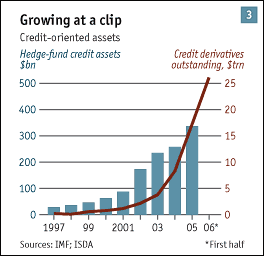
More febrile still has been the popularity of newfangled derivatives with difficult names, such as credit-default swaps (CDSs). These are as complex as they sound. But they are also among the past decade's most important financial innovations—and a cause of both regulatory hand-clapping and hand-wringing. The International Swaps and Derivatives Association said on September 19th that the notional amount outstanding of credit derivatives rose by 52% in the first six months of the year to $26 trillion (see chart 3). That number would be far smaller if banks' positions were netted out for offsetting exposures. But less than a decade ago, the credit-swaps market barely existed.

Credit derivatives, which behave a bit like insurance contracts, allow investors to buy or sell cover against default by a borrower, and the price moves depending on perceptions about the borrower's creditworthiness. Increasingly, they are being pooled into collateralised debt obligations (CDOs), another form of investment vehicle that is growing as fast as a hedge-fund manager's bank balance.

Such products, known as “structured credit”, encourage liquidity, partly because they can be created out of thin air. They also allow banks to sell on the risk of loans turning bad, possibly enabling them to lend more. Robert McAdie, head of credit research at Barclays Capital, says the change has been profound—and for the better. After the dotcom boom, when heavily indebted telecoms firms were on their knees, banks had almost no way to hedge themselves. Now they do: “The use of credit derivatives has totally liberalised the debt market,” he says. “It has created an enormous shift in the risk profile of banks. It allows them to hedge against their risk and manage their regulatory and economic capital more efficiently.”

Hedges and hedge funds
On the other hand, a recent paper by researchers at the European Central Bank says part of the problem with CDSs is that they are used for speculation, as well as hedging. “We have introduced a new product, “insurance”, that appears to be used by people not looking for insurance. It is not the instrument[s] which [are] causing liquidity concerns but the way market participants may be using them.”

On September 11th, in its semi-annual Global Financial Stability Report, the IMF warned that such “structured credit products” were one of its main concerns, especially if financial markets take a turn for the worse and liquidity dries up.

The problem, broadly identified by many regulators, is that not a lot is known about how structured-credit products behave in unusual conditions. Even if they normally mitigate risks, they might suddenly magnify them when financial conditions seriously deteriorate. The products have been developed in a decade when interest rates have been low, the appetite for risk high and liquidity ample. It is easy to assume they are always a benign influence. But it is hard to know how they will react when hard times return.
It all seems almost too good to be true - insurance for speculators. Insurance products that allow individuals and companies to take on as much risk as their models allow using borrowed money to increase their leverage to the extent that their models allow, secure in the knowledge that if something does go wrong, it won't be that big a deal.

A stock market crash, the collapse of Enron, September 11th, junk bonds from GM and Ford, Refco, the emerging market meltdown in May, and most recently plunging energy prices. All of these potential crises turned out to be just another bump in the road - the road to ever greater riches for those willing to borrow money and place a bet, purchasing some insurance just in case.

What could go wrong?

Read more...

A Legacy of Debt and Delusion

Saturday, September 26, 2009

[This post originally appeared on October 05, 2005. ]

Never before have so many borrowed so much.
Never before have so many become so wealthy.
Never before have so many been so deluded.

In recent months, much has been written about the legacy of Federal Reserve Chairman Alan Greenspan, who, after eighteen years, will retire in January. Most of the legacy discussion has been based on the steady hand of the Fed Chairman - a steady hand that has resulted in an era of low reported inflation and mild recessions, while fostering sustained growth through what many have hailed as superb monetary policy.

Others don't see it that way.

Some believe that the Greenspan legacy will be one of debt and delusion - debt of all kinds piled high, lingering far into the future, and delusion in reflecting back, at how we have all behaved during recent years.

Debt

Debt is "money owed". It is present today in huge quantities, for everyone to see - not too many people seem to care. As long as asset prices rise faster than personal debt and there are buyers for U.S. Treasuries, debt just doesn't seem to matter. It just keeps piling up.

It is as if it never has to be paid back.

More debt has been created in recent years than anyone could have possibly imagined just a short time ago. A "culture of debt" has been created - from the Federal Government all the way down to Wal-Mart credit cards.

Over the course of nearly two decades Alan Greenspan has facilitated this debt - he has overseen a system that has supplied the credit that has created the debt that has sustained an entire nation. An entire nation that has been the envy of the world for its dynamic growth. Growth which is based to an ever-increasing degree on new debt creation, and a populace willing to continue its profligacy.

Up until the 1980s, most people probably still agreed with Benjamin Franklin's view toward debt, "Rather go to bed without dinner than to rise in debt", and Adam Smith's wisdom as well, "What can be added to the happiness of a man who is in health, out of debt, and has a clear conscience?"

Today, as individuals and as a nation, we accept debt as an integral and necessary part of a lifestyle to which we have become accustomed, but a lifestyle that we increasingly can not afford.

Wealth

Wealth is defined as "goods and resources having value in terms of exchange or use". Surprisingly, it maintains no relationship with debt. Debt does not offset wealth, they coexist. An individual or a nation can be very wealthy at the same time that they are hopelessly indebted to others. It is under these circumstances that time becomes a factor, as wealth is converted into money to service the debt.

Our nation has acquired much wealth in the last two decades, under the stewardship of Alan Greenspan. The quantity and value of goods and resources has increased dramatically - so has debt. Rising values for stocks and now housing have made many Americans much wealthier than they could have ever imaged just a short time ago.

Spending money borrowed against the rising value of homes has been called the "wealth effect". Many people think they are spending their own money, but this is not the entire story. They are converting their wealth into money, which they can then spend - in the process they have created new debt. They are no less wealthy as a result, in fact, since debt does not offset wealth, they are indeed wealthier - they still have the home, from whence the new debt and new money came, but now they also have more goods that the new money has purchased.

They have become wealthier, and they have acquired more debt.

The wealth effect has been good for our consumption-based economy - many new jobs have been created as a result of converting more and more wealth into money which is then be spent on more goods and services.

One problem with wealth, however, is that it is not constant - it can change over time. Since wealth is based on the value of goods and resources, wealth changes as the market value of these goods and services change. Debt, on the other hand is constant. Debt service can change with fluctuating interest rates, but the debt itself remains as is, until it is added to or paid down.

Delusion

Delusion is the "act of deluding", or "the state of being deluded". Misleading or being misled. One of the difficulties with this terminology is the tense. By definition, one can not knowingly be deluded or misled - it is only after the fact, when one is wiser and takes time to reflect back, that the delusion is recognized and understood.

Some people believe that today's high housing prices and hence individual wealth, have become far detached from fundamentals and are not likely to continue into the future. They feel that the masses are being misled - not with respect to the current wealth of homeowners, this is real, but in the expectation that housing prices will maintain current levels or continue to rise.

There are questions about whether current wealth will endure.

Many people believe there is nothing unusual about a home, unchanged from five years ago, which is now valued at say, $300,000 more than it was then. It is valued at this level because other people are able and willing to pay that much for similar homes, and hence the homeowner, who may also be unchanged from five years ago, is now $300,000 wealthier than before. Moreover, the homeowner believes his current wealth will be projected into the future.

Time and stability have a way of reinforcing beliefs such as these.

Most homeowners today truly feel wealthy; otherwise we would not see home-equity driven consumption at the levels that have been witnessed in recent years. If they suspected that maybe they were being misled regarding their prospects for continued wealth, they likely would not spend this wealth at current rates.

Legacy

A legacy is something that is "transmitted or received from a predecessor". Like delusion, it is does not really work in the present tense - it is only after the predecessor has left the scene that one knows, factually, what the legacy of the predecessor is. Any discussion of the legacy of a contemporary is just speculation.

So, what kind of legacy will Alan Greenspan leave? Surely it will be a legacy of debt. There is so much debt at all levels - personal, business, government - and this debt will not go away quickly. It will linger, and it will need to be serviced. Will it all be repaid? Likely not. Many individuals are in far over their heads and do not have the same advantage that the government has in paying future debt with a currency which loses value.

But what else will the legacy consist of?

The legacy could also consist of continued wealth - current wealth could continue at these levels or rise as we charge into the future. But that depends on many factors. Most individuals today are wealthy due to rising real estate prices - if this trend does not continue, or worse, reverses, much of this wealth could disappear.

The Fed Chairman has been warning of this scenario often lately.

With the way individuals have unwittingly overextended themselves recently, it is a good bet that much of this wealth will disappear in the years ahead - that many loans will go bad, home prices will decline, and wealth will decrease.

So, can housing wealth be replaced with wealth created from some other source?

After the 1980s bond and real estate boom went bust, it was replaced with a technology boom. After the 1990s technology boom went bust, it was replaced with another bond and real estate boom. If the most recent boom goes bust, what will replace it?

That is the key question.

If there is something to replace housing as a source of wealth in the future - a technology boom in renewable energy, or nanotechnology perhaps - then in the years ahead the Greenspan legacy may be thought of as one of debt and wealth. Not bad really.

As long as wealth stays ahead of the debt, things will be fine. This has worked well so far.

However, if in the years ahead, it becomes clear that there is no new asset class that can be inflated to generate wealth for the millions and millions of Americans accustomed to rising debt to support their standard of living, then maybe people will look back at this period of time and think that maybe they have been misled.

Maybe people will come to understand that they behaved in ways that they shouldn't have because they were led to believe that their current wealth was based on sound fundamentals and that it would endure. Maybe people will realize that they were duped into acting in ways that they now regret and were swept up in a mania, the likes of which the world has never seen before. The Great Real Estate Bubble.

At that point, they will realize that they were misled, deluded.

This is the scenario that seems to make more sense - that the Greenspan legacy will be one of debt and delusion.

Read more...

A new era of family lending

Monday, September 21, 2009

I just stumbled across this story in the current print issue of Money Magazine and was kind of struck by the casual nature of the $100,000 home equity debt problem and solution within the Hetherington family.

Lend to family the right way
A loan to a relative can be a sweet deal for both sides, if it's served up correctly.
By Linda Stern, Money Magazine

(Money Magazine) -- When Brian Hetherington complained to his father two years ago about the weighty 9% rate he and his wife were paying on their home-equity line of credit, Jim, the senior Hetherington, had an idea. He could lend the couple the $100,000 to pay off the loan and charge them only 6%. It's been win-win ever since. "We haven't missed a payment," says Brian, 43. And his folks are still earning a return on their money.
It seems as though the senior Hetherington was more concerned with quadrupling the current rate of return on his bank CD than, perhaps, details surrounding the fact that his son pulled a cool hundred grand out of his house.

Read more...

The paradox of thrift

We're all going to be hearing a lot about the "paradox of thrift" in the months (and probably years) ahead, the well worn maxim that economic growth suffers when more people save, due to the fact that more saving means less spending.

This report in the LA Times covers the topic quite well.

After the most punishing downturn in half a century, the U.S. economy has finally begun showing signs of renewed life. Stock prices and factory orders are up. The housing market appears to be stabilizing. Job losses are moderating. Overall, the economy has begun to grow, officials believe.

Welcome as all those developments are, many analysts worry that they may not be enough to offset another trend: the continuing refusal -- or in many cases the inability -- of millions of U.S. consumers to go out and spend money the way they did before the crash.
Yes, conventional economic "wisdom" has it that there was nothing fundamentally wrong with an economy where more than 70 percent of all activity came from personal consumption.

As formerly spendthrift consumers all across the country begin to rebuild their personal balance sheets, now realizing that their home equity isn't going to fund their kids' higher education and their own retirement, more traditional methods of saving (e.g., spending less than you make) are becoming popular again.

No less an economic expert than former Fed chairman Alan Greenspan feared this development not long ago, noting that a higher personal saving rate (after tax income minus spending) could make an economic recovery difficult.

He seems to be right about a lot more things in retirement than when he ran the central bank.
When American Express asked a sampling of 2,032 people late last month what they would do if they found $500, the answers were like a pitcher of ice water in the face of retailers. Survey respondents were offered a list of possible spending choices that included splurging at a restaurant, going on a shopping spree and taking a trip.

But a mere 10% or fewer marked one of those items. Most went down the list and checked off paying regular bills, reducing credit card debt or simply saving the money.

"What we see consumers doing is exhibiting a level of discipline that we didn't know," said Gail Wasserman, a spokeswoman for American Express, which like other card companies has reinforced the reduced- spending trend by issuing fewer cards and slashing credit lines to lower their own risks.

"It's very clear consumers have hit the reset button. They've reevaluated their priorities and separated their wants from their needs," Wasserman said.
Apparently, that's what happens when you reach the maximum level of debt that a system can sustain and asset prices can be pushed no higher - you hit the reset button.

That is an odd analogy - hitting the reset button.

For example, when computers are functioning properly, there is no need to reboot. Normally, it is only when things go awry that a restart is needed. It seems that if the system had been designed a little better, there would be no need to reset it...

Read more...

Retirement or college?

Friday, September 18, 2009

Where we used to live in Northern California, news came recently that a couple just put their retirement home up for sale (purchased in 2007, ouch!) after the recession had taken a toll on the business owner's income while the college tuition bills just kept coming.

As said business owner was of the view that the U.S. economic slowdown was nothing more than a "media-created" event as recently as a year ago, his plight will not elicit any sympathy from these quarters but, based on this story at CNN/Money, he is surely not alone.

As much as a college diploma may assist today’s youth with their future employment, paying for that education is giving their parents a severe headache. New surveys released by Fidelity Investments, the College Savings Foundation, and Sallie Mae have found that parents understand they’re not saving enough, are worried about it, and are even planning to delay their own retirement to pay their kids’ tuition..
...
Make no mistake, college is expensive. This year’s numbers aren’t out, but college costs have risen 23% since 2000, after inflation. It’s great that many parents are willing to delay retirement a few years. But if it comes down to a decision between retirement savings and college savings, don’t feel guilty for making your kid finance his education or work his way through school. If you’re able to save more down the road, you can always help him pay off his loans, but no bank is going to lend you money to supplement your retirement savings if you come up short.
The approach to saving for both retirement and college that seemed to work so well earlier in the decade (i.e., figuring that your rising home equity will not only fund your kids' education but your golden years as well) is, sadly for many people, not working so well anymore.

Read more...

Dollar concerned about debt

Friday, September 11, 2009

At first, the headline for the report excerpted below looked like some kind of a funny typo or maybe even an April Fool's joke that comes seven months early. But, upon further inspection, it is not the U.S. Dollar that is concerned about demand for U.S. debt (though it should be), but economist David Dollar, who toils away at the Treasury Department.

U.S. Concerned on Debt Demand, Treasury’s Dollar Says
Sept. 11 (Bloomberg) -- The U.S. government is concerned about overall demand for Treasuries, not appetite from individual countries, said David Dollar, the U.S. Treasury Department’s economic and financial emissary to China.

“The interest rate on long-term treasury bonds is at a very low level by historical standards,” Dollar said today at the World Economic Forum meeting in Dalian, China. “That says that the market has confidence the U.S. will get the fiscal problem under control.”
...
In an interview with Bloomberg Television, Dollar said that countries still favored holding reserves in dollars because of the breadth of the U.S. market.

“The U.S. dollar happens to be the best choice,” Dollar said. “It is one of the few very good places where you can put large amounts of assets and have confidence of their future value.”
Mr. Dollar's optimism regarding future U.S. budget deficits may ultimately prove to be unfounded (see, even that sounded like some kind of joke). Don't be surprised if they have to trot Mr. Dollar out repeatedly to assure the Chinese that their investments are safe.

ooo

Read more...

Big Red's big red calculator

Thursday, September 03, 2009

After discovering that most household calculators are not nearly big enough to display the national debt, Colorado businessman Matt Miles set out to fill that market niche by developing his Big Red Calculator - The Official Calculator of the National Debt.
IMAGE It's available at Amazon.com for only $12.99 and, so far, there is one very positive review:

Don't let the novelty packaging fool you. This is a full-featured calculator with added features that set it above a run-of-the-mill unit.
- The display is large - 16 digits! That's up to quadrillions!
...
If there's any draw back is that it is not pocket-sized. It will easily fit in a backpack and on your desk.
Always one to be thinking ahead, I was wondering what comes after "trillion" and, as indicated in the product review, it is "quadrillion".

We may as well all get used to that one now - instead of $250 trillion, we'll soon be hearing the phrase, "a quarter of a quadrillion dollars".

Read more...
IMAGE

  © Blogger template Newspaper by Ourblogtemplates.com 2008

Back to TOP