

![[Most Recent Quotes from www.kitco.com]](http://kitconet.com/charts/metals/gold/t24_au_en_usoz_2.gif)
![[Most Recent Quotes from www.kitco.com]](http://kitconet.com/charts/metals/silver/t24_ag_en_usoz_2.gif)
![[Most Recent USD from www.kitco.com]](http://www.weblinks247.com/indexes/idx24_usd_en_2.gif)
That pesky right-hand column
Saturday, February 07, 2009
If someone could just do something about that column on the far right (via the WSJ) ...



 Posts
All Comments
Posts
All Comments


If someone could just do something about that column on the far right (via the WSJ) ...
Don't know quite what to make of this - could psychics do any worse?
Should anyone be surprised that "target-date" retirement funds failed to shield investors from the storm last year?
In recent years, these were said to be the savior of 401k plans. The idea behind them was simple enough - just keep piling money into the fund whose name corresponds to the year you plan to retire, and some manager somewhere will take care of the rest by buying you a heavy helping of stocks when you're decades away from calling it quits, then shifting to a heavier weighting of bonds as you get older.
According to this report in MarketWatch, things aren't exactly working out as planned.
Target-date retirement funds were supposed to be the greatest thing since sliced bread. Then 2008 happened. And all of the 264 target-date funds sold by the 39 mutual fund firms that market them performed poorly and contrary to expectations.As if there wasn't already enough working against conventional wisdom when it comes to retirement planning, you get results like this.Indeed, the most conservative target-date retirement funds - those designed to produce income - fell on average 17% in 2008 and the riskiest target date retirement funds - designed for those retiring in 2055 - fell on average a whopping 39.8%, according to a recent report from Ibbotson Associates, a Morningstar company.
Not a single target-date fund had a positive return, according to Tom Idzorek, Ibbotson's director of research and author of the report.
But what was especially troubling, according to Idzorek, was the disparity in performance among funds for those in or near retirement. Target-date funds designed for those retiring in 2010 -- next year -- were all over the map. The best of the 31 funds with 2010 in their name fell 3.5%, while the worst fell 41.3%.There's a good discussion of risk tolerance and risk capacity at the end, though nothing on the subject of "risk" that is anywhere close to the inanity of this item from a couple weeks ago.
What gives? To understand the problem, you have to get under the hood of these funds. In short, target-date funds are collections of other mutual funds actively managed by an adviser. Typically, the adviser buys a mix of stock and bond funds, usually from the in-house fund family, and then adjusts the mix over time, reducing the percentage invested in risky assets -- stock funds -- the closer the fund gets to its target date.
But every fund firm has a different take on what a target-date fund is and how it should be managed. Each firm has its own theory on what the mix of stock and bond funds should be. And each firm has its own theory on what's called the glide path, how the mix of stock and bond funds should change as the fund nears its target date.
Thus, funds with the same target date could have entirely different stock-bond mixes: one firm's 2010 might have 20% in stocks while another's could have 40%.
Fans of the many animated .gifs that have appeared here in recent months will surely not be surprised by what appears below - the nonfarm payrolls data before and after the benchmark revisions that were incorporated into today's labor report. As would be expected, there was a huge 385,000 downward revision to the 2008 data but, surprisingly, the 2006 data was revised up by 40,000 and the 2007 data was revised up by 56,000, neither of which would seem to make sense (particularly the changes for 2007) given that the economic expansion was coming to a conclusion during these years.
In fact, nonfarm payrolls were revised upward by 155,000 in November 2007, the month before the recession began, and, at the official start of the recession in December, there was another upward revision of 79,000.
The revisions are a combination of updating both the birth-death model along with seasonal adjustment factors so, it's possible that the negative changes in former are being more than offset by positive changes in the latter.
Recall that, by the Bureau of Labor Statistics' own admission, the birth-death model does poorly at estimating job growth in real-time during economic turning points, underestimating job growth when a contraction turns into an expansion and vice versa.ooo
Yeah, yeah, yeah... The inventory at the SPDR Gold Shares ETF (NYSEArca:GLD) made another new all-time high yesterday. What else is new? It was the ninth new high in the last 13 days and the 12th new high in the last 23 days.
Here's a different way to look at the seventh largest (and fastest growing) gold holdings in the world - month by month since the fund was started back in late-2004. Aside from the initial purchases to start the ETF, those three circled periods are the fastest three-month rates of increases in gold inventory and it doesn't take a rocket scientist to see what happens to the gold price during and after these periods.
With three weeks left in the month of February, the fund has already increased its gold holdings by 109 tonnes since December 1st, slightly behind the record three-month increase of 125 tonnes in January of 2006 that occurred just before the spring price peak which, in the chart above, looks like a footnote (these are month-end prices, so the $725 an ounce price in mid-May of 2006 does not appear).
It's not clear which direction the yellow metal is going to go today, but analysts are falling all over themselves, ratcheting up their price predictions.
Goldman Sachs figures it will go to $1,000 an ounce in the next three months (up from a timid forecast of just $700 not long ago) while UBS concurs with the $1,000 price target sometime in 2009 and Merrill Lynch projects a price of $1,500 sometime over the next 12-15 months.Full Disclosure: Owner of physical gold and long GLD
The Labor Department released the January employment report a short time ago indicating that nonfarm payrolls declined to levels last seen in 1974 and the unemployment rate reached its highest level since 1992. Payrolls fell by 598,000 in January following declines of 577,000 in December (revised downward from -524,000) and 597,000 in November (revised downward from -584,000).
The unemployment rate rose from 7.2 percent to 7.6 percent, however, when adding in those who are too discouraged to look for work and those who are working part-time instead of full-time, the unemployment rate rose from 13.5 percent to 13.9 percent.
A total of 3.6 million jobs have been lost since the current recession began back in December of 2007, an average of almost a quarter of a million jobs per month.
By category, it was largely the same story that has been playing out over the last year or so with the exception that manufacturing payrolls declined by a whopping 207,000, their largest decline since October 1982. Net job losses of 121,000 were seen in professional services, 118,000 in trade, transportation, and utilities, and 111,000 in construction. Education and health care added a net 54,000 jobs and government employment increased by just 6,000.
Benchmark revisions to prior data resulted in a net loss of 385,000 jobs during all of 2008.
TOP STORIES
Payrolls plunge 598,000, the most since 1974 - MarketWatch
The world economy: The return of economic nationalism - Economist
Cheap Crops Won’t Last, Credit Suisse Says: Chart of the Day - Bloomberg
Obama: Economy faces catastrophe without stimulus - Reuters
Goldman, JPMorgan Won’t Feel Effects of Executive-Salary Caps - Bloomberg
Merrill Lynch Kisses Up to Gold, Predicts It Will Hit $1,500 - Seeking Alpha
Auto suppliers seek rescue as crisis deepens - Reuters
How Gold Is Being Driven by a $4 Trillion Hallucination - Seeking Alpha
MARKETS/INVESTING
Oil Falls on Signs OPEC Cuts Have Stalled, U.S. Demand Concerns - Bloomberg
Gold ticks down after 1.5 pct gain, ETF at record - Reuters
Madoff client list peppered with big names - Reuters
UBS: Bullish on Gold and Silver - Seeking Alpha
'Monster Move' Coming for Stocks: S&P Could Hit 1000 by Spring - Yahoo! Finance
Brazilian shares surge on resource-demand hopes - MarketWatch
ECONOMY
Jobless Rate Rises to 16-Year High; Payrolls Drop 598,000 - Bloomberg
What Falling Prices Are Telling Us - BusinessWeek
Stores see January sales fall; Wal-Mart posts rise - AP
Gross Says U.S. Must Spend to Avoid Mini Depression - Bloomberg
Biggest job loss ever for retail sector - MarketWatch
IBM to laid-off: Want a job in India? - CNN/Money
INTERNATIONAL
2 Central Banks, 2 Different Paths - NY Times
Poll: Most economists say China to see recovery in 2009 - China Daily
China’s Unemployment Swells as Exports Falter - NY Times
Toyota Loses Top Credit Rating as Car Demand Plummets - Bloomberg
Hooray! China has bottomed out - China Financial Markets
Russia's currency: Down in the dumps - Economist
India Bucks Auto Trend as Rate Cuts Spur Suzuki Sales - Bloomberg
Dubai expats give new meaning to long-stay car park - TimesOnline
HOUSING
Reviving the Housing Market: Will Loan Modifications Work? - Time
Mortgage losses: Move over, subprime - Economist
Foreclosures Rising: One Every 13 Seconds - WSJ RE Blog
The $15,000 Conundrum - ZillowBlog
Million-dollar home sales plummet in California - Sacramento Bee
FED/TREASURY/BANKING
Fed Calls Emergency Consultants to Treat AIG - Bloomberg
Treasury overpaid $78 billion under TARP: watchdog - Reuters
Geithner plans to unveil bailout plan Monday - AP
Mortgage rates hit six week high - CNN/Money
INTERESTING
Man, 93, Who Froze In Home Left $600,000 - Newsnet5
My museum, myself - Fortune
Kellogg dumps Phelps - CNN/Money


Not much has been heard from Phil Gramm since he called us a "nation of whiners" about seven months ago. That is, before the National Bureau of Economic Research determined that our collective "mental recession" had some physical properties as well.
This op-ed piece by former House majority leader Dick Armey is worth a look if for no other reason than its title contains the name of one of the most influential members of the Austrian School of economics - Freidrich Hayek.
Washington Could Use Less Keynes and More HayekDoes it matter?"In the long run, we are all dead," John Maynard Keynes once quipped. An influential British economist, Keynes used the line to dodge the problematic long-term implications of his policy proposals. His analysis of the Great Depression redefined economics in the 1930s and asserted that increased government spending during a downturn could revive the economy.
President Barack Obama and congressional Democrats (very few of whom likely have read Keynes's 1936 book "The General Theory of Employment, Interest and Money") have dug up the dead economist's convenient justification for deficit spending in defense of their bloated stimulus legislation. But none ask the most important question: Was Keynes right?
Government spending is, according to Keynes's construct, a key component in determining aggregate demand, so more spending, even to resod the Capitol Mall or distribute free contraception, drives the economy in the short run.Future generations? They don't vote (yet). It's future elections that are important.
A father of public choice economics, Nobel laureate James Buchanan, argues that the great flaw in Keynesianism is that it ignores the obvious, self-interested incentives of government actors implementing fiscal policy and creates intellectual cover for what would otherwise be viewed as self-serving and irresponsible behavior by politicians. It is also very difficult to turn off the spigot in better economic times, and Keynes blithely ignored the long-term effects of financing an expanded deficit.
It's clear why Keynes's popularity endures in Congress. Intellectual cover for a spending spree will always be appreciated there. But it's harder to see any justification for the perverse form of fiscal child abuse that heaps massive debts on future generations.
I'm not usually one to pile on, but, somehow, I feel obliged to put this up.
Those of you who follow the two national reports on home sales - new home sales from the Commerce Department and existing home sales from the National Association of Realtors - have no doubt noticed that new home sales just keep falling while existing home sales have stabilized somewhat over the last year or so, largely due to a big increase in distressed sales.
What would happen if those foreclosures and short-sales were removed? Note that, since there is no readily available data series for the percentage of existing home sales that are distressed sales, the following approximation was used, which may or may not be accurate prior to about 2007 (the latest figure of 45 percent comes from the NAR):
Distressed sales were estimated at two percent from 2002 to 2004, increasing linearly to 5 percent, 10 percent, 20 percent, and then 45 percent in 2005, 2006, 2007, and 2008, respectively.
Earlier this week, Rep. Ron Paul (R-Texas) reintroduced legislation to abolish the Federal Reserve. While it's not likely to go any further than it did last time, efforts like this are an important first step toward making substantive changes in the future:
How can you argue with any of this?Madame Speaker, I rise to introduce legislation to restore financial stability to America's economy by abolishing the Federal Reserve. Since the creation of the Federal Reserve, middle and working-class Americans have been victimized by a boom-and-bust monetary policy. In addition, most Americans have suffered a steadily eroding purchasing power because of the Federal Reserve's inflationary policies. This represents a real, if hidden, tax imposed on the American people.
From the Great Depression, to the stagflation of the seventies, to the current economic crisis caused by the housing bubble, every economic downturn suffered by this country over the past century can be traced to Federal Reserve policy. The Fed has followed a consistent policy of flooding the economy with easy money, leading to a misallocation of resources and an artificial "boom" followed by a recession or depression when the Fed-created bubble bursts.
With a stable currency, American exporters will no longer be held hostage to an erratic monetary policy. Stabilizing the currency will also give Americans new incentives to save as they will no longer have to fear inflation eroding their savings. Those members concerned about increasing America's exports or the low rate of savings should be enthusiastic supporters of this legislation.Read more...
Though the Federal Reserve policy harms the average American, it benefits those in a position to take advantage of the cycles in monetary policy. The main beneficiaries are those who receive access to artificially inflated money and/or credit before the inflationary effects of the policy impact the entire economy. Federal Reserve policies also benefit big spending politicians who use the inflated currency created by the Fed to hide the true costs of the welfare-warfare state. It is time for Congress to put the interests of the American people ahead of special interests and their own appetite for big government.
Abolishing the Federal Reserve will allow Congress to reassert its constitutional authority over monetary policy. The United States Constitution grants to Congress the authority to coin money and regulate the value of the currency. The Constitution does not give Congress the authority to delegate control over monetary policy to a central bank. Furthermore, the Constitution certainly does not empower the federal government to erode the American standard of living via an inflationary monetary policy.
In fact, Congress' constitutional mandate regarding monetary policy should only permit currency backed by stable commodities such as silver and gold to be used as legal tender. Therefore, abolishing the Federal Reserve and returning to a constitutional system will enable America to return to the type of monetary system envisioned by our nation's founders: one where the value of money is consistent because it is tied to a commodity such as gold. Such a monetary system is the basis of a true freemarket economy.
In conclusion, Mr. Speaker, I urge my colleagues to stand up for working Americans by putting an end to the manipulation of the money supply which erodes Americans' standard of living, enlarges big government, and enriches well-connected elites, by cosponsoring my legislation to abolish the Federal Reserve.
TOP STORIES
Bank of England cuts interest rates to 1pc - Telegraph
U.K.’s Brown and Depression, a Freudian Slip? - WSJ Economics Blog
SEC Stonewalls at Senate Hearings on Madoff - Naked Capitalism
Senate Advances Tax Break for Homebuyers - NY Times
Stumbling on Their Sense of Entitlement - Washington Post
At Madoff Hearing, Lawmakers Lay Into S.E.C. - NY Times
Why saving for your future is so hard - CNN/Money
Obama caps executive pay tied to bailout money - AP
MARKETS/INVESTING
Gold Rises a Second Day on Inflation-Hedge Demand - Bloomberg
Oil hovers near $40 a barrel - CNN/Money
Dubai gold jewellery sales crash by 60 percent - Commodity Online
Target-date funds missed the target in 2008 - MarketWatch
Oil Inventory Build Surprises Analysts, Not Traders - Hard Assets Investor
Silver Investment Demand - Gold & Silver Blog
Wall St. Pay Moves in Cycles (Guess Where We Are Now) - NY Times
ECONOMY
U.S. jobless claims surge to 626,000 - MarketWatch
U.S. Productivity Rose More Than Forecast - Bloomberg
State furloughs may delay unemployment benefits - LA Times
About that deflation risk - Krugman, NY Times
2009 GDP Forecasts - Calculated Risk
Bill Gates warns of tough economy - Reuters
Senate OK's softened "Buy American" plan - Reuters
INTERNATIONAL
Mizuno: BOJ Must Take Extraordinary Steps - Bloomberg
Toyota shuts down all but one assembly line - CNN/Money
Sticky Prices Help ECB Save Interest-Rate Ammunition - Bloomberg
Australia facing debt-driven depression - ABC News
Russia Fuels Ruble Tumble With Bank Loans - Bloomberg
Economists React: Signs of Stabilization in China? - WSJ Economics Blog
U.K. house prices see January bounce - MarketWatch
McDonald's slashes China prices by up to 33 percent - Reuters
HOUSING
272 O.C. homes lose million-dollar status - OC Register
Senate approves $15,000 home purchase tax credit - LA Land
52% of homes in LA/OC sold at a loss - OC Register
Analyst Explains Why Housing Will Not Bottom This Year - WSJ Developments
O.C. million-dollar home sales tumble 45% in 2008 - OC Register
FED/TREASURY/BANKING
Volcker Chafes at Obama Panel Delay, Strains With Summers Rise - Bloomberg
End the Fed - Ron Paul, GoldSeek
Obama’s ‘Screw-Up’ Leaves Geithner on Thin Ice - Bloomberg
Bernanke Picks Up the Pace - WSJ Economics Blog
INTERESTING
Number of alien worlds quantified - BBC
'Evangelists' accused of stealing from Tenn. homes - AP
I don't know. Maybe there is hope that we might someday find a way to extricate ourselves from our long-term problems through education. This is in ten parts - the others are here.
The highlight of the week's economic reports comes on Friday when the Labor Department releases the employment data for January which, in itself, may be quite a shock. But, this report also includes the annual revisions to prior data where the BLS (Bureau of Labor Statistics)updates its "birth-death model" numbers, among other things, to try to bring the revised numbers a bit closer to reality, from which they strayed quite noticeably over the last few years. Here's the official announcement from last month: A large portion of those estimated 125,000 construction jobs that were created by the birth death model in 2007 are going to disappear and the construction job growth of 100,000 in 2008 may turn negative as many more home-building businesses were dying than being born whilst the housing bubble was rapidly deflating.
One of the great deficiencies in the employment data coming from the BLS is that, due to the amount of estimation and modeling that is required to provide timely data, much of the estimation and modeling go horribly wrong when the economy turns from expansion to contraction or vice-versa.
The BLS is quite up front about this in their documentation, however, this doesn't stop huge revisions from largely invalidating the data that was reported prior to the revisions. Recall that a couple years ago, over 800,000 jobs showed up in one of these annual revisions and suddenly, all the talk of Bush's "jobless recovery" stopped.
As it turns out, many of those jobs involved nailing drywall and peddling mortgages to people who either didn't understand what they were doing or didn't care because they thought they'd soon be rich beyond their wildest dreams, but that's a discussion for another time.
Look for many hundreds of thousands of 2007-2008 jobs to "vanish" in a similar fashion on Friday as another turning point was reached and the BLS attempts to correct all of those embarrassingly large positive numbers with more reasonable figures.
As I understand it, the revisions will only cover the period up to March of 2008, primarily for the twelve months prior to March 2008, meaning that, even this revised data will quite old.
[The following conversation between two top U.S. economists was recently overheard at the World Economic Forum in Davos, Switzerland. For obvious reasons, their names have been withheld - they will be referred to here as Lloyd and Harry.]
Two economists hatch a plan to save the global economy...
Lloyd: Harry, what are we going to do about deflation? We missed it by a whisker last month in the U.S., but you know next month's Consumer Price Index is going to show deflation and then people are going to stop spending money because they know they'll get lower prices if they just wait a little longer and that's going to just kill the economy...as if things aren't already bad enough.
That's what happened during the Great Depression and you know it will happen again if we allow deflation to take hold.
Harry: I know Lloyd, that's been keeping me up at night too. A lot of us our scratching our heads right about now. Macroeconomics used to be easy. Over the last twenty years, all you had to do was raise interest rates when the CPI went up and lower rates when the CPI went down, though that deflation scare in 2002-2003 was pretty frightening.
Lloyd: It's a good thing that we had Greenspan around at the time because he snuffed out that deflation like it was nobody's business. He had it down on the mat with those low interest rates and he wasn't going to let it up no matter what. That was really something!
Harry: Yes it was. You know all this criticism he's taken lately is really unfair. If he hadn't done what he did, we'd be six years into a deflationary spiral and people would be saying, "It's all Greenspan's fault for not doing enough to fight deflation".
Lloyd: Yeah, it really is unfair, but, what are we going to do about deflation this time Harry? Short-term rates are already at zero and the Federal Reserve and Treasury have already bought or guaranteed trillions of dollars worth of bank assets and, so far, quantitative easing just isn't working.
Harry: I don't know Lloyd, maybe if we can put our heads together we can come up with something, anything, to stop that deflation train that's barreling down the tracks. Lloyd: You know, Merrill Lynch is predicting year-over-year inflation of minus 3.2 percent by summertime - I guess we'll all have to stop talking about in-flation and start saying de-flation when these new inflation numbers come out...or should I say, "when the de-flation numbers come out".
Harry: And I hear Goldman Sachs just polled some money managers and found that 83 percent of them think de-flation, not in-flation, is now the biggest threat to the global economy. I just hate the sound of that...de-flation.
Lloyd: Hmmm... what to do...
Harry: Hmmm... is right.
Lloyd: Hey, I've got an idea. You know how some people still think that the price of gold is some sort of an indication of future inflation?
Harry: Uh-oh. Don't start any of your "crazy gold talk" again Lloyd. You've studied all the same textbooks as I have and you've got a PhD in economics just like I do yet, about once a year, you seem to get this wild hair up your derriere where you somehow think that the price of gold is relevant in what we do.
Lloyd: Just hear me out, Harry. I think I may be on to something that could really save our bacon here - you know, economists aren't all that popular these days because, except for Roubini, Shiller, and a couple of others, none of us saw this financial crisis coming.
Harry: Yeah, I really thought we were going to be OK with a zero savings rate in the U.S. back in 2005 because we were all so house-rich. I hear Bernanke's upside down on that place he bought in Washington back at the peak of the bubble when he was appointed Fed chair.
Lloyd: Don't distract me Harry.
Harry: Sorry. Lloyd: Anyway, you and I both know that gold is irrelevant - why banks still keep the stuff is beyond me and, please, don't get me started on the Germans and their weird fascination with the stuff today, almost a hundred years after that Weimar episode.
But, a lot of the people in the world still think gold does matter, so if the gold price went higher, that might get enough people to start questioning the CPI numbers which, as we both know, are going to tell the real story this year - deflation.
Harry: You know, that's an interesting idea. It's inflation expectations that are important, so if enough people expect inflation because the price of gold is rising, maybe they'll be more likely to spend their money even if prices are falling.
Lloyd: Exactly. Back in the Great Depression, long before we had computers and our advanced economic models, they had the currency fixed to gold - $20 an ounce as I recall. When they revalued gold in 1933 to $35 an ounce, that's when things started to improve. To revalue gold, they had to print up lots and lots of new money and that's what really cured the deflation of the 1930s.
Harry: I've read about that...
Lloyd: You know, President Obama already thinks of himself as the new FDR, we could probably talk to Bernanke and Geithner and get him on board. If we could somehow push the price up to $1,500 or $2,000, then people would stop obsessing about deflation and go out and spend some money. You know adjusted for inflation, gold could go to about $2,500 and still not exceed its 1980 high, so it wouldn't really be extraordinary - we could still say that gold hasn't made any gains in 30 years.
Harry: Adjusting the price of gold for inflation? Lloyd, remember that you have a PhD in economics - don't embarrass yourself. Uh-oh! You've got that crazy look in your eye again Lloyd - I get the feeling that the next thing you're going to tell me is that the Federal Reserve, today, should print up money and buy gold.
Lloyd: Exactly! Harry: Hmmm...
Lloyd: Look, people are scared to death with all these job losses and falling home prices so they're not borrowing and spending as they should. When deflation hits this spring, things will get even worse. If we could somehow convince them that we have in-flation instead of de-flation, despite what the government's data says, maybe that will help.
Harry: You know, that wouldn't cost much either. Let's see...100 tonnes of gold costs somewhere around $3 billion. If we went out and bought, say, 1,000 tonnes, that would be a good start and no one would notice an extra $30 billion on the Fed's balance sheet.
Lloyd: Yeah, that's just a drop in the bucket compared to all the other money that's being borrowed and printed to try to get us out of this mess.
Harry: Plus, the Fed would have the gold in their possession - they'd probably make money on the deal, unlike all the other stuff they've been buying lately.
Lloyd: It's just crazy enough that it might work. Huh?
Harry: Yes, it just might work, Lloyd.
Lloyd: I'm glad we had this talk - I think we really came up with something that might help.
Harry: You know, sometimes you really surprise me Lloyd - I don't know why everyone says you're so dumb.
Lloyd: Who says I'm dumb?
 Uber-bank analyst Meredith Whitney really needs to read some of the works of Paul Kennedy and/or Kevin Phillips to understand why some might view today's comments on Wall Street compensation as being not too different from Erin Burnett's views expressed recently on Meet the Press and skewered by new-favorite website The Daily Bail in this memorable ripost:
 Click to play in a new window
Wall Street pay is getting scrutiny after New York banks and securities firm paid $18.4 billion in bonuses for 2008 while the six biggest New York-based financial companies lost a combined $42.4 billion and got $90 billion in government bailout funds. JPMorgan Chase & Co. Chief Executive Officer Jamie Dimon said yesterday that “pay got a little exuberant.”And ... what's wrong with that?
President Barack Obama will today announce a cap of $500,000 on compensation of top executives at companies that receive significant federal assistance, according to an administration official who requested anonymity.
The failure to pay employees well may drive away “the best and the brightest,” Whitney said.
“If you can’t compensate your employees, they’re going to go somewhere else,” she said. “You’re going to get a different variety of folks who are going to come in.”
The omnipresent (and seemingly omniscient) Nouriel Roubini talks to CNN about the dimming prospects for an economic recovery in 2009 and how he may one day transform from bear to bull, at which time, the financial media may see fit to give him a new nickname.
TOP STORIES
Planned layoffs in January hit 7-year high - Reuters
California bond rating drops lower than any other state's - LA Times
Bank Rescue Would Entail Triage for Troubled Assets - Washington Post
‘Failed’ Wall Street Means Biggest Rules Rewrite Since 1930s - Bloomberg
Additions by Senate Push Stimulus Near $1 Trillion - NY Times
Madoff Whistleblower Markopolos Finally Speaks - ClusterStock
U.S. Plans to Curb Executive Pay for Bailout Recipients - NY Times
Refinery strike averted as contract reached - Reuters
Senate votes to give a tax break to new car buyers - AP
MARKETS/INVESTING
Gold steadies above $900/oz, rate decisions awaited - Reuters
How Citigroup Makes Hay in the Oil Market - Time
Cash4Gold Ad Does Not Signal a Top in Gold - The Big Picture
Got gold? Why TV ad men want yours - Christian Science Monitor
Sprott Says U.S. Depression Will Boost Gold Price - Bloomberg
Gold as Part of a Portfolio - Seeking Alpha
Unfinished Business - Butler, Investment Rarities
ECONOMY
Goldman says fund managers expect deflation - Credit Writedowns
ADP employment index finds 522,000 private-sector jobs lost - MarketWatch
Taxed and spent: Consumers are telling Washington, 'No we can't' - MarketWatch
`Buy American' isn't new, but is it really a good idea? - McClatchy
GM U.S. sales fall 48.9% to 128,198 units in January - MarketWatch
Pending home sales post increase of 6.3 pct - AP
INTERNATIONAL
Utsumi Says G-7 Nations May Reinstate Call for Yuan Flexibility - Bloomberg
China shares up on new loans, manufacturing index - AP
Hyundai Defies U.S. Slump as Asians Grab Record Share - Bloomberg
Putin Speech at Davos World Economic Forum - The Oil Drum
GE Capital Sells FDIC-Backed Hong Kong Dollar Bonds - Bloomberg
China outraged after India bans all toy imports - Telegraph
Indonesia Cuts Rate for Third Month to Spur Growth - Bloomberg
Canadian parliament approves economic stimulus plan - AFP
HOUSING
Record 19 Million U.S. Homes Stood Vacant in 2008 - Bloomberg
Plan Orange: The Mortgage Crisis Killed Quickly - Your Mortgage or Your Life
Here We Go Again: S&P Slashes Thousands of RMBS Ratings - HousingWire
Housing Prices Will Continue to Fall, Especially in California - newgeography
Conventional loan limit is a hurdle for high-end homes - USA Today
High-End Housing Market Ravaged by Stock Selloff - CNBC
Remodeling industry has room for recovery - MarketWatch
FED/TREASURY/BANKING
Toxic-Asset Guarantees Gain Momentum in U.S. Bank-Rescue Talks - Bloomberg
U.S. Debt Default, Dollar Collapse Altogether Likely - Seeking Alpha
Fed Extends Emergency-Loan Programs, Swaps to Oct. 30 - Bloomberg
Thoughts on an Inflationary Depression - Seeking Alpha
INTERESTING
Dewey, Cheatham and Howe announces new partners - FFTP
Twitter, Communication, and My Intermittent Inner Luddite - Naked Capitalism
Free breakfast a 'Slam' dunk in tight economy - Times Online
Historic tiny Sacramento County town has king-size problems - LA Times
There's no way to embed this video that is now up on the main page at Yahoo! about squatters who were found in a million dollar foreclosed home, but there's this:
As bad as things were for investments last year, that is, for everything other than short funds, Treasuries, and gold, if you owned a home it was even worse. Zillow reported that the U.S. housing market declined $3.3 trillion in value last year - that's about $11,000 for every man, woman, and child in the country. More homeowners than ever before now owe more than their house is worth and there are no signs of the price declines slowing down, though someday they surely will.
According to this story in Bloomberg, Stan Humphries, Zillow's vice president of data and analytics said, "It’s like a runaway train gaining momentum. It’s difficult to say when we’ll see a bottom to the housing market."
As far as the destruction of what we once fondly called "home equity" is concerned, things are much worse than the headlines would indicate since home equity losses come right off the top for homeowners and these percentage declines can be devilish.
Say, for example, you owe $300,000 on a house that used to be worth $500,000 and, after last year's decline, it's now worth $400,000. While your home's value only went down 20 percent, your home equity went down 50 percent.
After another 20 percent decline in home values this year (which looks quite reasonable in many areas) that's a 40 percent decline for your property but it completely wipes out what we used to affectionately call "housing wealth".
That's the stuff that was supposed to pay for the kid's college and your retirement.
Humphries continued, "A witch’s brew of economic insecurity, foreclosures and tightened lending standards are helping to keep hard-hit markets down and to widen the scope of markets showing declines. Negative equity will trigger new foreclosures, and that will add to inventory and depress prices".
It's no wonder that families are moving back in together - once the economy turned south and people started losing their jobs, who could afford those $5,000 mortgage payments.
Certainly not Mr. Tixe of Queens, whose family is featured in this USA Today report.Last year, Kanessa Tixe's dad had just finished building a three-family house when he lost his superintendent job in February. He wasn't sure how to make the $5,000-a-month mortgage on the new house in Queens, N.Y.
Well, never let it be said the bursting of the housing bubble doesn't have at least a tiny little silver lining - it's bringing families closer together.
So Tixe and her siblings decided to help out in an unusual way: They moved in. In December, her father moved into the first floor; her stepsister and husband moved into the second floor; and her stepbrother and Tixe took the third floor. The entire family has become roommates, banding together to pay rent and help their dad with the mortgage until he finds long-term tenants.
"We're still living there now. Times are rough," says Tixe, 26, a publicist. "It's been very beneficial that we're all together. My stepbrother and I have a wonderful relationship now. We eat together for dinner, and I've become closer to my dad, too. This is an important time for family to help, the way the housing market is going. Our story is a testament to how families should come together to help with a mortgage."
Similar things are undoubtedly going on out here on the West Coast. All those people who bought homes in Riverside and San Bernardino County a few years back - what today is "ground-zero" for the Southern California real estate bust - many of them are probably back living with relatives somewhere in Los Angeles County now.
As for the rust belt - that part of the country that had the unfortunate luck of getting a housing bust without the preceding boom - Luke Mullins at U.S. News & World Report points his readers to a story in the Toledo Blade that has an elected official counseling her constituents to become squatters instead of moving out when the sheriff comes knocking on their door.
After you stop making payments, Rep. Marcy Kaptur recommends the following:"I'm saying to them possession is 99 percent of the law; you stay in your house," Miss Kaptur said yesterday, continuing a crusade she started several weeks ago in Congress and CNN picked up Thursday night...
This kind of stuff used to be great fun to write about but, in 2009, the housing bubble just isn't very funny anymore.
She urged homeowners not to panic and leave their home just because they receive a foreclosure notice from their lender, and she said they should demand that the mortgage-holder produce a mortgage audit.
"I say to the American people, you be squatters in your own homes. Don't you leave," she said during a speech in Congress earlier this month.
This just in from Fox Business News (actually, it was a little while ago) - pictures from inside the Ponzi Scheme offices and news that a former employee turned a laptop computer, once belonging to Bernie Madoff's wife, over to federal investigators.
Yesterday's post on Cash4Gold's Super Bowl advertisement resulted in a few enlightening comments and two links detailing how the company operates, at least according to a former employee and a customer who was at first unhappy, then happy, then very curious.
Here are the links:
It would be interesting to know what kind of a haircut this would be off of a "typical" retail price for the stuff (if there is such a thing). Most people are deluding themselves if they think that jewelry is anywhere near as good an investment as gold bullion in coin or bar form which, today, fetches about $20-$30 over spot.While the article "Is it worth investing in gold, silver jewellery?" is well worth reading in its entirety because, not only does it unequivocally answer the question posed in the title, but it makes a number of other good points about investing in precious metals, the relevant excerpts to help answer the question asked yesterday are below.
A very large necklace containing 1 ounce of pure gold (0.9999 pure or 24 carat) will normally cost well in excess of 250% of the actual market price for gold. If gold is trading at £560/oz, this means the necklace will likely cost at least £2,000/oz plus the VAT. A gold bar which also has 1 ounce of pure gold (0.9999 pure or 24 carat) will be sold at the trading price plus a small mark up of around 5% or £588 (£560/oz+5%=£588) and no VAT.It's not exactly clear what a re-sale value of "30% off its original cost" means but, fortunately, that's not important to do the calculation that is required here.
While these considerations start at purchase, there are also draw backs when it comes to selling the jewellery bought as an investment. Unfortunately for the vendor, re-sale jewellery would not normally realise more than 30% of its original cost price.
In this piece at Alternet.org, Joshua Holland asks an interesting (and timely) question: Why aren't Americans rioting in the streets in response to the worsening financial and economic crisis like much of the rest of the world?
It seems that people are pretty riled up everywhere these days.Over the past few years, a series of riots spread across what is patronizingly known as the Third World. Furious mobs have raged against skyrocketing food and energy prices, stagnating wages and unemployment in India, Senegal, Yemen, Indonesia, Morocco, Cameroon, Brazil, Panama, the Philippines, Egypt, Mexico and elsewhere.
For the most part, those living in wealthier countries took little notice. But now, with the global economy crashing down around us, people in even the wealthiest nations are mad as hell and reacting violently to what they view as an inadequate response to their tumbling economies.
The Telegraph (UK) warned last month that protests over governments' handling of the crisis "are widespread and gathering pace," and "may spark a new revolution".
Notably absent from the list of countries where the economic crunch is rending the social fabric is the good ole US of A, a state with the greatest level of economic inequality in the wealthy world.Surprisingly, the role of religion in the American culture was not mentioned, but, it is arguably as big a factor as any other.
Outside of a few scattered and quickly contained protests, the citizens of the U.S. -- a country born of revolution, but with an elite that's been terrified of that legacy since immediately after its founding -- have been calm, despite opinion polls showing that Americans are more dissatisfied with the direction in which the country has been headed since they began measuring such things.
It's a baffling disconnect, considering that real wages for all but the top 10 percent of the economic pile haven't increased in 35 years.
...
Americans are rightfully angry about that state of affairs, but with a few small exceptions, quietly so. Why? It depends on whom you ask.
In a 2006 interview with Harper's, Barack Obama shared a subtle, but rather fundamental observation about America's political culture: "Since the founding," he said, "the American political tradition has been reformist, not revolutionary." If there is to be positive change, Obama has argued, it must be gradual; "brick by brick," as he put it in one of his final campaign speeches.
Mark Ames, author of Going Postal: Rage, Murder, and Rebellion -- From Reagan's Workplaces to Clinton's Columbine and Beyond, argues that Americans have been beaten down to a degree that they're now a pacified population, largely willing to accept any economic outrage its elites impose on them.
In a 2005 interview with AlterNet, Ames said the "slave mentality" is stronger in the U.S. than elsewhere, "in part because no other country on earth has so successfully crushed every internal rebellion."
Slaves in the Caribbean for example rebelled a lot more because their oppressors weren't as good at oppressing as Americans were. America has put down every rebellion, brutally, from the Whiskey Rebellion to the Confederate rebellion to the proletarian rebellions, Black Panthers, white militias ... you name it. This creates a powerful slave mentality, a sense that it's pointless to rebel.
...
As The Nation's Bill Greider told Democracy Now's Amy Goodman, "you can't do this to people year after year -- that is, upturn their lives, take away what they thought they had earned, and so forth and so on, without provoking rather intense political reactions. ... We're just, just beginning to see a few bubbles like that around this country. I don't say we're going to have riots, but I think ... people, out of their own distress and anger, will organize their own politics, and they will make themselves seen and heard around this country."

Curious to see what annual GDP growth since the Great Depression might look like, a chart was promptly whipped up. It's a bit surprising, particularly the World War II era. So much attention is paid to the annualized quarterly economic growth rates that you forget what things look like from year-to-year. The last recession in 2001 did not produce a contraction when measured over a calendar year, however, the three prior ones did in 1991, 1982, and 1980 with declines of 0.2 percent, 1.9 percent, and 0.2 percent, respectively.
Unless a second half rebound materializes, that 1982 mark will be tested (if not shattered).
The World War II period is pretty fascinating - who says war isn't good for the economy?
TOP STORIES
Dow Chemical Posts $1.5 Billion Loss - NY Times
Motorola loses $3.6B, suspends dividend, CFO exits - AP
BofA had some details of Merrill bonuses - Reuters
Road Trip - Kunstler, CFN
Treasury needs to borrow $493B in current quarter - AP
Macy's to cut 7,000 jobs, slash dividend - AP
California delays $3.5B in payments - CNN/Money
Morgan Stanley plans up to 4 percent in job cuts - Reuters
MARKETS/INVESTING
Oil hovers above $40 after more grim economic news - AP
Gold May Drop With Sellers Lured by Six-Month High - Bloomberg
“Dividends; the secret to long-term returns!” - Saut, Raymond James
Declining costs to catapult gold miners and developers in 2009 - MineWeb
A Tale of Two “Flations” ... Revisited - Totle, Raymond James
Is it worth investing in gold, silver jewellery? - Commodity Online
ECONOMY
The new jobless - Fortune
Stimulus plan's job numbers get 2nd look - USA Today
The Inflation-Deflation Debate - Saville, Goldseek
Obama sets himself 2012 deadline to fix economy - Globe & Mail
GM, Chrysler offer workers cash, cars to leave - Reuters
U.S. manufacturing index rises in January-ISM - CNBC
A recession of biblical proportions - Fortune
INTERNATIONAL
China to spend $19 billion in second stimulus tranche - Reuters
Big jump in Spanish unemployment - BBC
China's Wen Blames Crisis on Lax Controls - Washington Post
We can have a global depression if we really work at it… - Financial Times
China: A New Wave Of Violent Riots - Clusterstock
The whole world is rioting, but why not America? - Commodity Online
Canberra and Tokyo step up stimulus - IHT
Germany's Big Banking Bailout - Spiegel Online
Canada's housing market in a deep freeze - Globe & Mail
HOUSING
U.S. Property Owners Lost $3.3 Trillion in Value Last Year - Bloomberg
Just a Band-Aid on the Foreclosure Problem? - Washington Post
U.S. Mortgage Time Bomb Needs Defusing Yesterday - Bloomberg
More families move in together during housing crisis - USA Today
Congresswoman to Owners Facing Foreclosure: Stay in Your Home - US News
Secondary Markets Won’t Recover Until 2011, Insiders Say - Housing Wire
FED/TREASURY/BANKING
Hazardous Materials? - The New Yorker
Bad bank + toxic debts = moral hazard x10 - MarketWatch
Fisher: says protectionism equals "economic death" - Reuters
Fed: Banks still tightening loan standards - AP
INTERESTING
Zimbabwe dollar sheds 12 zeros - BBC
Postal Service Pushes the Envelope, Then Folds - Bloomberg
Wall St., a Financial Epithet, Stirs Outrage - NY Times
 It is not at all clear what, if any, significance the survey results attached to this story in the U.K.'s Times Online hold but, when asked which of ten individuals to blame for the current financial mess, fingers were pointed squarely across the Atlantic Ocean at the guy who ran the Federal Reserve for almost two decades.
Are the British that attuned to monetary policy in the U.S. or are they, perhaps, more willing to look overseas for a culprit rather than on their own soil?
(BTW - that little radio button thingy is my vote, just in case anyone was wondering.)
The much better known local boy, Gordon Brown, comes in a distant second (for very good reason, actually) and George W. Bush is even further back in third place.
Interestingly, the three individuals who were probably more responsible than any politician in the world - Fuld, Paulson, and Mozilo - filled the next three spots.
As for the other four, the British are probably about as familiar with the name Hank Greenberg as Americans are with Sants, Goodwin, and Corbert, though, after reading the descriptions provided, these three clearly deserved more votes than they received.
Here's what they had to say about former Fed Chairman Alan Greenspan:Alan Greenspan was feted for his management of the US economy while he stood in charge of the US Treasury, but has since been put under the spotlight. He was responsible for cutting interest rates to near zero in the US in the aftermath of September 11, flooding the world with cheap and easily available money. Did this pave the way for a “once-in-a-century credit tsunami"? In October last year he said: “I made a mistake in presuming that the self-interest of organisations, specifically banks and others, was such that they were best capable of protecting their own shareholders.”
The confusion about the Fed chairman heading up the U.S. Treasury Department may be understandable as we Americans are often confused by the British position of Chancellor of the Exchequer which we'd be just as likely to say headed up the Bank of England.
Allan Meltzer is a professor of political economy at the Carnegie Mellon University in Pittsburgh, said: “Alan Greenspan was much too afraid of a slowdown or other recession…he allowed the credit to expand too rapidly."
This video of Ron Paul at a Mises event in Houston was spotted just after reading the AP headline: Treasury needs to borrow $493B in current quarter. What a contrast...
One of the very few benefits of living through the tumultuous period of the last couple years is that people begin to look around at other parts of the world and other periods in time to gain some perspective.
Sometime last year, U.S. economists began looking back past the last two recessions in 2001 and 1991 for comparable statistics, more often than not seeing a lower low during one of the two recessions of the early 1980s.
But, more and more, you hear that we've reached the lowest level since record keeping began back in the 1960s or 1950s with a few "worst in the postwar period" characterizations thrown in for good measure.
Perspective is important because, among other things, it provides some reassurance that the "end of the world" might not really be at hand, despite those who have already seen fit to throw in the towel (see Japan’s Economy Is Killing Far Too Many Japanese).
This chart from a Christan Science Monitor story earlier today gives a good long-term view of conditions in the U.S. over the last half-century or so and, when looking at things from this vantage point, you'd have to think that the reaction to recent economic developments is, more than anything else, an indication of just how soft we've become. Based on what's happened so far in the current recession, we've clearly been through much worse before, but, the all-important questions is how much worse things might get due to the fundamental changes in the world economy during "The Great Moderation" (as it was once called) from the mid-1980s up until a year or so ago.
The CSM report provides some details about how things are different this time around.Not long ago, the world economy overall was enjoying its fastest growth in modern times. The expansion of trade has meant expanding productivity rates and jobs, allowing most nations to grow faster than they could without such ties.
We are just starting to see trade tensions develop around the world, a natural response by nations when growth slows and job losses mount.
But many nations relied on US consumer spending as an engine of growth. Now, as American households retrench, there is suddenly less momentum for growth abroad as well as at home. In the long run, economists say other nations must strengthen their domestic consumption to create a more balanced world economy. But that transition may not happen quickly, even if other governments join the US in fiscal stimulus efforts to counter the recession.
Global trade plummeted in the fourth quarter of last year. Those US consumers cut their demand for imports at a 16 percent annual pace.
...
The delicate US-China relationship faces new tension. As a presidential candidate, Obama pledged to take a tougher line on trade issues with China.
Officials in Beijing weren't pleased when US Treasury Secretary Timothy Geithner told senators at his confirmation hearing that China was manipulating its currency.
Vice President Joe Biden said on Thursday that the Obama administration had made no determination on whether China was manipulating its currency and would not make a unilateral attempt to block its exports.
In a phone call Friday, Chinese President Hu Jintao told Obama that he wanted to strengthen cooperation between the two countries to fight the global economic slowdown, China's Xinhua news agency reported.
Some economists say that it's legitimate for the US to work harder to end abuses of current trade law, with China topping the list of alleged offenders. But most economists also warn that a recession is a risky time for trade relations to fray. In the Great Depression, rising trade barriers deepened the downturn.
Like the near-term prospects for most economies around the world, these tensions are likely to get worse before they get better - maybe all countries need a little better perspective.
Yesterday's Cash4Gold Super Bowl ad says a lot more about the dire condition of the typical American's balance sheet than it does about the trajectory of the gold price.
Phil Conners (Bill Murray) and Ned Ryerson (Stephen Tobolowsky) meet on consecutive mornings prior to the appearance of Punxsutawney Phil in the 1993 classic Groundhog Day.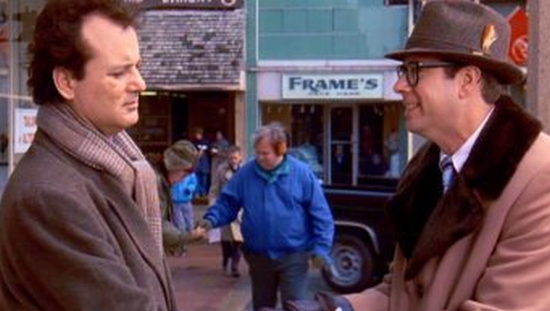 The arrogant, egocentric, and frustrated weatherman from a Pittsburgh, Pennsylvania TV station was assigned to the annual Groundhog Day festivities in Punxsutawney, only to find himself experiencing the same day, February 2nd, over and over.
His interaction with a high school classmate on consecutive days went like this:
And don't forget all the Super Bowl ad compilations from yesterday's extravaganza.-- Day 1 --Ned: Phil? Phil Connors? Phil Connors, I thought that was you! Hey now, don't you tell me you don't remember me 'cause I sure as heckfire remember you.
Phil: Not a chance.
Ned: Ned... Ryerson. "Needlenose Ned"? "Ned the Head"? C'mon, buddy. Case Western High. I did the whistling belly-button trick at the high school talent show? Bing. Ned Ryerson, got the shingles real bad senior year, almost didn't graduate? Bing, again. I dated your sister Mary Pat a couple of times until you told me not to anymore? Well?
Phil: Did you turn pro with that belly button thing or what?
Ned: I sell insurance.
Phil: What a shock.
Ned: Do you have life insurance, Phil? Because if you do, you could always use a little more. I mean who couldn't? Am I right or am I right?
Phil: I would love to stand here and talk with you, but I'm not going to.
[Phil walks away, Ned follows]
Ned: I'll walk with you. Whenever I see an opportunity now, I charge it like a bull. Ned the Bull, that's me now. I have friends who live and die by the actuarial tables. It's all one big crap shoot. Have you ever heard of single premium life? I think that really could be the ticket for you.
[Phil turns to cross the street]
God! It is so good to see you! What are you doing for dinner?
Phil: Something else.
Ned: Watch out for that first step. It's a doozy!
[Phil steps into a pothole full of icy water]-- Day 2 --Ned: Phil? Phil Connors? Phil Connors, I thought that was you! Hey now, don't you tell me you don't remember me 'cause I sure as heckfire remember you.
Phil: Ned Ryerson?
Ned: Bing! First shot right out of the box! How's it going, old buddy?
Phil: Actually, I'm not feeling well. Would you excuse me?
Ned: It's funny you should mention your health. You will never guess what I do now.
Phil: Do you sell insurance?
Ned: Bing again! You are sharp as a tack today. Do you have life insurance? If you do, you could always use more. Right? Who couldn't? You know something? I got a feeling you ain't got any. Am I right or am I right?
Phil: I gotta go.
Ned: Watch out for that first step. It's a doozy.
[Phil avoids the pothole]-- Day 3 --Ned: Phil?
Phil: Ned.
[Phil punches Ned in the face]-- Later that day --Phil: I was in the Virgin Islands once. I met a girl. We ate lobster and drank pina coladas. At sunset we made love like sea otters. That was a pretty good day. Why couldn't I get that day over and over and over...
Back to the serious stuff in a little while...
© Blogger template Newspaper by Ourblogtemplates.com 2008
Back to TOP