Wikinvest Wire

Sell the IMF gold to China - it's a start

Wednesday, October 07, 2009

[This originally appeared here on October 2, 2007. With the gold price now at a new all-time high, China having fessed up to roughly doubling their gold stockpile over the last few years, and the looming IMF gold sales apparently doing little to dampen the renewed "gold fever", it takes on a whole new context.]

Here's a simple solution to the problem of China having too many dollars and the IMF not having enough - start selling the IMF gold to China.
Talk is heating up again about the International Monetary Fund selling 400 tonnes or so of its gold reserves in order to square its books after revenue shortfalls the last couple years.

It just so happens that there might be a buyer in Asia who would be interested in beefing up their bullion reserves - China is woefully short of the Euro-area recommended 15 percent of reserves that prudent central banks should hold as gold.

As shown in the annotated table above from the World Gold Council, the inventory at the streetTRACKS gold trust is about to overtake China in gold reserves (maybe this month at the current pace) and, the embarrassment of this event aside, China really does need more gold.

That 400 tonnes would fetch about $10 billion at today's gold price.

Hey, China could buy all of the IMF gold for less than $100 billion - this would barely make a dent in the $1.4 trillion they have amassed in foreign exchange reserves.

Is that math right?

That sounds like that's way too many dollars and way too little gold.

Read more...

Dreams and delusions in Bend

Tuesday, October 06, 2009

We are still very much on vacation, on our way from Maine to somewhere in upstate New York today, but, it seemed a shame not to share this story (hat tip MD) about our new hometown a few thousand miles west of where we are at the moment.

It seems that, in a follow-up to a previous story about mortgage fraud in the area, roving recession reporter Christina Davidson of The Atlantic has stumbled upon one of the handful of stories that best capture the 2005-era housing mania - The Shire in Bend, Oregon.
IMAGE We've been to this place and, believe me, the pictures in this article provide a completely different impression than the one you'd get if you drive into the six acre development...

It's also a very sad tale, as Christina describes.

In doing advance research about foreclosures in Bend, Oregon, I happened across local news coverage of a most absurd housing development. A planned community with Old World architectural detailing designed to resemble a Lord of the Rings hobbit village, the Shire represents a prime example of irrational excesses that an untrammeled housing market can nurture. I intended to take pictures of the now bankrupt and foreclosed development so I could write a post ridiculing those behind its creation, until I learned one of them had committed suicide.

The Recession Roadtrip charted a course through Bend in central Oregon specifically because of the community's unusually high rate of foreclosure. At around 4 percent, Deschutes County's per capita foreclosure rate is half that of Vegas, but still two to three times any other county in Oregon. As I wrote last week, the fairly pervasive role of mortgage fraud throughout the local real estate market's expansion sets up the community for a steep fall.

Developer Ron Meyers originated the concept of building a community inspired by medieval fantasy and Old World architecture. He partnered with former emergency room doctor Lynn McDonald to secure financing for the project. Lynn and his wife Janet signed for a $3.4 million loan from Umpqua Bank in December 2004, and building began in fall 2005.

The Shire's artificially thatched-roof cottages would have dragon-shaped support beams and "hobbit holes" instead of tool sheds, and come with fantastical background stories and names like "Butterfly Cottage" or "Thatcher House." The meticulous landscaping includes stone paths along a man-made pond and a burbling stream, traversed by way of a rustic wooden bridge. The inhabitants were to adhere to a "Declaration of Interdependence" listing both practical and feel-good neighborly codes and covenants.

By the time the real estate market started to decline, only one Shire house had been completed and sold--for $650,000. A second nearly-finished house, "Butterfly Cottage," was unsuccessfully listed for sale at $899,000 in July 2008, the same month a notice of default on the development was filed with the Deschutes County Clerk's office, and just a couple of weeks after Lynn McDonald committed suicide. At the time of his death, Lynn and Janet McDonald owed Umpqua Bank more than $3 million.

Butterfly Cottage never found a buyer, and the bank foreclosed after the development failed to sell at public auction in December. The six-acre 14-lot property, including one nearly completed house, languished on the market for many months, listed at $1.3 million for the whole package.

In May, Castle Advisers LLC, a Hood River-based private equity firm that says it represents investors across the country, nabbed The Shire for a firesale bargain price of $750,000. The firm is re-branding the community "Forest Creek," and plans to sell off lots individually over the next five years as the market recovers.

NOTE: After writing two unflattering pieces from Bend, Oregon, I feel like I need to voice a disclaimer on behalf of its residents. I don't mean to paint Bend in a negative light; it's a beautiful little community and everyone I met there seemed incredibly nice. Also, the local Deschutes Brewery makes an excellent microbrew: Jubelale.
A normal posting schedule will resume sometime toward the end of next week as we'll be working our way slowly across the country between now and then.

Gold at $1,025... Yikes!

Read more...

The ever-rising debt (ceiling)

Monday, October 05, 2009

[Congress is getting ready to raise the debt ceiling once again to around $13 trillion or so, something that has become a routine part of government operations as noted here back on September 28, 2007 when the following post originally appeared.]

What would we do without the debt ceiling? Without it, elected officials would spend money like drunken sailors. With it, elected officials do spend money like drunken sailors who, once every year or so, have to get a permission slip.

Yesterday, Congress prepared to send a bill to the White House that would formalize the lifting of the U.S. government debt limit from $8.965 trillion to $9.815 trillion, enabling the continuation of vital debt-financed spending and preventing a government shutdown.

If there is one issue that both parties can usually agree on, it is this one - to enable more borrowing in order to continue spending. According to Wikipedia:

At any given time (at least in recent decades), there is a debt ceiling in effect. Whereas Congress once approved legislation for every debt issuance, the growth of government fiscal operations in the twentieth century made this impractical ... If the outstanding debt grows to this ceiling level, the Treasury may not issue any additional debt beyond replacing maturing amounts. In some past episodes, in combination with appropriation impasses, this led to many agencies of the government being shut down or only providing extremely limited service. However, the ceiling is routinely raised by passage of new laws by the United States Congress every year or so.
There you have it - a self imposed system of modest restraint.

According to zFacts the situation is as follows:
Wow! That's more than a $600 million increase in the general fund debt since this screen-shot was taken about eight hours ago.

Is that a lot?

The sad fact is that, these numbers are so big that nobody really comprehends what they are or what they mean except for lonely Comptroller General David M. Walker who has made it his mission in life to do something about the growing debt and the nation's mounting financial obligations - unfortunately, no one seems to care.

The Associated Press reports that the 53-42 vote comes just before the October 1st deadline to authorize continued spending.
Congress has never failed to raise the debt ceiling and prevent default on U.S. obligations, but the vote nonetheless illustrates the fiscal failings of Bush and Congress since the U.S. recorded four straight years of surpluses ending in 2001, Bush's first year.
...
Senate Budget Committee Chairman Kent Conrad, D-N.D., noted that the bill would be the fifth debt limit increase - totaling $3.865 trillion - since Bush took office.

Bush's 2001 budget presentation promised tax cuts, spending increases and $2 trillion in debt buyback made possible by huge budget surplus forecasts - estimates that proved very, very wrong.

"Instead of paying down the debt, the debt has exploded on his watch," Conrad said.

Treasury Secretary Henry Paulson praised the Senate for protecting "the full faith and credit of the United States."
Well, as long we are protecting "the full faith and credit of the United States"...

Read more...

The Fed, Housing, and Inflation

Sunday, October 04, 2009

[This post originally appeared here on October 12, 2006, back at around the time that optimists were still hoping for a "leveling out" of home prices, something akin to a "permanently high plateau". Of course, things didn't work out that way...]

Yesterday's release of the Minutes of the Federal Open Market Committee from last month's Fed policy meeting showed continuing concern over rising prices, members indicating a "substantial risk" that inflation may not decline with a slowing economy.

Members were also concerned about housing, though apparently they're falling a little behind in their reading.

In their discussion of major sectors of the economy, meeting participants focused especially on developments in the housing market. Although the situation varied somewhat across the nation, housing activity was continuing to contract in most regions. Home sales had slowed considerably, and anecdotal reports suggested that more buyers were canceling contracts for purchases. Participants noted that inventories of unsold homes had climbed sharply in many areas and that builders were taking a number of measures to reduce inventories. Both permits for new construction and housing starts had declined significantly. Available measures of home prices suggested that appreciation had slowed considerably but prices in most areas were not falling, although some sellers were reported to be providing various inducements to potential purchasers that reduced effective prices.
Apparently they haven't seen last month's report from the National Association of Realtors where both new and existing home prices have fallen from year ago levels - it was in many of the papers.

It's plain to see in the chart from Northern Trust below.
If they're waiting for the third quarter report from the OFHEO (Office of Federal Housing Enterprise Oversight), they'll have to wait another two months. The December report will include a highly anticipated data set as it reflects resale prices of existing homes as well as assessed values for refinancings. This report is generally deemed the most reliable measure of home prices and the December publication could be a doozy.

No one seemed overly concerned about consumer spending - the lynchpin of our modern economy. Maybe they should be. The buoyant effects of increasing household wealth due to rising home prices may be short-lived - not likely to be offset by more jobs and higher wages anytime soon.

In fact, you have to wonder what they're referring to in the first bold, italicized passage below. Lackluster job creation and a fraction of a percent gain in real wages can't be driving consumer spending - it's still all about home equity and easy credit.
Thus far, the drop in housing market activity appeared not to have spilled over significantly to other sectors of the economy. Indeed, consumer expenditures appeared to have been expanding moderately over the previous few months, buoyed by increases in employment, personal income, and household wealth. Contacts in some Districts reported that retail sales had picked up a little most recently. Meeting participants noted that consumer spending going forward would be supported by the higher levels of personal income indicated by recent revisions to the national income and product accounts, by further gains in employment, and by the decline in consumer energy prices over recent months. However, considerable uncertainty was expressed regarding the ultimate extent of the downturn in the housing sector and the degree to which the slowing in housing activity and the deceleration in home prices would affect consumption and other expenditures going forward.
This is going to be a long slow process - opinions about something as dear as real estate are slow to change. This is painfully obvious when reviewing a recent survey in Barron's where it is learned that more than 90 percent of the people surveyed still think that home prices only go in one direction - up.

More than three-fourths of those polled saw their home's value rising over the next few years. More importantly, almost half believe the gain will be more than five percent per year and almost a third believe future gains will top ten percent annually.

Inflation Central

On inflation, there was near consensus that vigilance is still needed. Efforts to tame the cost of owners' equivalent rent have met with some success - it's too bad this is a cost that no one pays. In the view of the assembled board, there is clearly more work to do.
Many meeting participants emphasized that they continued to be quite concerned about the outlook for inflation. Recent rates of core inflation, if they persisted, were seen as higher than consistent with price stability, and participants underscored the importance of ensuring a moderation in inflation. To be sure, very recent data on inflation suggested some improvement from the situation in the late spring, partly reflecting slower increases in owners' equivalent rent. Also, the considerably lower level of energy prices of recent weeks, if sustained, would help reduce overall inflation and damp increases in core prices.

Moreover, businesses would meet more resistance to attempts to pass through cost increases in the less robust economic circumstances that were likely to prevail at least for a time. However, energy prices remained quite sensitive to a wide range of forces, including geopolitical developments, and might well rebound. To date, the available evidence indicated that inflation expectations remained contained--indeed, expectations of price increases for the next few years had fallen some as energy prices declined. Nonetheless, several participants worried that inflation expectations could rise and the Federal Reserve's willingness to carry through on its intention to seek price stability could be called into question if cost and price pressures mounted or even if there was no moderation in core inflation. Looking forward, most participants thought that the most likely outcome was a reduction in inflation pressures, but the anticipated decline was only gradual and the uncertainties around that forecast were skewed toward higher rather than lower inflation rates.
Still wondering how poll respondents can assess future inflation based on anything other than what they see at the gas pump each week, the thought of the Fed's inflation fighting resolve being called into question if the public doesn't see core inflation recede - well, that's just silly.

The decision to hold rates steady in September was easier than in August, a decision that was described as "a particularly close call". Bond prices fell on word that inflation is not yet dead and the expectation of future rate cuts declined.

Meanwhile the Dissenter Speaks

At about the same time that the Fed meeting minutes were released, Jeffrey Lacker of the Richmond Fed spoke before the Washington D.C. Chamber of Commerce on the regional economic outlook. Recall that Mr. Lacker has been the lone dissenter at both of the last two Fed meetings, casting his vote for a another quarter point hike while the rest of the board felt that "no-change" was the correct course.

He made a point to express his discomfort with what he's seen in the inflation statistics lately.
I’ve said on several occasions that I would like to see inflation average about 1.5 percent over time, as measured by our preferred statistic, the price index for core personal consumption expenditures (often referred to as just “the core PCE index.”) Moreover, I have also said that I would be comfortable if inflation was a little higher or lower, coming in between 1 percent and 2 percent. Several other policymakers and economists have also endorsed that range as a functional definition of price stability. But inflation has been outside that comfort zone for over two years now. It was 2.2 percent in 2004, 2.1 percent in 2005, and has come in at a 2.5 percent annual rate so far this year. And inflation looks worse if, instead of using the core PCE index, we were to use the overall index, which includes energy prices. That measure of inflation was 3.2 percent over the last 12 months.
That's funny - inflation looks worse if you include energy.

The official definition of inflation is now clearly two steps removed from reality - first you have the prices that people actually pay for things, then you have the overall consumer price index, and then finally, there is the definition of inflation in the eyes of practitioners of the dismal science - the core rate.

But, there appears to be a breach in the core.
Moreover, the longer inflation remains elevated, the more difficult it will be to bring it back down. As people observe actual core inflation of 2.5 percent, along with the FOMC’s reactions, they adjust expectations regarding future inflation, and those expectations become the basis for price setting in product and labor markets. (By the way, it was for his contributions to economic research on exactly this phenomenon that Professor Edmund Phelps was awarded the Nobel Prize in economics a few days ago.) If the Fed were to allow inflation to remain above target for too long, inflation expectations could become centered around the higher rate. Once that occurs, history tells us that strong and more costly policy actions would be needed to bring inflation and inflation expectations back down. We don’t have any perfect measures of inflation expectations, but what we do have suggests that market participants do not foresee a rapid fall in core inflation. This is why I have argued for further policy actions to convincingly restore price stability.
Economists really are a naive lot. For some reason they think that market participants are tuned into the whole idea of core inflation, and that somehow this is an indication of whether or not the Fed is doing its job? While we can all dream of inflation only being around two percent, that appears to be a concept that exists only in Fed studies and classrooms.

Someday, people will realize what is happening to their money, and if this survey is any indication - a survey that shows the number one worry people currently have is rising prices - that day may be sooner rather than later.

Read more...

A cruel joke

Friday, October 02, 2009

[This item originally appeared here on October 10, 2006. Looking back at this sort of news three years hence, it all just seems kind of sad, David Lereah and all.]

Amid news that home prices are now falling across the nation, in some places rather precipitously, comes word that a few government regulatory agencies have arrived on the scene, ready to help the process along.

What does this mean for the future retirees of America who have become comfortable with the notion of spending more than they earn, sure that the rising value of their real estate will provide for them, not only in the present, but in the future as well - in their golden years?

It looks like we're going to find out.

According to this story in yesterday's LA Times, mortgage lending standards are being tightened and lenders are being advised to ensure that borrowers can actually repay their loans.

A Novel Approach

The standards come in the form of "guidance" from the Office of the Comptroller of the Currency (OCC), the Office of Thrift Supervision, the Federal Reserve, and other regulators. This is the same regulation that has been flopping around in seemingly endless review and comment cycles since late last year.

Federally chartered lenders are now strongly urged to evaluate borrowers' ability to repay their loans based on more than just the low payments enabled by interest-only, option-ARMS, and low introductory interest rates.

A minor detail here is that interest-only loans and option-ARMS don't normally result in the loan being repaid - perhaps this is one of the reasons that the nation's housing market is currently in such peril.

Further, stated income loans, also known as "liar loans", are only to be used when the borrower's situation warrants, rather than as a means to get the deal done when income is not available as a mortgage repayment source (see Casey Serin).

It seems that all of these nontraditional mortgage products have been misused in recent years.

Kathy Dick, deputy U.S. comptroller for credit and market risk, said interest-only loans and option ARMs originally were for a minority of savvy, well-off people whose income was variable — the self-employed and those who worked on commission or were paid intermittently.

"Now they're used to get someone into a home without a real analysis of their ability to pay," Dick said. "Lenders are qualifying people for homes they can't afford. We felt that wasn't consistent with prudent lending principles."
No, that doesn't sound prudent. What took you so long?

It remains to be seen how effective this "guidance" will be. Regulators promise remedial action for those who don't comply, however, these types of loans have accounted for more than half of all first-time mortgages and refinancings in recent months. It's hard to imagine how homes can be sold at current prices given the new tougher qualifying standards.

Now for the Bad News

That's where the bad news comes in and it may get a lot worse than just "bad" when it's all said and done. Some have been expecting this sort of thing for a while now.
"Just as the loosening of credit standards made the housing bubble go higher and last longer, the tightening of standards is going to make it deflate further and faster," said Michael Calhoun, president of the Center for Responsible Lending, a research and advocacy group that fights predatory lenders. As borrowers find they qualify only for smaller loans, Calhoun predicted, sellers will have to cut their prices.

"There's some pain coming," he said, noting that California "is at ground zero on this."
That Michael Calhoun sounds like a smart fellow. Maybe the federal regulators should hire him, or a least call him once in a while. Maybe they should have called him a couple years ago.

An acceleration in the decline in home prices may put a crimp in the current spending and future retirement plans of many homeowners, particularly the 20 million or so in California. Realistically, most Californians can do without a Hummer today, but many are counting on that home equity later on in life.

That's what David Lereah at the National Association of Realtors seems to think.

In this Chicago Tribune story from last week, when asked to comment on a study by Moody's economy.com that house prices in some areas are set to "crash", Mr. Lereah remarked, "I don't think I would use the word 'crash'. When you use a word like that, it's almost a self-fulfilling prophecy in the housing market. These are people's homes. Their retirement is depending on it."

Oops! Maybe some thought should be given to a Plan B.

Hopefully, there will be enough time for workers in their prime earning years to save for their retirement if their homes let them down. That's the way it used to work - this home equity wealth always seemed a little too good to be true. Maybe it will vanish as quickly as it appeared, and we'll all be better off for it.

Maybe this new guidance is a sort of tough love that was never administered during the Greenspan era.

An Intervention

It's as if federal regulators are about to conduct an intervention for America's negative savings rate. It's long overdue and it won't be pleasant, but someone's got to do it. Maybe then people will start to once again think of housing as a place to live, rather than a place to get rich.

The real question is what took them so long?

Wasn't it obvious a year or two, even three years ago, that regulation was needed? Low interest rates are one thing, but when cheap money is combined with lax lending standards, you're asking for trouble. Problems arose with Freddie Mac as early as 2002 and with Fannie Mae in 2003.
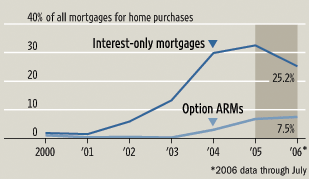
Once the default risk was shifted from government sponsored enterprises to Wall Street, government regulators hit the snooze button. Whenever you go from zero to almost 50 percent of anything (see chart), someone should be paying attention.

In the last few years people have actually come to believe that their home will provide for them, not only in the present (as evidenced by the last few year's $1 trillion in home equity withdrawal), but after they stop working as well.

Mr. Lereah certainly seems to think this way, and as a result millions of homeowners do too.

As it is, coming late to the game after home prices have soared for years, regulating the risky loans that have supported astronomical home prices when millions of homeowners are now counting on these prices to remain astronomical far into the future, well, that just seems like a cruel joke.

Read more...

Introducing a new product, "Insurance"

Thursday, October 01, 2009

[This item first appeared here on September 25, 2006. As usual, just over three years ago, the folks at The Economist were early in sounding an alarm that few heard.]

The boys at The Economist are once again sounding the alarm over hedge funds, derivatives, and now dark matter. No, not the chimerical good will and brand value used by some supply-siders to rationalize away the huge trade deficit - the dark matter in this case is debt. As in the current cover story, The Dark Side of Debt.

There are three stories in the current issue about the new dark matter that is driving the world economy - there may be more than three, as the entire magazine has not yet been reviewed. Surprisingly, all three are in the public area of the website, available to passersby at no charge. The cover story starts the ball rolling, wondering what a low-interest rate world hath wrought.

Thanks to the low cost of debt, private lenders, such as hedge funds, are extending vast amounts of credit to leveraged buy-out firms and other private borrowers. Forsaking the sunlit uplands of global finance, the market for capital is plunging into the shadows.
For the financiers, that is an irresistibly lucrative place to be. In thinly traded, lightly regulated and untransparent markets, the bold can make an awful lot of money—and they can lose it on an even more extravagant scale. A bunch of investors is $6 billion or so poorer this week, after it emerged that Amaranth Advisors, a hedge fund that had some $9 billion under management, suffered catastrophic losses in a few weeks on the back of falling natural-gas prices.
Not usually one to question the prose of others, the "a bunch of investors is poorer" phrase did give momentary pause. It would appear that the staff at The Economist are so concerned about lightly regulated credit creation and leveraged speculation that they're starting to talk like Americans.

The Amaranth blow-up has everyone a bit unsettled these days, many now expecting another hedge fund to drop and who knows what else. From little more than 500 hedge funds in 1990 with less than $50 billion under management, today almost 9,000 shops have been set up to oversee more than $1 trillion.

Are there more Amaranths out there waiting to fess up to their clients about a bet that's gone bad. In the Finance and Economics section of the current issue, this account of the recent Flare-up at Amaranth is provided.
How did it happen? Brian Hunter, the 32-year-old Canadian energy trader, had made a fortune for Amaranth in 2005 when he bet that natural-gas futures would rise and then benefited from surging gas prices after Hurricane Katrina. Last year Trader Monthly ranked him the 29th highest-earning member of his profession, estimating his annual income at $75m to $100m. He was named head of Amaranth's energy-trading operations in the spring. This summer no big storms materialised and the same sort of positions—highly leveraged and insufficiently hedged, analysts say—left the fund exposed to falling prices. Natural-gas futures prices have dropped by two-thirds in the past nine months.

“I've never seen a hedge fund so highly leveraged in energy,” says Peter Fusaro of the Energy Hedge Fund Centre. He reckons that the fund held about 10% of the global market in natural-gas futures. “Somebody was not monitoring this correctly.”

As its losses mounted, last weekend Amaranth quietly summoned a group of investment banks to its Connecticut headquarters to try to sort out the financial mess. With teams from each firm ensconced in separate rooms, officials from Amaranth shuttled between them, seeking to sell off positions, craft bridging loans and possibly negotiate a takeover. By the end of the weekend, enough had been done to prevent panic. Unlike at LTCM, the Federal Reserve did not have to intervene. To help cover its losses, Amaranth also sold a big chunk of its leveraged loans. They were snapped up, mostly by buyers in Europe.
A prerequisite for high leverage is plentiful credit. It's near impossible to make big bets without someone standing behind you, like at a craps table, ready to help you raise the bet with each lucky roll. Sometimes you wonder who's being more reckless, the borrower or the lender.

It is all explained in the feature story Shadows of Debt in which is it learned that even if there were regulators looking after this sort of thing with more than a passing interest, and even if the regulators knew where to look, they still couldn't keep up with the "innovations" that hedge funds and their bankers are driving.
Indeed, the market has changed so fast that regulators are not sure if it is spinning out of control. On one hand, innovations in the credit markets have helped to provide a remarkable period of stability in the world's financial system. In recent years, markets have lived through the end of the internet bubble, the collapse of Enron, the terror attacks of September 11th 2001, debt downgrades in the car industry and a stampede out of risky assets in May and June. Any one of these might once have triggered a financial crisis. But none did.
...
Regulators worry that some of the complex financial instruments conjured up around the lending and borrowing of money—worth trillions of dollars—may sow the seeds of the next financial crisis.
The president of the New York Federal Reserve, Timothy Geithner, can be clearly counted in the worried camp. He's taken notice of the rapidly evolving world of hedge funds and has been speaking out lately. In a speech in Hong Kong last week, he wondered if maybe a few smaller crises would be better than one big one.
"The same factors that may have reduced the probability of future systemic events, however, may amplify the damage caused by, and complicate the management of, very severe financial shocks. The changes that have reduced the vulnerability of the system to smaller shocks may have increased the severity of the larger ones."
Of course people have been warning about this sort of thing for years now and nothing bad has yet happened - surely people just worry too much.

By far, the most dangerous innovations in credit creation in recent years have been the variety of insurance products now offered for sale by hedge funs, many of which promise to make the buyer of the insurance whole again should something bad happen to whatever happens to be the hot speculation of the day.

For years now, credit default and interest rate swaps have beckoned yield starved investors to carry riskier loans and place riskier bets. The simple math of better returns far exceeding the added cost of the insurance has been manna from heaven for both lenders and borrowers - all presumably part of the technology-driven wealth creation that the Chicago Fed writes glowingly about regarding housing, and that applies to other hedge fund activities as well.
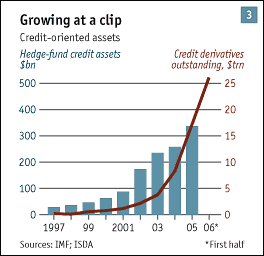
More febrile still has been the popularity of newfangled derivatives with difficult names, such as credit-default swaps (CDSs). These are as complex as they sound. But they are also among the past decade's most important financial innovations—and a cause of both regulatory hand-clapping and hand-wringing. The International Swaps and Derivatives Association said on September 19th that the notional amount outstanding of credit derivatives rose by 52% in the first six months of the year to $26 trillion (see chart 3). That number would be far smaller if banks' positions were netted out for offsetting exposures. But less than a decade ago, the credit-swaps market barely existed.

Credit derivatives, which behave a bit like insurance contracts, allow investors to buy or sell cover against default by a borrower, and the price moves depending on perceptions about the borrower's creditworthiness. Increasingly, they are being pooled into collateralised debt obligations (CDOs), another form of investment vehicle that is growing as fast as a hedge-fund manager's bank balance.

Such products, known as “structured credit”, encourage liquidity, partly because they can be created out of thin air. They also allow banks to sell on the risk of loans turning bad, possibly enabling them to lend more. Robert McAdie, head of credit research at Barclays Capital, says the change has been profound—and for the better. After the dotcom boom, when heavily indebted telecoms firms were on their knees, banks had almost no way to hedge themselves. Now they do: “The use of credit derivatives has totally liberalised the debt market,” he says. “It has created an enormous shift in the risk profile of banks. It allows them to hedge against their risk and manage their regulatory and economic capital more efficiently.”

Hedges and hedge funds
On the other hand, a recent paper by researchers at the European Central Bank says part of the problem with CDSs is that they are used for speculation, as well as hedging. “We have introduced a new product, “insurance”, that appears to be used by people not looking for insurance. It is not the instrument[s] which [are] causing liquidity concerns but the way market participants may be using them.”

On September 11th, in its semi-annual Global Financial Stability Report, the IMF warned that such “structured credit products” were one of its main concerns, especially if financial markets take a turn for the worse and liquidity dries up.

The problem, broadly identified by many regulators, is that not a lot is known about how structured-credit products behave in unusual conditions. Even if they normally mitigate risks, they might suddenly magnify them when financial conditions seriously deteriorate. The products have been developed in a decade when interest rates have been low, the appetite for risk high and liquidity ample. It is easy to assume they are always a benign influence. But it is hard to know how they will react when hard times return.
It all seems almost too good to be true - insurance for speculators. Insurance products that allow individuals and companies to take on as much risk as their models allow using borrowed money to increase their leverage to the extent that their models allow, secure in the knowledge that if something does go wrong, it won't be that big a deal.

A stock market crash, the collapse of Enron, September 11th, junk bonds from GM and Ford, Refco, the emerging market meltdown in May, and most recently plunging energy prices. All of these potential crises turned out to be just another bump in the road - the road to ever greater riches for those willing to borrow money and place a bet, purchasing some insurance just in case.

What could go wrong?

Read more...
IMAGE

  © Blogger template Newspaper by Ourblogtemplates.com 2008

Back to TOP