Wikinvest Wire

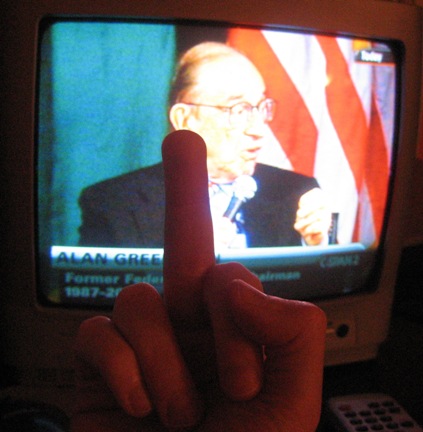
Digitus Impudicus

Wednesday, March 14, 2007

In performing the mandatory minimum of ten minutes of research before offering up more fare here, it is clear that there are lots of people out there with lots of free time on their hands.

Not that there's anything wrong with that.

Going first to Wikipedia for basic background material, a treasure trove of information on the Highway Salute is found.

Then, external references such as The Straight Dope dispelled notions that the gesture had, as its origins, a romanticized 15th century battle between the French and the British.

(Well, romantic except for the part about getting your finger cut off.)

How do you make it onto Wikipedia as one of two subjects asked to demonstrate "the bird"?

What is that second guy wearing anyway? His picture would appear here were it not so disturbing (someone should flag this page at Wikipedia - it is in obvious need of some sort of attention).

This is a photograph that I took of myself performing a one finger solute.

This is me, the author, wearing clothing that I designed and made.

I give permission to copy and use this picture.

Look Mom! I'm on the internet!

None of the above has anything to do with what appears below, save for the digitus impudicus (also known as digitus infamis) itself.

Once again, a relatively long row has been hoed but the payoff is surely worth the effort, the hard work already having been done by Eddy Elfenbein over at Crossing Wall Street.


Eddy is apparently none-too-pleased with all the attention the former Fed Chairman has been getting.

Just wait for the book tour this summer.

Read more...

I Hear Nothing! I Know Nothing!

That's the way it seems to have been in the last twenty years, since Alan Greenspan first sat in the big chair at the Federal Reserve way back in 1987.

Even more so in the last five years.

During his term, the former Fed chairman was much like Sergeant Schultz on the 1960s hit comedy series Hogan's Heroes. Fans will recall that the good-hearted German POW camp guard would invariably look the other way after spotting all sorts of untoward behavior.

"I hear nothing, I see nothing, I know nothing!"

Once in a while a real crisis would develop, but somehow things always worked out.

In a story originating from Irvine, California (aka subprime central), new favorite economist Jim Svinth of Lending Tree wondered why regulators didn't catch on to all the hushed voices and sneaking around over the last few years and acted sooner to avoid the current subprime mortgage mess.

"That horse has left the barn," he commented, adding "the Federal Reserve should have acted three years ago."

It's hard to argue with that assessment or the timeframe.

Early in 2004 would have been an excellent time to have a look at what was going on in mortgage lending. The year before, significant problems were uncovered at both Freddie Mac and Fannie Mae related to derivatives and credit scoring.

The result? At the urging of the Fed chairman, a bigger share of mortgage debt was offloaded to Wall Street. As shown in the chart below and as noted here previously, "three years ago the GSEs were reined in and then the Fed hit the snooze button".


Wall Street firms and mortgage originators began digging tunnels, forging papers, and all sorts of shenanigans followed.

"I hear nothing, I see nothing, I know nothing!"

The Credit Suisse Mortgage Report

The chart above is from the new Credit Suisse paper on mortgage lending, available over at Bill Cara's blog Mortgage Liquidity du Jour: Underestimated No More (.pdf). It is a comprehensive, 67-page accounting of what has happened in the world of real estate finance over the last few years, likely to answer just about any question you might have on the subject.

See pages 52 through 55 for a review of what hasn't happened in the area of mortgage lending regulation - Recent Events May Force Regulators' Hand.

Apparently, back in 2004, it wasn't enough to have short- term interest rates at one percent with U.S. Treasury purchases by the Bank of Japan pushing the 10-year note to about 3.5 percent.

At this same time, mortgage lenders began making "liar loans" in huge numbers. That is, no-documentation and low-documentation loans that make up more than 80 percent of the next mortgage lending trouble spot - Alt-A loans.

What a good time everyone had while home prices rose. Like Sergeant Schultz, many looked the other way including those responsible for regulating the industry.

Now for the bad news - the current subprime mortgage mess is probably just the beginning and all that will be accomplished by new regulation will be to quicken the shakeout currently underway.

Home prices are probably going to go down. Maybe a lot. Here's why.

As noted in the recent report on delinquencies from the Mortgage Bankers Association, the highest rates of foreclosures are occurring in non-bubble states. As noted earlier this week here, the fastest rate of change in delinquencies is now occurring in some of the bubbliest areas.

One possible explanation is that prices have risen so high in bubble areas in recent years that distressed homeowners have still been able to sell and pocket some gains rather than go into foreclosure, though that may be changing.

The foreclosure report was for the fourth quarter of 2006 and if the more recent rate of change in subprime delinquencies is any indication, things are changing very quickly now.

As Mr. Svinth commented, everyone would have been much better off if lenders had been better regulated three years ago.

It looks like Congress is getting ready to do that now.

Read more...

Two Views on the Mortgage Mess

Tuesday, March 13, 2007

Two views on the mortgage mess appear in today's Wall Street Journal (actually there were a few more as the paper now seems to be almost wall-to-wall with news on subprime lending - more than anyone really needs to know, especially about New Century Financial).

The first view of contemporary mortgage lending comes in this report($) on the growing distress in securitized debt. It paints a dark picture of what may lie ahead in the weeks and months to come.

For years, an obscure class of Wall Street investment vehicles has acted like a locomotive in the housing-finance business, driving growth by soaking up risky mortgage bonds and parceling them out to investors around the world.

Now, as mortgage problems mount and a wave of mortgage-bond downgrades looms, these investments, known as collateralized debt obligations, are starting to look like a different vehicle -- rockets overloaded with combustible fuel.

Some big investment banks have been wavering when launching new CDO deals because of problems in the subprime mortgage market, which caters to the least credit-worthy borrowers. The problems also have investors demanding much higher returns on the CDOs they buy, which makes them harder to sell and drives down their prices.

CDOs are an integral part of Wall Street's mortgage dicing-and-slicing machine. After mortgages are written, investment banks pool them together and use the cash flows they produce to pay off mortgage-backed bonds, which the investment banks underwrite.

The mortgage bonds, in turn, are often packaged again into CDOs and sold off in slices. Investors can choose to buy the risky pieces of the bonds or purchase slices with less risk.


Until now, credit rating agencies have been slow to react, prompting the question of whether there will be a broad-based tightening of credit.
To date, credit-ratings companies have downgraded less than 1% of subprime bonds issued in 2006.

But some investors say the woes could mount, particularly for CDOs holding the riskiest mortgage bonds.

"The downgrades of subprime bonds are just starting, and they are going to accelerate," says John Cutting, a managing director at MBIA Asset Management, which invests in and manages some mortgage CDOs.

"In time they'll start triggering downgrades in some of the lower-rated classes of CDOs."
The more optimistic take($) on things comes from the editorial page (surprise!) courtesy of Michael Darda, chief economist at MKM Partners, who probably thinks that subprime lending has been getting far too much attention lately.
Some argue that the problems in the sub-prime mortgage market and manufacturing are only the beginning of a much broader and more intense slowdown that is likely to undermine the labor market and stifle consumption. While the problems in the sub-prime mortgage market shouldn't be taken lightly, mortgage resets are estimated at $10 billion to $15 billion during the next two years -- about 0.1% of nominal GDP and 0.02% of aggregate household net worth. Sub-prime borrowers are mostly households in the bottom 20% of the income distribution, which accounts for only about 8% of total consumption spending.

With broad measures of commercial bank credit and household deposits expanding at a 9.8% and 10.3% annual pace, respectively, and global foreign exchange reserves expanding at a 17% year-to-year pace, it hardly seems that a broad-based liquidity squeeze or credit crunch is on the horizon.
...
As the drags from housing and manufacturing abate sometime later in 2007, it is more likely than not that the economy will return to an above-trend growth rate powered by strong consumption (via a tight labor market), strong global growth (exports) and a pickup in capital spending (thanks to record profits and still-tight credit spreads).
It's probably a safe bet that with Hank Paulson at Treasury and Ben Bernanke at the Federal Reserve, liquidity is not going to be a problem.

Finding qualified borrowers might be.

Read more...

Inflation, Zimbabwe Style

With two important reports on inflation due later this week, a look at some recent developments in Zimbabwe might be useful, just to put rising prices in the U.S. into better perspective - to see what the worst case scenario might look like.

As you'll recall, Zimbabwe is a South African nation currently experiencing "hyperinflation". According to Wikipedia, after hundreds of millions of dollars were spent on a recent war and efforts to develop a market-oriented economy were abandoned, inflation has skyrocketed from an annual rate of 32 percent in 1998 to a high of 1,730 percent just last week.

With an unemployment rate of 80 percent, President Robert Mugabe blames foreign governments for meddling, while the international community argues that the country's difficulties stem from Mugabe's controversial program to seize land from white farmers.

For ordinary citizens, the turmoil has real consequences.

Late last month came word that life for young Nelson Banya is full of challenges, not the least of which is figuring out how much things will cost with each new day. Not to be confused with The Economist's Big Mac Index (where, curiously, the Zimbabwe currency does not appear) Nelson finds a "Lunchbox Index" to be a useful indicator of declining purchasing power.

Last August, when the central bank introduced new banknotes, having lopped off three zeros, 1,000 Zimbabwe dollars could provide a decent packed sandwich; a couple of slices of bread, some eggs and even a slice of ham on good days.

Now 1,000 Zimbabwe dollars will buy only two eggs. Bread, which cost about 250 dollars 12 months ago, now costs 1,000 dollars.

Cash machines have stopped dispensing 1,000 dollar bills and now issue 10,000 dollar notes.

The bundles of banknotes keep growing. Where 100,000 dollars would go a long way in meeting my grocery needs for a month last August, I need five times that amount now.
Amid high unemployment, demand appears to be strong for one job - grocery store clerk. It seems that changing prices tags on a daily basis keeps many of them from restocking shelves.

In this story from earlier this month, the government announced that new bills were being put into circulation to help combat the inflation.
Zimbabwe's central bank introduced two new bank notes on Thursday as it battles a four figure rate of inflation that is rapidly eroding the value of the local currency.

The new 50,000 dollar note, worth around 200 US dollars, and the 5,000 bill are the latest additions to a series of temporary notes that were introduced three years ago to ease critical cash shortages.


The temporary notes are only valid for a short period of time. The current ones expire in July.

The central bank said in an advert placed in the local press that it was "introducing the new 5,000-dollar and 50,000-dollar bearer cheques from March 1, 2007 for your convenience."
Lopping off zeros from the currency failed to achieve the desired objective of halting price increases. Similarly, issuing larger denomination notes helped to alleviate back strain while lugging around cash, but has no other discernible impact.

A two month strike by doctors recently came to a peaceful conclusion. This report from the LA Times details how the government reached a deal with doctors, nurses and paramedics to boost their wages to help them keep up.
Government doctors stopped work in December, demanding an 8,000% wage increase, with the government offering a 300% hike.

Before the strike, state doctors earned currency worth about $224 at the official exchange rate but about $7 on the black market.

The president of the Hospital Doctors Assn., Kuda Nyamutukwa, confirmed that doctors had agreed a pay deal with the government but declined to give details of the new wages.
...
Analysts have warned that rising discontent over the economic meltdown in Zimbabwe could trigger street protests against Mugabe's government.
Well, it's probably going to get worse than just street protests.

Yesterday, The Economist reported that those opposing Mr. Mugabe are being tortured and beaten as the economy "sinks deeper into the mud".

Throughout all of this, the Reserve Bank of Zimbabwe continues to operate. Their website appears to be in working order and reports are available to get a better feel for how monetary policy is being conducted.

In fact, the central bank recently released their semi-annual monetary policy statement that anyone can download and have a look at. Here's one of the more interesting charts.

Annual Inflation Profile (Jan. 04 - Dec. 06)

The report is an interesting read. Bankers state their current condition in a very matter-of-fact way, discussing the challenges ahead and ways that progress can be made.

Some are predicting that inflation will get worse before it gets better - 4,000 percent is the figure now frequently mentioned.

Read more...

Central Valley Subprime Smashup

Monday, March 12, 2007

Those of you who live in California's Central Valley or drive through there on the 99 freeway can surely appreciate the impact that the unraveling of subprime mortgage lending is going to have on prices for all those newly built homes, clearly visible from the freeway.

This story($) in today's Wall Street Journal had the following graphic showing a total of five California communities with delinquency rates that are increasing rapidly.


Ranked by percent of loans in default, East Coast communities are ahead by a wide margin, but the bubble started there many months before it did in California.

Prediction: the Golden State will quickly narrow the gap.

Not being familiar with the areas of Massachusetts or New Hampshire indicated above, it's not known whether a similar pattern exists there, but in California, the map looks like this:


It would be a reasonable guess that Fresno, Visalia, and Bakersfield are not far behind those areas already circled in red.

The text of the story seems to be just more or the same subprime news that everyone's been hearing for the last two months. Surprise! Some economists are optimistic.

As more financially stretched homeowners renege on their debts, and mortgage lenders go under by the dozen, economists are surprisingly sanguine about the broader economy's ability to weather the storm. But they add a big caveat: Much depends on how investors react to an increasing wave of worrying news, and how much some homeowners' difficulties aggravate the nation's deep housing slump.

By all accounts, the market for "subprime" mortgages -- home loans made to people with poor or sketchy credit histories -- has unraveled with impressive speed and intensity. In some parts of California, the proportion of seriously delinquent subprime loans has quadrupled in the past year to about one in eight, according to data provider First American LoanPerformance. In the past month, subprime lenders have run into serious trouble or shut their doors at a rate of about two a week.
...
So far, though, many economists -- including Federal Reserve Chairman Ben Bernanke -- haven't changed their forecasts as a result of the subprime troubles. Some see the sharp rise in defaults among riskier borrowers as a natural, albeit acute, symptom of the housing slump that began in late 2005, rather than a separate ailment in itself. With house prices falling, consumers who got no-money-down mortgages with the help of loose lending standards, have little to lose by walking away from their homes and debts.
...
Ethan Harris, chief U.S. economist at Lehman Brothers in New York, estimates foreclosures in the subprime market could bring an additional 15,000 to 20,000 homes on to the U.S. market every month starting next year.

The pain could be particularly acute in frothy markets such as California and Florida, and in depressed places such as parts of Ohio and the auto-producing areas of Michigan. In some areas in and around Detroit, Cleveland and Atlanta, subprime loans make up more than half of all mortgage loans outstanding, according to First American LoanPerformance.

"In some of these regions you could have a pretty tough environment, in which a bad local economy, tightening credit and weakening home prices all kind of reinforce each other," says Mr. Harris.
Anyone passing through these areas will notice that all the billboards are still there, pitching the American dream of homeownership to anyone who wants it.

Stop throwing away your money on rent - you could be in a brand new home now!

Bad credit - no problem.

No money down - no problem.

Until now.

Read more...

Even Reader's Digest Hates Realtors

The popular family magazine with a circulation of 10 million, better known for reader-submitted jokes and book excerpts, can now be added to the growing list of organizations and individuals where the real estate profession is despised.

According to this story in the February issue of Reader's Digest, it's because the system is rigged.

Real Estate Ripoff
by Michael Crowley

Last fall, Marjorie Deprez decided that she didn't need a traditional real estate broker to sell her Chappaqua, New York, home. After all, she had bought the house as an investment and wanted to maximize her profit any way possible. So she paid an online discount broker a flat fee of just under $1,000 to list her home on the Internet.

Deprez would handle everything else. She'd pay the buyer's agent a 2.5 percent commission but save on the usual seller's commission -- in this case, about $25,000.

Smart idea, except when she held an open house for brokers, only a few showed up. When Deprez joked with one of them that she'd been blacklisted, the agent replied, "Who told you?" To Deprez's amazement, she was then informed that a local real estate executive had been calling brokers and urging them not to show her house.

Sure enough, Deprez got very few nibbles, even though her house was priced to sell quickly. Frustrated, she finally took her home off the market.

"It was an organized boycott," says Deprez, who reported her experience to the New York Attorney General's office. Put another way, it was a case of insiders rigging the system to protect their sweet deal. In a traditional home sale, the brokers for the buyer and seller split a commission that usually amounts to around 5 to 6 percent of the sale price. This broker fee doesn't just hit the seller's wallet; the buyer pays more because the commission gets built into the price of the home.
...
Nothing is more important to real estate cartels than controlling the Multiple Listing Services (MLS), the databases of homes for sale. Real estate websites often allow home-buyers to peruse local MLS listings on the Internet. Yet they sometimes censor or omit listings sponsored by a discount broker. And many established real estate agents won't allow their own listings to appear on a discount broker's site. That spiteful move led the U.S. Justice Department to sue the National Association of Realtors (NAR), the industry's ultra-powerful lobbying group, for allowing members to discriminate against Web-based brokers. (The Justice complaint is expected to take years to resolve.)
...
The industry's muscle is no surprise when you consider that the NAR contributed more money to candidates in federal elections last year (almost evenly split between Democrats and Republicans) than any other donor, even ahead of the trial lawyers and teachers unions. In fact, the NAR has been the biggest donor to these campaigns every year since 1997. At the state level, the National Institute on Money in State Politics says the real estate industry contributed $43 million to campaigns in 2006.
...
No one says that brokers can't make a buck like everyone else. But they shouldn't be allowed to rig the system at our expense.
If the nation's housing market wends its way to what many think will be a rather unpleasant conclusion in the next few years, don't be surprised to see Congress balk at taking contributions from the NAR and Gallup pollsters add a new category to their popular survey of honesty and ethics by profession.

The most recent poll provides no category for the real estate sales profession - realtors, with or without the capital "R" or the trademark, are noticeably absent. (Note that engineers rank just above priests, though it's not clear if that's a good thing or not, and, on second thought, no one should count on Senators or Congressmen refusing NAR contributions - these people can't be trusted either).

They'll probably want to add a new category for mortgage broker while they're at it. From the anecdotal reports heard over the last few years, both new categories should fall somewhere right in there with elected officials, between stockbrokers and car salesmen.

Well, maybe mortgage broker will be below car salesmen.

Read more...

An American Hero

Sunday, March 11, 2007

An increasing amount of mail is directed this way when Alan Greenspan pops up in the news, something that appears to be happening with frightening regularity these days.

This was once referred to as something like the movie Groundhog Day, where, day after day the same events unfolded (i.e., waking up to find new links from readers about the recent exploits of the former Fed chairman).

With his memoirs set for publication this fall, this condition is likely to get worse before it gets better.

[On a related note, understanding that the name of this blog can not endure forever, alternatives are being considered. The name www.BadMacro.com has been reserved for possible future use. Any thoughts on this would be appreciated.]

Anyway, this link was forwarded a day or two ago where it was learned that Stocks, Futures, and Options Magazine is about to anoint the departed Fed chairman an "American Hero" for 2007.

A bit premature perhaps, as 2007 is still quite young...

Had the group checked their calendar, they would have realized that there are almost ten months to go in 2007 and, if the current state of affairs in subprime lending is any indication, this award may look a little silly when the budding leaves currently developing begin to drop from trees this fall.


Alan Greenspan, who was Chairman of the Board of Governors of the Federal Reserve from 1987 to 2006, was one to whom the famous phrase from the E.F Hutton ad resoundingly applies: When he talked, people listened. In fact, the talking heads on CNN et al. (not to mention heads of global financial institutions) spent hours parsing his sentences for clues to Fed policy. He was famous for giving speeches that were difficult to interpret but fraught with meaning—he once mocked himself for this trait, telling a U.S. Senate Committee in 1987, “I guess I should warn you, if I turn out to be particularly clear, you’ve probably misunderstood what I said.”

Greenspan is seen as more than a brilliant, perceptive and trusted Chairman of the U.S. Federal Reserve Board, which oversees the Federal Reserve Bank – a private corporation chartered in 1913 by Congress and then-President Woodrow Wilson to service the nation’s banks. He remains to this day an icon, something of a sage or oracle.

He presided over the greatest period of economic expansion in U.S. history, bringing a previously erratic economy under control and stabilizing it. He was frequently called “a steady hand on the tiller of the ship of interest rates.” During his unprecedented, five-term tenure as Fed Chairman, comparable only to the stewardship of William McChesney Martin Jr., who served in the role from 1951 to 1970, he was the most influential economic figure in the world.
...
Largely responsible for directing U.S. national monetary policy, in essence, Greenspan was the face of American capitalism. Twice a year, he presented Congress with his assessment of America’s economic status, and millions around the world tuned out everything else to hear each word.
...
He brings out effusive praise from many who know him. Senator John McCain said in 1999, when running for President, “I would not only reappoint Mr. Greenspan, but if Mr. Greenspan should happen to die, God forbid – I would do like they did in the movie ‘Weekend at Bernie’s.’ I’d prop him up and put a pair of dark glasses on him and keep him as long as we could.”

SFO has chosen to honor Mr. Greenspan as an “American Hero,” at the magazine’s annual luncheon at the Futures Industry Association Annual International Conference in Boca Raton, Florida, on March 15.

SFO Publisher, Russell Wasendorf Sr., said: “For our American Hero series we choose people from varied sectors of life. We have had a military leader, a philanthropist, and a representative of the media and journalism. Dr. Greenspan, as the voice of the Federal Reserve and the face of capitalism, is heroic for his advocacy of America’s beloved free market system and as a leader who has served this country with integrity, foresight and dexterity in the field of economics.”
Hat Tip to Gary M. for forwarding this story.

ooo

Another double-shot of cartoons from The Economist, the first one featuring you-know-who.


Read more...

IMAGE

  © Blogger template Newspaper by Ourblogtemplates.com 2008

Back to TOP