Wikinvest Wire

How Do We Get Out of This Alive?

Monday, August 29, 2005

You can get a pretty good feel for the general mood at the Kansas City Fed's annual central bank symposium held over the weekend in Jackson Hole, Wyoming just by scanning the headlines of the articles that were written. Links to most of these appeared in yesterday’s post.

During a conference with a theme of "Greenspan's Legacy", many headlines contained phrases such as "problems await", "economic risks", "if the bubble bursts", “uncharted waters”, and “market trauma” among others. This seems to indicate a real sense of unease on the part of many writers filing stories related to this event.

Looking through these articles, and counting Paul Krugman’s late entry on Sunday, there were a total of four headlines which included the word “bubble” - one from the L.A. Times, two from Bloomberg, and Krugman’s editorial which appears in today’s N.Y. Times.

In the fifty articles in yesterday’s list from major news reporting organizations (i.e., everything from the group of Reuters stories at the top, down to the one from Investors Business Daily) there were 128 instances of the word “bubble”. That’s about two-and-a-half instances per story, with the heaviest concentration in the N.Y. Times, L.A. Times, and Bloomberg stories. Interesting. A quick scan for the word “burst”, revealed 18 instances. Also interesting.

Like the conference itself, many of the stories focused on the legacy of Alan Greenspan.

All of these stories included words of praise for the sustained economic growth and low inflation experienced during this time, but they also included unanswered questions about what will become of the housing bubble and how it will affect the rest of the economy. Most telling of these legacy articles is the one by long-time Fed watcher Greg Robb of CBS MarketWatch where he chose to end his piece with a quote which is the title of this post (see excerpt below).

We are working on our own story about the Greenspan legacy - more on that later this week. In the meantime, here are some selected excerpts from the reporting over the weekend:

Reuters - Glenn Somerville
Fed eyes asset-price rises closely-Greenspan

"Such an increase in market value is too often viewed by market participants as structural and permanent," said the 79-year-old, who is due to step down as the U.S. central bank's chairman at the end of January.

"To some extent, those higher values may be reflecting the increased flexibility and resilience of our economy," he said.

But he added "newly abundant liquidity can readily disappear" if investors grow wary for some reason and demand a higher risk premium for lending.
New York Times - Edmund L. Andrews
Greenspan Says Housing Boom Is Nearly Over
He also acknowledged more strongly than before that the housing boom, which has been fueled in large part by the Fed's own decision to prop up the economy with low interest rates, is closely tied to the nation's soaring trade deficit and its record level of foreign indebtedness.

But Mr. Greenspan also seemed intent on defending his legacy against critics who say his policies contributed to the United States' imbalances, which could lead to higher interest rates and potentially wrenching declines in housing prices and consumer spending.
Los Angeles Times - Bill Sing
If 'Bubble' Bursts, Legacy of Greenspan May Deflate
But the final chapter of Greenspan's legacy might be based on how well the central bank manages what many experts say is a crisis looming on the horizon: a housing bubble.

Many experts say the nation's real estate market draws disturbing similarities to stocks in the late 1990s — a market driven to unsustainable price levels by what Greenspan famously called "irrational exuberance." They fear a similar ending: a sharp fall in prices that could bite the net worth of many Americans and trigger a recession.

And some experts say Greenspan deserves at least some of the blame for fostering housing market conditions that the Fed chairman himself has called "frothy." The Fed, they say, hasn't done enough to damp real estate speculation, while maintaining cheap credit for too long.
CBS MarketWatch - Greg Robb
The measure of the chairman
Many economists think Greenspan made a policy mistake by accommodating and even encouraging asset bubbles that developed in the stock market and later in the housing market. Greenspan has argued that the policymakers can't know it's a bubble until after it has burst and can only then react to it.
...
"Greenspan should weigh against asset markets in the good times -- just as he works to support them in the difficult times. He's been one-sided in his policies," said Zandi of Economy.com. Investors sense this and act on it, Zandi said.

In the current environment, the housing sector has been immune to the Fed rate hikes to date. Home prices have risen steadily and many consumers have been borrowing against this price appreciation. "The Fed has never said this borrowing is a mistake and that this is a problem," said Brusca of FAO Economics.

Many say the final assessment of Greenspan's tenure as Fed chairman will not be written until it is clear how the possible housing market bubble is resolved. Some economists said the Fed should "unleash the regulatory machinery" to rein in excesses in the mortgage and housing markets.

Economists are worried that low savings rate and the possibility that a sharp decline in housing prices could make the next economic downturn more severe.

"The question is, how do we get out of this alive?" said Robert Dederick, president of RGD Economics in Hinsdale, Ill.

At the moment, the only answer is that we'll have to do it without Greenspan.
Prudent Bear Credit Bubble Bulletin - Doug Noland
The Greenspan Era: Lessons to be Learned
No discussion of Greenspan’s possible legacy will stand the test of time without addressing the momentous financial sector developments nurtured under his watch. Ultimately, I expect that he will be judged most by the success or failure of the Financial Sphere he cultivated, sustained and endorsed. Curiously, I have yet to read or listen to any comments regarding the unprecedented buildup of debt under The Greenspan Regime. He has operated for too long as undisputed Master and Commander of what has evolved into today’s massive and unwieldy global pool of speculative finance. Disconcertingly, his impending exit will coincide with increasingly vulnerable U.S. Mortgage Finance and Credit Bubbles.

Read more...

Greenspan Overload

Sunday, August 28, 2005

Someone's been in the news over the weekend ...

From the Central Bankers
Remarks by Chairman Alan Greenspan - Reflections on central banking
Remarks by Governor Donald L. Kohn
Monetary Policy and 'Credible Alertness' - Jean-Claude Trichet
Remarks by Chairman Alan Greenspan - Closing Remarks

Reuters - Glenn Somerville
Fed eyes asset-price rises closely-Greenspan
Rubin: problems await Greenspan successor
Greenspan heir must replace 'one-man band'-Blinder
Greenspan: end of housing boom inevitable
Markets should heed central banks-Kohn

Associated Press - Jeannine Aversa
Greenspan: Investments Won't Soar Forever
Greenspan Confident About His Successor
Greenspan: Housing Market Will Cool Off
Crisis Management Is Greenspan's Specialty
Greenspan issues warning

Washington Post - Nell Henderson
Jackson Hole Symposium -- 2005 Program
Rocky Mountain High Finance
Paper: Understanding the Greenspan Standard
Rubin Praises Stance Of Greenspan on Deficits
Greenspan Confident About Successors
Greenspan Cites Economic Risks For Consumers

New York Times - Edmund L. Andrews
The Doctrine Was Not to Have One
Greenspan Warns That Economic Risks Remain
Greenspan Chides Investors
Greenspan Says Housing Boom Is Nearly Over

Los Angeles Times - Bill Sing
If 'Bubble' Bursts, Legacy of Greenspan May Deflate
Fed Chief Warns on Housing Costs
Fed Chief's Comments, New Data Hit Stocks

Bloomberg - various
Ready for the Greenspan Hosannas? Here's Mine: Caroline Baum
Asset Bubbles or Bust -- What's the Fed to Do?
Greenspan Fans at Jackson Hole May Differ on View of Bubbles
U.S. Treasuries Fall on Greenspan Speech; Yield Curve Shrinks
Greenspan Successor May Limit `Explicit' Guidance, Study Says
Greenspan Says Housing Boom to `Simmer Down,' Prices May Fall
Fed's Kohn Defends Communicating Interest Rate Moves
Greenspan Says Fed Paying Attention to Asset Prices

CBS MarketWatch - Greg Robb
The measure of the chairman
Next Fed chief faces uncharted waters
Housing Boom is an Imbalance: Greenspan
Bernanke, Hubbard, Feldstein or ?
Oil prices biggest risk, Sinai says
Greenspan keeps secrets of success
Housing boom will 'simmer down'
Greenspan to have succession role

CNN/Money - Kathleen Hays
Greenspan: Hero? Or goat?
Greenspan: Rein in risk
Greenspan: Risks from deficits, housing

Financial Times - Andrew Balls
Greenspan warns on impact of asset prices
'Market trauma' warning when Greenspan goes
Greenspan warns on dangers in US housing market

Dallas Morning News - Danielle DiMartino
Greenspan Cites Warning Signs

Times Online - Graham Searjeant
US heading for house price crash, Greenspan tells buyers

U.S. News - Paul J. Lim
Greenspan's tenure: From bust to bust?

San Francisco Chronicle - Alan T. Saracevic
The real power guys -- Greenspan decipherers


Investors Business Daily - Kirk Shinkle
Greenspan Offers Cautious Outlook, Concerns On Debt

Prudent Bear Credit Bubble Bulletin - Doug Noland
The Greenspan Era: Lessons to be Learned

New Economist
Papers from the August 2005 Jackson Hole symposium
Dean Baker slams Greenspan's record

Economist's View
Greenspan Sums It Up
Fed Watch: Forecast Calls For More Rate Hikes
Robert Rubin Praises Greenspan’s Opposition to Deficits
Greenspan’s Closing Remarks

macroblog
The Top Ten Things We Have Learned From Alan Greenspan...

MaxSpeak, You Listen
GREENSPANFEST ’05: BE GLAD YOU WEREN’T INVITED


Read more...

Dumb Things Said by the Fed

Friday, August 26, 2005

The Federal Reserve's wild weekend in Jackson Hole starts today. There will be lots of parties and late night antics to be sure. Loud and unruly economists stumbling through hotel lobbies in the wee hours, up to their rooms for some pre-dawn hanky panky with no consideration for other hotel guests in adjacent rooms.

Then finally trying to get a couple hours of sleep before showing up at the morning conferences bleary eyed, still reeking from the night before - winks, nods, and hand signals to each other as they sit there fidgeting, feigning interest in what another speaker is prattling on about, all the while planning more sordid fun for the rest of the day.

Or, maybe not.

While waiting to hear what will be said by the Fed in Wyoming this weekend, we look back at some of the things they have said in recent years - some of the dumber things that have come out of the mouths of Federal Reserve board members. We don't have to look back very far.

Michael Moskow, President of the Federal Reserve Bank of Chicago
August 25, 2005

"Moskow said mortgages such as interest-only loans and other specialized floating-rate products that hold down initial payments but are vulnerable to rising interest rates are generally good for the economy. That's because they've opened up home ownership to more people. That said, he emphasized that the Fed has felt it necessary to warns banks of added risks with these loans."
So, getting someone into a house that they couldn't otherwise afford by using risky loan products, with terms that the borrower probably doesn't really understand, is good for the economy? Yes, in the short-term this bids up housing prices which makes more people want to buy houses because the prices are going up - this creates construction and real estate jobs. Other people feel wealthy because housing prices are going up, and these people borrow against their homes and spend money, which adds to GDP. An excellent plan for the short-term, but what about the long-term?

Robert McTeer, President of the Federal Reserve Bank of Dallas
February 2, 2001
"The way Robert McTeer sees it, there's nothing wrong with the economy that couldn't be fixed with a little more consumer spending. 'If we all join hands together and buy a new SUV, everything will be OK,' said the president of the Federal Reserve Bank of Dallas."
Let's see, the average price for a gallon of regular gasoline in the years since this advice was offered was $1.38 in 2001,$1.31 in 2002, $1.52 in 2003, $1.81 in 2004, and $2.10 in 2005. On Tuesday, the national average was $2.58. So, not a bad suggestion really ... for about year. After that fuel costs for your gas-guzzling SUV would have risen dramatically, having almost doubled as of just a few days ago. There's that poor long-term thinking again - pretty dumb when you look at it today.

Alan Greenspan, Chairman of the Federal Reserve
February 23, 2004
"Indeed, recent research within the Federal Reserve suggests that many homeowners might have saved tens of thousands of dollars had they held adjustable-rate mortgages rather than fixed-rate mortgages during the past decade, though this would not have been the case, of course, had interest rates trended sharply upward.

American consumers might benefit if lenders provided greater mortgage product alternatives to the traditional fixed-rate mortgage. To the degree that households are driven by fears of payment shocks but are willing to manage their own interest rate risks, the traditional fixed-rate mortgage may be an expensive method of financing a home."
Yes, when rates go down, you can save lots of money. In that case, adjustable rate mortgages are great - far superior to fixed rates. But when rates go up, then you'd rather have a fixed rate. Guess what? Short-term rates started going up just a few months after this speech and there is no indication that they will stop rising anytime soon. That's why people like fixed rates. And, that part about households that "manage their own interest rate risks"? That whole idea is pretty dumb considering the surprising number of households that don't even understand what interest is.

July 20, 2005
And, indeed, since the late ’70s, central bankers generally have behaved as though we were on the gold standard.
This behavior must be occurring in some parallel universe somewhere, or maybe the reference is relative. Like, compared to the central bankers in Zimbabwe, we have generally behaved as though we were on the gold standard. We don't see any gold standard like behavior from our central bankers. All we see is a money and credit explosion for the last two decades, the likes of which the world has never seen. When they write the history books, it is unlikely they will refer to monetary policy during this era as being like the gold standard. This was just dumb.

Ben S. Bernanke, White House Chief Economist (former Fed Governor)
November 21, 2002
Like gold, U.S. dollars have value only to the extent that they are strictly limited in supply. But the U.S. government has a technology, called a printing press (or, today, its electronic equivalent), that allows it to produce as many U.S. dollars as it wishes at essentially no cost.
This was in reference to fighting deflation and how central banks can always create inflation if they need to. It may not sound all that dumb to most people today, however, it has the potential to be the all-time dumbest thing any central banker has ever said, if, in the coming years, the housing bubble goes bust and a new Fed Chairman looks to inflate another asset class to mitigate its fallout.

Your Recollections

We've really just scratched the surface here. Surely there are many, many more dumb things that Federal Reserve Board Members have said in recent years. Readers are encouraged to cite their favorites in the comments section.

Read more...

When Confidence Fails

Thursday, August 25, 2005

For the better part of three years now, we have seen the impact of the fearless and resilient American consumer. Given access to abundant and easy credit, and encouraged by a host of government and business officials, the American consumer has supported not only the U.S. economy but also the world economy. We have wondered for some time now, just how long this can go on, when and how the borrowing and spending might slow, and what the fall-out might be.

We may start getting some of these answers at around the end of the year.

Some argue that the borrowing and spending never has to stop, that debt and deficits don't matter. We will see. It seems that in the long run, debt and deficits do matter, or at least they should - that it's really just a matter of how long the long run really is. Surely, it is not nearly as long as it was when the nation first charted this course of debt and consumption during the Reagan administration, guided by the steady hand of Fed Chairman Alan Greenspan.

Stephen Roach frequently refers to the American consumer as "savings-short" and "asset-dependent". It seems many are hooked on easy credit, low monthly payments, and rising asset prices. The rising asset prices enable more credit, which in turn enables continued consumption, and all the while many believe that this is just the way that things work, that somehow Americans are special.

At the same time that they borrow and consume, the American consumer maintains supreme confidence in the fundamental soundness of the economy. Unwavering confidence in the rightness of what they do and the ability to continue doing it.

But the vast majority of American consumers do not look beneath the surface. They have not the time, inclination, or in many cases the ability to scratch at the shiny exterior - to question what they are told about our collective economic well-being. They do not wonder about low unemployment rates when jobs seem scarce, they feel comfortable with the levels of debt they carry because they are told that it is OK. They do not question the official economic statistics and pronouncements. Perhaps too many people have too much confidence in our economy, and maybe we are all a bit too giddy about the rising value our homes.

It is natural to wonder how easily this confidence might be shaken, or what would happen when confidence fails.

We don't make predictions here - we learned our lesson a few years back when assessing the prospects of the U.S. economy in the aftermath of the bursting of the stock market bubble. We were little aware of the lengths to which central banks, government fiscal policy, and lenders would go to inflate another asset bubble, which by most accounts is much more dangerous than the one it replaced.

Absent predictions, we simply note an intriguing set of events and trends, all of which seem to be converging in time at around the end of the year. These events and trends have the potential to shake the confidence of the American consumer like it hasn't been shaken in quite a while. The fundamental soundness of the economy may be brought into question.

Today we mention these events and trends briefly (in no particular order). We will return to this list, filling in details as necessary over the coming weeks and months.

Derivatives

We mention this first only because of this news yesterday. It is not clear what this all means, but if Warren Buffet calls interest rate derivatives "financial weapons of mass destruction", and now there is concern that "the $8.4 trillion industry is rife with unconfirmed trades", there is potential for disaster. If memory serves, back during the LTCM meltdown, it was several months before details of the LTCM problems became public - yesterday's news may be the beginning of the derivatives disaster of which Mr. Buffet warned, and the full impact may not be known or understood until closer to the end of the year.

Rising Home Inventory and Stalling Home Prices

Inventory continues to build, while volume declines, and prices continue to rise - an indication of the early stages of a stalling real estate market. The yellow line that is the San Diego year-over-year change to median home price will get very interesting in the next few months. On it's current trajectory, it will cross the x-axis of the second graph sometime around November. This should get the attention of most everybody in Southern California, and may dramatically alter the ingrained belief of many that real estate is a safe investment. There are some other aging real estate bubbles around the country which may experience similar trends - San Diego is closest to home, so we follow that one closely.

The New Bankruptcy Bill

The recent rise in bankruptcy filings and the potential for a mad rush to file for bankruptcy in October could have a chilling effect on the confidence that many people have in managing their debt. Many of the provisions of the new law take effect on October 17th and in the coming months there will be a stepped up campaign by bankruptcy professionals on afternoon television and radio to compel individuals to take advantage of this last opportunity to clean up their balance sheet without the pain that will be involved after October 17th.

Rising Oil and Gas Prices

With oil now at $67 a barrel, it may be only a matter of time before economists will no longer be able to calm people's fears by saying that "on an inflation adjusted basis, oil prices would need to hit $90 a barrel to match what they were 25 years ago". With the supply/demand fundamentals that exist today, if there is a supply shock, then $90 oil could become a reality rather quickly. That would translate to about $3.50 per gallon for regular gas , with no assurances that prices would stop there. Without a supply shock, the price of oil may make it to $90 by the end of the year anyway. After a few more months of high gas prices, people may begin to question their consumption habits rather than just shake their heads when they fill up.

Politics and War

Thankfully, these topics are not covered on this blog. We feel obligated to mention them, however, since they have tremendous potential to influence consumer confidence over the course of the next six months.

Higher Short Term Rates

Like the recent rise in gas prices, the rise of short-term interest rates has been like a slow and steady water torture for borrowers servicing home equity lines of credit and other revolving debt. Or perhaps, the better analogy is the boiled frog. Rising short term rates have affected adjustable rate mortgage rates as well, but sadly, it appears that today's wacky lending practices are not nearly as interest rate sensitive, at the margin, as they once were. However, with the Fed Funds rate likely to be at either 4.0% or 4.25% by January, this will have some impact on debt service and home loans in the coming months.

Greenspan Retirement

Maybe the most significant of all trends or events over the next six months is the transition from Alan Greenspan to a new Fed Chairman, scheduled for the end of January. If the White House takes the same approach with this appointment as it has with some others, markets and consumer confidence are sure to be rattled. But, even if the transition goes smoothly, there is still great potential for danger. It was only weeks after Paul Volcker stepped down in 1987 that the Dow dropped precipitously, some 22% in a single day, only to recover gradually and steadily over the following months and years under the watchful eye of the new Fed Chairman. There is a big difference, however, between 1987 and 2005.

Read more...

Cashiers at Wal-Mart

Wednesday, August 24, 2005

Having recently posted a series of three articles on the quality of the jobs created in America over the last few years (see here, here, and here), we paid close attention to this story last week about how 11,000 people applied for 400 positions at the new Wal-Mart in Oakland.

A bit too weary of the entire jobs dilemma to comment on it at the time, after almost a week, the story has not left our thoughts.

We continue to think about the irony of it all. By the millions, men and women make the long journey from rural areas in China to densely populated cities in the hope of securing manufacturing jobs paying less than 50 cents per hour. At the same time in Oakland, by the thousands, men and women make the short trip over to the new Wal-Mart in the hope of securing retail trade jobs paying 20 times that amount.

The products sold in Wal-Mart first pass through the Chinese hands of factory workers half way around the world. They then go into boxes, onto ships and trucks, and onto store shelves where they are selected by the end-consumer. Before beginning the final leg of their journey, these products pass briefly through the American hands of cashiers at Wal-Mart.

"I needed a job ASAP, and they had their doors open," said Virginia Ford, 19, of Oakland, who had applied for 25 jobs in three months before she landed one as a cashier at Wal-Mart in Oakland on Tuesday.
It is unlikely that Virginia sees the irony. She's just happy to have a job.
Stephen Levy, an economist for the Center for Continuing Study of the California Economy, said the pent-up demand for work reflects the Bay Area's slow recovery from the dot-com crash ... ""It's not about Wal-Mart -- it's about the rest of the labor market," Levy said. "If the rest of the labor market was strong, you wouldn't have 11,000 people applying for 400 jobs."
Stephen probably doesn't see the irony either. It sounds as though Stephen is close enough to the problem of job creation in America that irony such as this would be the furthest thing from his mind. He and a growing number of economists are increasingly concerned that there are serious problems with the quantity and quality of jobs being created in the last few years - despite what the government statistics indicate.

What the government statistics indicate in this case is quite peculiar indeed. Per the 2002 census data, there are a total of 1,461,000 people in Alameda county, of which about 950,000 are between the ages of 18 and 65. With a reported unemployment rate of about 5%, this would mean that there are less than 50,000 unemployed individuals in the county, and 11,000 of them applied for jobs at Wal-Mart!

Now, you can do the math any way you like, for example, including nearby counties or considering a different proportion of the total population, but the fact remains - 11,000 job applicants (as reported by Wal-Mart) and low unemployment (as reported by government statistics) can not both describe what happened at Wal-Mart.

Of course, we can offer no solutions to the problems of job creation in America. We just think it would be nice if policy makers could come up with something better than the current approach to job creation. The current approach, that is, of using ultra-low interest rates and ultra-loose lending standards to enable a dangerous housing bubble, which then creates a small number of housing related jobs, but which more importantly makes enough homeowners feel "wealthy" enough that many of them will borrow against their homes to aid in their continued purchase of imported goods from China at stores like Wal-Mart, thus creating more low-paying jobs at retailers like Wal-Mart.

Read more...

The Housing Bubble Poster Boy

Tuesday, August 23, 2005

Meet Chris Cowen.

In another era, he would probably be doing something entirely different at this point in his life. But, having found himself in the middle of the biggest credit and debt orgy ever created by man, he is seizing the opportunity with which he has been presented, and he is buying condos. Lots of them.

He's racked up some hefty gains so far. Why not?

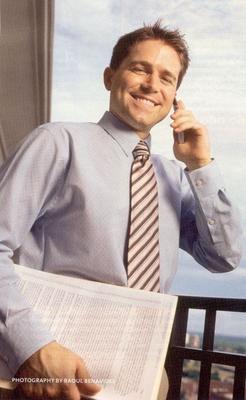
At the spry young age of 32 years, Chris Cowen graces page 57 of the September issue of Money Magazine, the lead character in this story about how so many people have gone Cuckoo for Condos! Here he is working on another real estate deal, managing a portfolio of investment properties, which has been growing in value at an astonishing rate.

Cell phone at the ready, legal documents in hand, and with a big smile, Chris has done well for himself - his friends and family must be proud.
At a relatively young age, he has achieved what most others can only dream about. He has taken on risks that his more conservative contemporaries would refuse to take on, and it seems to be paying off handsomely.

Having quit a well-paying job, cashing-out his 401k in the process, Chris somehow managed to assemble $246,000 in investment capital that has been deployed in the purchase of "28 condos (solo or with partners) in various stages of completion", with an estimated equity of $868,000 and market value of $6.2 million.


So, pre-construction or under-construction condos, no carrying costs - just read the purchase agreements carefully, then ante-up with the down payment, and watch the prices rise.

What could go wrong?

We don't know how this is all going to work out for Chris, and we wish him well. But we don't blame him.

Chris is a capitalist in a segment of a free-market economy that is experiencing a boom. A big boom. During booms, people get excited and bid prices up beyond what would seem reasonable in retrospect - this is what excited people do. There are risks and there are potential gains.

There is nothing new here except for one thing - the availability of money and credit.

Without the inordinate amount of money and credit available to Chris and people like him, none of the excesses we see in the housing market today would be possible. We saw the same sorts of excesses some time ago during the internet boom, and, like today, these excesses would not have been possible without easy access to money and credit.

We don't blame Chris or other people caught up in the housing bubble. We just look back and think that, at least after the stock market bubble burst five years ago, there was something good left behind when everyone came to their senses. Then, once all the pieces were picked up, the excess capacity left behind resulted in a high-quality communications infrastructure and inexpensive broadband connections for everyone.

If things turn sour for Chris over the next few years, and real estate goes bust like stocks did, what kind of excess capacity will we be left with this time?

Towering, vacant high rise condominiums next to the half completed construction?

ooo

[We don't know what to make of this new, somewhat cautionary tone that Money Magazine has adopted toward real estate in their September issue. As chronicled many times on this blog - here, here, and here for example - they have been one of the biggest real estate cheerleaders in the mainstream financial media for some time. Maybe, when the only two people they can get on record to defend the real estate boom are David Lareah and Gary Eldred, with books to peddle and masters to please, they figure they should tone it down a bit.]

Read more...

Fifty Dollar Fill Ups

Monday, August 22, 2005

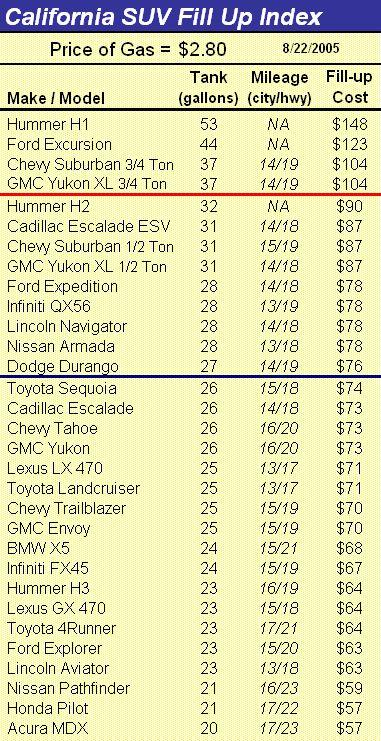
Gas prices have gone up sufficiently in the last week or so that we can now call it at $2.80 per gallon for regular gas in this part of California. That means that it's once again time to update the California SUV Fill Up Index. This index was first published in this post from about ten days ago, and we'll continue to provide an update with each 10 cent increase at the pump - at least until we start getting hate mail from flustered SUV owners.

The list has been expanded a bit to include some other SUV models, so if you felt left out last time, maybe now you can see how your SUV ranks with the others. A fuel economy column has also been added. If you want to have some fun, try finding out what kind of mileage you get for the SUVs which have NA in the Mileage column below. Apparently, if a vehicle is over 8500 pounds (yes, that would be over four tons), then fuel economy ratings are not required and buyers are left to figure this out on their own before buying one of these - either that or trust an SUV salesman who has little interest in providing bad news.

Here's the updated chart:


We've added a blue line to the chart to demarcate fill up costs above and below $75. Since prices will have to rise to over $3.00 per gallon to see vehicles crossing over the red line into the $100 fill up range, the next movement will come around the $75 mark.

It's hard to imagine paying $75 to fill up a Toyota, but with the next update, that's where the Sequoia will be. Just a wild guess here, but maybe Toyota's Sequoia production line will not be quite so busy in the coming years as it has been in recent years.

Of course, oil could drop back down to $30 or $40 a barrel and then we can all resume the "non-inflationary prosperity", to which we have all become accustomed. We'll see.

Gas Lines at Costco and Fifty Dollar Fill Ups

While waiting in line to purchase gas at Costco over the weekend, watching the gentleman in front of us squeezing the handle six or eight times to finish dispensing what turned out to be a neat $50.00 load of gas into a small truck, a feeling of first wonder, then trepidation overcame us. Just how much was it going to cost to fill up our Dodge Dakota which has provided so much enjoyment on frequent camping and hiking trips into California's Sierra Nevada mountains. It's used sparingly around town, so it's been a few weeks since we last added gas, and prices have gone up.

The answer would soon come.

At the time we didn't know how large the tank was (turns out it is 22 gallons), and the gas light had just illuminated, so there was danger to be sure. At Costco, regular gas was priced at $2.679 (why the tenth of a cent, still?), which was the usual 10-20 cents lower than most nearby Chevron and Mobil stations. So, after pondering the previous truck owner’s fuel purchase, we began filling the tank and waited impatiently for the numbers on the display to stop.

[If gas prices continue to rise, someone should really look into slowing the rate at which fuel is dispensed - watching the fuel purchase amount while dispensing gas at today's prices gives you that same uneasy feeling you get when watching the tenths-of-a-mile digit on your odometer when doing 85 miles an hour on the way to Las Vegas - it is very unsettling when the numbers are increasing so fast].

So, as the display raced into the high forty dollar range - 47, 48, 49 - our first fifty dollar fill up seemed assured. But, like some kind of intervention from above, the pump handle clicked off, and the display stopped - $49.59.

We didn't top it off.

In the future, we plan to fill up more frequently. If gas prices continue to rise, perhaps we can maintain our own personal illusion of "non-inflationary prosperity" if we never let the tank get below 1/4 full. That would translate into roughly a 30 cents a gallon "buffer", postponing the day of routine $50 fill ups for our truck.

Come to think of it, if gas prices really get out of hand, we'll just reset the mark to 1/2 full, then 3/4 full, if necessary.

We recommend other truck and SUV owners do the same.

Read more...
IMAGE

  © Blogger template Newspaper by Ourblogtemplates.com 2008

Back to TOP