Wikinvest Wire

The Return of the Short Sale

Wednesday, June 07, 2006

If you lived in California about fifteen years ago you probably remember short sales - it looks like they're about to make a comeback. A report from Sacramento this week sounds eerily similar to the 1990-1996 California real estate bust, except home prices are multiples of what they were back then.

The possibility of a short sale arises when you need to sell your house, but you owe more than it's worth - like a fully-financed new car being driven off the dealer's lot, you are "upside-down" on your loan. That's a phrase we might be hearing a lot more of in the years ahead - "upside-down".

With home prices apparently falling in Sacramento after a phenomenal run-up in recent years, many of those who purchased real estate at last summer's peak and put little or no money down, today owe more than their home will fetch in a real estate market now crowded with inventory.

If, for one reason or another, these homeowners must sell, then they are faced with a few choices, none of which are very appealing:

  1. Sell the house, and pay the difference to the lender
  2. Walk away, and give the house back to the lender
  3. Make a deal with the lender to accept less than the loan amount
According to the story, Scott L. Williams of Re/Max, who specialized in this sort of thing in the 1990s, has dusted off his short sale notebook and is now out helping people hand their homes back to their lender with the least amount of fuss and muss. Going seven years without a single short sale, his office has done nine in the last few months.

The two cases cited, one seller upside-down by $30,000 and the other by $60,000, are likely a sign of things to come in Sacramento and elsewhere in the country as the real estate market continues to cool and prices continue to weaken.

Back in the early 1990s, this became routine ... but not at first.

When homeowners first began losing their defense jobs as a result of the Cold War ending, and as the S&L scandal widened, banks were reluctant to negotiate with distressed sellers who bought near the peak and then wanted out.

This was back in the days when most people had to put money down before a loan would be made, so lenders had a bit of a cushion to start with. It wasn't until housing prices declined by 20 percent, then 30 percent, and in some places 40 percent or more, that the problems really began.

In 1992 and 1993, lenders were adamant.

The seller had two choices - make good on their obligation or face foreclosure. Many people just walked away, "Oh yeah, Ernie got laid off about six months ago, so when the money ran out, he and Betty just packed everything up and left. It's too bad, because they just got finished remodeling the place before he lost his job".

So, houses like Ernie and Betty's would revert back to the lender and they would sit there for a while until the paperwork was final and the bank had time to take a look at the place to see what had to be done to get it ready to sell. By that time, the lawn had died and there were a few broken windows and maybe somebody had taken up residence on an occasional basis.

As the number of people taking the same approach as Ernie and Betty multiplied, the banks quickly fell behind and the amount of time it took them to get the abandoned houses fixed up and back on the market stretched out to a year or more. After a while, some lenders would immediately nail plywood over all the windows so that "guests" would at least have to break a sweat to take up temporary residence.

Lenders then realized that maybe they should be a little more receptive to offers of partial loan repayment, as the mounting inventory was requiring an increasing amount of repair work to get back on the market, and the worst part for the bank's bottom line - prices were still declining.

By 1995 and 1996, lenders were embracing short sales - they were becoming routine.

With a reasonably competent realtor, a seller could simply fill out a few forms with all their financial information (kind of like when they bought the house), and the bank would come back with their offer. Based on a sale price estimated by the realtor, depending upon their assets and income, the seller would be asked to make a lump sum payment and/or agree to a repayment schedule.

Depending on the particulars, this would amount to anywhere from zero to maybe half of the difference between the sale price and the outstanding mortgage balance.

If you lost your job and had little or no savings, it was fairly straightforward - the bank didn't ask you for much, unless of course you were dumb enough to leave thousands of dollars in a savings account and include that amount in the paperwork submitted to the lender. Usually it was just a matter of selling the house, paying all the transaction costs, and what was left was send back to the bank.

For those who remained employed but still had to sell, it was much more complicated. Then the bank would ask for at least some sort of a monthly payment to get the deal done. Sellers could always try to negotiate the terms with the lender, and some had reasonable success, but the banks quickly got good at this and the realtor was always ready to offer advice that would help an agreement be reached.

The funniest part about the whole process was how the asking prices were set.

The seller didn't really care - he just wanted out. The bank was inundated with borrowers in similar situations - they just wanted it sold and off their books. The realtor was the one that influenced the asking price most - he just wanted a commission.

These homes were priced to move and the neighbors hated it, "They're asking how much? They're destroying property values in this neighborhood."

Most sellers agreeing to a short sale didn't realize the income tax implications of the deal when they signed their paperwork. When a deal was made with the bank, money squirreled away in retirement accounts was untouchable, so if you had no other savings and very little or no positive monthly cash flow, you usually go off pretty easy.

Many were surprised to hear at tax time that they were liable for taxes on something called "debt forgiveness", where, to the extent that it does not make you insolvent, an individual must pay taxes on the amount of debt "forgiven" by a lender.

The idea was that since the bank was going to write this off as a loss, the IRS would attempt to collect it elsewhere, and the tax laws at the time required that if you were forgiven $40,000 in debt when your short sale was complete, and you had a net worth of $25,000, you owed taxes on $25,000.

If you were able to show zero net worth, then all was forgiven. The really bad news for some people was that the IRS insolvency calculation included retirement savings. In many cases this allowed sellers to get off easily as far as the bank was concerned, but not with the IRS.

News of short sales and of goings on in real estate in general didn't travel very well or very fast back in the mid 1990s, as the internet was still in its infancy and there were no such things as blogs, where individuals could report what was going on in their neighborhood.

It will be interesting to watch how the lender/borrower, foreclosure/short sale relationships play out this time around.

Read more...

Tough Talk or Tough Love?

Tuesday, June 06, 2006

In the scheme of things, tough talk about "inflation" will have little effect on what happens in the U.S. and world economy over the coming months and years - too much of the outcome is already "baked in the cake". While economists can prattle on about "core inflation" or any other measure of consumer prices that may or may not bear any relationship to what consumers actually pay for things, this is much more a story of the declining value of the U.S. dollar, a decline that now appears to be accelerating.

Nevertheless, the "inflation" discussion that was prompted by yesterday's hawkish remarks by Fed Chairman Ben Bernanke, and the response by financial markets, are certainly fun to watch.

In trying to make sense of yesterday's speech, a chart of the daily change to the Dow Jones Industrial Average and a marked up copy of the three month core inflation numbers from the Bureau of Labor Statistics were whipped up.

The idea?

To have a look at what effect all this talk about "inflation" is having on stocks and to see how unusual the inflation numbers are - to try to judge whether all the gyrations that equity markets are experiencing is warranted.

The chart of the Dow over the last three years clearly shows the effect that the new Fed Chair is having on the share prices for thirty of the largest publicly traded companies in the world. Over the last three years, three of the worst five days for the Dow have occurred in just the last couple weeks. Four of the five worst days have occurred with Ben sitting in the big chair or getting ready to.
Recently it's been the question of his inflation fighting credentials and his communication skills. There have been weak economic reports, then talk about pausing, then a misunderstanding, then the Maria Bartiromo incident, then tough talk about inflation, then more weak economic reports, then tough talk about inflation.

It's enough to wear you out if you own lots of ExxonMobil and GE and have been waiting patiently for the Dow to poke through its 2000 high.

Why not just change how "core inflation" is calculated once again and let everyone get on with more of the "asset inflation" that we have all come to know and love?

So what about the inflation numbers cited in yesterday's speech? All this talk about core inflation, of energy prices "feeding into" the core, about underlying inflation, about rising inflation expectations. From the speech, the key passages were as follows.

Consumer price inflation has been elevated so far this year, due in large part to increases in energy prices. Core inflation readings--that is, measures excluding the prices of food and energy--have also been higher in recent months. While monthly inflation data are volatile, core inflation measured over the past three to six months has reached a level that, if sustained, would be at or above the upper end of the range that many economists, including myself, would consider consistent with price stability and the promotion of maximum long-run growth. For example, at annual rates, core inflation as measured by the consumer price index excluding food and energy prices was 3.2 percent over the past three months and 2.8 percent over the past six months. For core inflation based on the price index for personal consumption expenditures, the corresponding three-month and six-month figures are 3.0 percent and 2.3 percent. These are unwelcome developments.
...
Therefore, the Committee will be vigilant to ensure that the recent pattern of elevated monthly core inflation readings is not sustained.
Uh-oh. It looks like the "inflation vigilantes" at the Fed are going to run us into a ditch again.

It's not as if home builders are going to saw up two-by-fours and send truckloads of them to the Federal Reserve building in Washington D.C. because interest rates are too high for people to afford to buy houses. That's what happened to Paul Volcker in the 1980s when he was pushing rates well into the double digits.

We as a country can't handle that kind of tough love, and Ben Bernanke is not the man to deliver it.

Tough talk - yes. Tough love - definitely not.

Besides, the "core inflation" numbers aren't that bad. He seemed to be concerned about the three month 0.8 percent rise that works out to be an annualized rate of around three percent, well above the two percent comfort level for the "core" rate. But, from a historical perspective, a 0.7 or 0.8 percent increase over 3 months is not that big a deal - look how many times it's happened in the last ten years.
This is not really a story of the Fed losing control of inflation. This is much more a story of the Fed losing control of inflation "expectations" due to high gas prices and that pesky owner's equivalent rent that makes up thirty percent of the figure. High gas prices are largely due to ethanol delivery problems at the refineries, which should soon pass, and now that home prices have about peaked, maybe it's time to revisit the whole owner's equivalent rent issue - maybe home prices really should be used for the "inflation" calculation.

In response to a question from a recent appearance before Congress, Ben Bernanke himself stated that the current calculation for consumer prices overstates inflation by nearly one percent.

It's pretty clear where this is all going. Whether recent comments indicate another quarter point rate hike is in the works for later this month or not, what we should expect from Ben Bernanke is much more "tough talk" than "tough love".

Read more...

Barron's on Jim Rogers

Monday, June 05, 2006

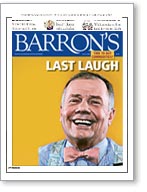
Barron's is really catching on to this whole commodity thing. Last week it was a dismissal of the commodity bubble thesis and an interview with Goldmoney.com founder James Turk. Gracing this week's cover($) we find commodity investor extraordinaire Jim Rogers.

Lately, this publication has become the preferred weekend reading material here, despite the fact that they have never fulfilled their promise of a complimentary print subscription - an attempt to compensate angered subscribers some time ago when they redid their online subscription plans.

A reader posted a comment on last week's Barron's post indicating that you have to call them to get the print subscription activated. Oh well, one more thing to add to the To Do list.

Aside from the little subscription quibble, the only complaint with recent issues of this publication is the title applied to this week's Jim Rogers story - Last Laugh. It seems a bit inappropriate, implying a sort of finality to the current happenings in commodity markets, in conflict with the substance of the interview and other views expressed in the pages of Barron's recently.


WITH THE PRICES OF OIL AND INDUSTRIAL METALS like copper, zinc and nickel screaming higher in recent months, such observers as Warren Buffett and Morgan Stanley's Steve Roach have proclaimed that commodity markets are in a bubble destined to burst soon.

But Jim Rogers, fabled hedge-fund manager of the 'Seventies and now ardent commodity bull, finds such talk ridiculous. Indeed, he has been pounding the drum for investing in commodities in recent years in numerous speeches and media interviews, even writing Hot Commodities, a book propitiously published in late 2004 that predicted a coming price boom in everything from aluminum to zinc.

Barron's caught up with Rogers on a recent rainy morning as he worked out on a stationary bike in the fourth-floor exercise room of his five-floor mansion on New York's Upper West Side. Bloomberg Radio droned in the background as he talked while occasionally glancing at a laptop computer, perched precariously on the machine's handlebars. "How can anybody say that a bubble has developed in commodities yet" -- brief pant -- "with sugar 80% below, silver 75% below and corn and cotton less than half their all-time price highs?" he huffed. "You can't have a bubble when the media has only begun to pay attention to commodities in recent months after years of disinterest. We're now only in the early part of a long-term commodity price boom that has years to run and will likely see literally dozens of raw- material prices make new highs. Even crude oil and copper have a long way to go, even though they recently set price records."

How long will the surge run? Based on the past longevity of commodity bull markets (Rogers mentions ones that, by his reckoning, lasted from 1906 to 1922, 1933 to 1953 and 1968 to 1982), the current boom could last eight to 14 more years. The commodities-bubble crowd scoffs at that, just as skeptics did when Rogers predicted the current boom a few years ago.
Living in Southern California suburban sprawl it's hard to imagine exactly what a five floor mansion on the Upper West Side of New York might be like, but it sure does explain the deferential comments that are made by every other guest on Cavuto on Business.

As to the "Last Laugh" title, based on what appears in the beginning of this story, a more appropriate phrase might be something along the lines of "Not the Last Laugh, but a Big Smile".

~~~~~~~~~~~~~~~~~~~~~~~~Advertisement~~~~~~~~~~~~~~~~~~~~~~

Another junior mining company has just been added to the Iacono Research model portfolio which is recovering nicely from the recent market correction, now up 24 percent on the year. To find out more about this approach to commodity investing, click here.

For one low subscription rate, guaranteed for a lifetime, click here.

~~~~~~~~~~~~~~~~~~~~~~~~~~~~~~~~~~~~~~~~~~~~~~~~~~~~~~~~~~

References to studies about how commodities have outperformed equities keep popping up in Barron's. Last week it was an Ibottson study, this week Barry Bannister of Stifel Nicolaus, Gary Gorton of the University of Pennsylvania, and K. Geert Rouwenhorst of Yale all chime in with the same idea.

Alert reader John Law (not his real name) has provided this link(.pdf) to the Yale study.

It all seemed so obvious to a select few people around the turn of the century, and seems obvious to more people today, but the idea of equities as second fiddle to boring commodities is anathema to the vast majority of those with money to invest.
To Rogers, the past few years have witnessed another changing of the guard; commodities will rule over stocks and bonds for the next decade or more. Inflation will continue to flare and not just because of rising raw-material prices. According to Rogers, new Fed Chairman Ben Bernanke is "an amateur with no knowledge of markets" whose academic work revolved around how nations could avoid depressions by printing more money. And, finally, he throws into this witches' brew the likelihood of a collapse in the dollar as a result of America's accelerating debtor status. Rogers views commodities as the ultimate refuge from these scourges.
That's a stinging criticism of the new Fed Chairman and a cogent summary of his writing on both the Great Depression and the "lost decade" in Japan. Even if you don't agree with him, or if you think that he's just talking his book (in this case, both the Rogers Raw Material Fund and his book Hot Commodities), it's refreshing to hear someone speak this bluntly about monetary policy.

He was no fan of Alan Greenspan, and may think even less of Ben Bernanke.

Rogers has been bullish on all things Chinese for many years now, and rightly figures that despite many bumps along the way, the emerging Chinese middle class will eventually drive global consumption, exposing the underinvestment in infrastructure and exploration during the last two decades for what it was - a poorly timed cost saving measure.
CHINA IS NOW the No. 1 consumer of copper, steel and iron ore, and No. 2 in the use of oil and energy products to feed its industrial maw, which is growing at a prodigious rate of nearly 20% a year. And the torrent of textiles, refrigerators, color TVs and computers aren't just flowing to overseas outlets like Wal-Mart. Burgeoning economic growth is also creating a Chinese middle class aspiring to better meals and more creature comforts. In Rogers' view, it's delusional to deny that competition for commodities will continue to heat up as a result of China's pell-mell rush from a peasant economy to economic giant. Today, there are only 30 million private vehicles on the roads in China, versus 235 million passenger vehicles in the U.S., even though China has almost 4½ times as many people.
From a recent documentary, the image of a young Chinese couple living in what looked like a 400 square foot apartment going to the local automobile dealer to purchase their very first car will forever remain fresh in my mind. Give these eager young workers credit cards and then, later on, wacky home loans, and we'll soon find that China doesn't need the U.S. or our dollars to sustain their manufacturing output.

Citibank is working on that.

As to the recent investor interest in commodity funds and the theory put forth elsewhere by certain quacks in the financial media that the new commodity ETFs are driving prices ever higher, someone who might know a little something about commodities weighs in.
In all, some $90 billion in institutional and individual investor money has poured into various commodity index products with the Goldman Sachs index boasting around $60 billion of the total. Hot performance has been part of the lure, to be sure. In addition, the commodity markets have become infinitely more respectable as a result of academic studies, such as the earlier-mentioned Gorton-Rouwenhorst paper, asserting that fully collateralized futures positions shield investors against inflation while offering stock-like total returns over the long haul, though timed to different stages in the economic cycle.

Some observers contend that the advent of commodity index funds, along with the addition of exchange-traded funds based on a single commodity, such as gold or silver, artificially pumped up prices through collective buying. The ETFs purchase physical commodities as money pours in, while the index funds concentrate on futures that are near expiration. The latter activity also boosts "spot" or cash price of commodities, some maintain.

ROGERS FINDS SUCH contentions preposterous. First, he argues, the commodity index funds are minuscule, compared with the index funds that operate in the stock and bond markets. Also, commodities index funds must constantly roll their futures positions forward as their existing futures approach expiration. This relieves buying pressure on nearby futures. The Rogers funds, in fact, buy only futures two delivery periods away from expiration.

Finally, the large commercial interests that trade commodities aren't about to let speculators wrest control of prices. "ExxonMobil can drown all the index funds, hedge funds and other speculators in the energy markets if anyone tries to manipulate prices," Rogers asserts. "It's largely the surging global demand for raw materials that is pushing prices up."
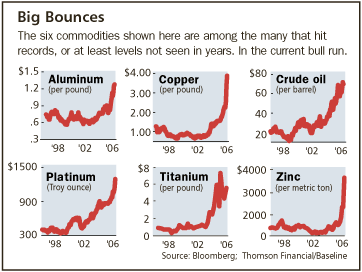
It should also be noted that copper and zinc, the commodities that have gone vertical in the charts above are poorly represented in existing commodity indexes. In the Goldman Sachs Index cited above, these base metals account for two percent and one percent of the total index, respectively.

In conclusion, and again demonstrating the inappropriateness of the title of this article, the following prognostication is offered.
THE COMMODITY BOOM, like all bull markets, eventually will end in a crescendo of hysteria. The public will feel an overwhelming desire to invest in raw materials rather than stocks or bonds. Financial publications will be chronicling the derring-do of commodity kingpins with the reverence and wonder once accorded the dot-com billionaires. Seemingly insatiable demand for commodities will provoke investment in new sources of supply, but few investors will notice as supply and demand start to come back into balance

But that day won't dawn for a decade or so, says Rogers, who hopes to be on to the next big thing by then.
Recent talk of a commodity bubble bursting seems awfully premature and maybe somewhat of an instinctive, defensive response from a financial media that has been conditioned for more than two decades to just promote stocks and bonds.

The public is not on board yet - not by a longshot. The public is either thinking about how to make next month's mortgage payment or still dreaming of granite countertops - how to divest themselves of a good portion of the money that has piled up in their houses in recent years.

There is no hysteria save for the financial media who were reluctant to call housing a bubble but eager to apply the label to commodities as a whole, when only a few items have experience extreme price rises, many still far below nominal highs reached over two decades ago.

Read more...

Loyal to the End

Sunday, June 04, 2006

It's hard to critique John Snow's performance as Treasury Secretary from the perspective of fulfilling expectations. When he was brought in a few years back to replace Paul O'Neill it was clear what the job entailed - be a loyal spokesman for the White House.

It should be entertaining to contrast the public statements of the incoming Secretary with those of the outgoing Secretary, who, in this commentary on Friday's jobs report is proving to be loyal to the very end.

"With unemployment at a remarkable 4.6 percent, this month's employment report shows continued strength in the U.S. labor market and an economy moving in the right direction. These gains are broad-based, with Hispanic unemployment at a new record low and African American unemployment reaching historic lows, lower than the average of the 1990s.

"We have now seen thirty-three straight months of job growth and more than 5.3 million new jobs created since the President's 2003 tax cuts took effect.

"Today's report is good news for American families. It shows that our economy is on solid footing and that we are heading in the right direction, giving Americans a renewed sense of optimism.

"With more people working, more good jobs, and more businesses hiring, it is not surprising that federal government revenues are up smartly. The surge in tax receipts is bringing down the government deficit ahead of the President's goal. Clearly this demonstrates that Americans can enjoy the benefits of rising prosperity and low tax rates with a declining federal deficit.

"My recent announcement that I will leave Treasury marks this as my last official jobs day statement. I am pleased to note that virtually everywhere one looks there is good economic news. I take great satisfaction in the strong expansion the country is enjoying."
Many thought the report was remarkable in ways very different than those enumerated by Secretary Snow. Maybe he figured that this was going to be his last commentary regarding employment, and felt inclined to lay it on extra-thick.
ooo

The cartoon in The Economist this week was not particularly exciting, but this ad from the CIA was pretty eye-catching. The blurry, offset font in the title is very curious - what could they have possibly been thinking when this was being discussed with the advertising agency?
Click to enlarge

Read more...

Friday Lite

Friday, June 02, 2006

The jobs report came in just a while ago - it looks like the rate-hike pause may be back on for later this month. The non-farm payrolls number came in far below expectations at +75,000 for May and there were hefty downward revisions for prior months.

The miss on the downside was not unexpected as initial claims for unemployment insurance had been trending up a bit in recent weeks, however the magnitude of the miss surprised many. Recall that it takes roughly 150,000 new jobs per month to keep pace with a growing population.

New positions in Education and Health Service led the way with 41,000 new spots (mostly health care) and Professional and Business Services registered 27,000 new jobs, 11,000 in Computer System Design. The Retail Trade category took the biggest hit, with 27,000 positions lost - a broad based decline led by clothing and general merchandise stores.

The unemployment rate edged down from 4.7 percent to 4.6, as more displaced sales clerks began selling their possessions on Ebay, thus qualifying as self employed (no, not really, but there's got to be some explanation why the unemployment rate is so low).

On to the regular Friday fare...

Lower Rates to 15% to Quicken the Expansion

According to this report from Brazil, they must be living in a Volckeresque world where the economy can be given a little boost by lowering interest rates from 20 percent all the way down to 15 percent. We must be soft here in the U.S. as many of our elected officials now regularly beg new Fed Chairman Ben Bernanke not to raise interest rates any further, "Don't go past five percent - people are hurting".

Brazilian central bankers lowered the benchmark interest rate to a five-year low, seeking to add to a quickening expansion in Latin America's biggest economy.

The central bank's nine-member board voted unanimously to pare the rate half a percentage point to 15.25 percent, the lowest since March 2001.
...
The central bank, which has brought the rate down 4.5 percentage points since September, will likely cut it by another half point in July and by a quarter point the following month, Valdivia said.
Just think what would happen if they took rates down to five percent in Brazil, or better yet, one percent - think of how much more quickly the expansion would proceed then. Completely independent of imported oil, most of their automobiles running on ethanol derived from domestic sugar cane, there's a lot to like about Brazil beyond Carnival.

Bubble Man and his Low Interest Rates

We've long wondered about that picture of Mark Gilbert over at Bloomberg, but he often finds interesting things to write about that you don't look too closely at the photo. In this story, he certainly seems to have found an interesting book by this blog's new favorite author, Peter Hartcher.
In "Bubble Man: Alan Greenspan and the Missing 7 Trillion Dollars", Hartcher accuses the former Federal Reserve chairman of dereliction of duty for allowing a U.S. stock-market bubble to balloon and then burst on his watch.

Hartcher sets out to convince the reader that Greenspan, the man dubbed "Maestro'' in Bob Woodward's biography, could and should have tried to restrain surging equity prices. Much to my surprise, Hartcher succeeds.
...
In the first half of the book, he shows how Greenspan neutered the Fed's monetary-policy meetings, holding pre-meetings to preempt dissent among the governors. By drafting the Fed statement before the meeting was held, "Greenspan had kept the trappings of due process but gutted their substance,'' the author says.
In his book, Mr. Hartcher touches on many of the same themes that were discussed here a few months back in the four-part series Three Sins, One Gift, which concluded on the day that the former Fed Chair retired - the frequency of those White House visits, as recounted in Sin #2 - Bending to the Will of Others, still seems very odd.

Low Interest Rates, High Debt

Calculated Risk (not his real name, or for that matter, maybe not her real name) has a few words about the national debt.
For the first eight months of the 2006 fiscal year (starts Oct 1st), the National Debt has increased $424.1 Billion. The previous record was $413.2 Billion for the first eight months of fiscal 2004.
...
If someone says the deficit is falling - laugh (or cry). Its not true.
The graphic is even better and flies in the face of recent pronouncements regarding the shrinking budget deficit - they really should start calling it the pro-forma budget deficit, since, like quarterly financial reports in recent years, it "excludes all the bad stuff".
Does anybody really believe anything anyone at the Treasury Department or the White House says about the nation's books? When they have to raise the debt ceiling by close to $1 trillion dollars every year or so, why does anyone believe reports of a budget deficit less than half that size and getting smaller?

Why do we have a debt ceiling if it keeps being raised? Part of its original reason for being was to shame elected officials into having to approve increased debt caused by their increased spending. But, there appears to be no shame associated with increased debt - that's the American way of life.

High Debt and Higher Interest Rates, Higher Foreclosures

The big difference between governments and individuals is that to service the debt in a rising interest rate environment, if you're the government, you just borrow and/or print the money you need. This interview of a Texas foreclosure expert from Danielle DiMartino sheds some more light.
As local foreclosure rates approach the heights of the savings-and-loan scandals of the 1980s, Mr. Roddy's depth of experience enables him to draw parallels – and distinctions – between yesterday and today.
...
What's the biggest unknown as you look to the future?

When you add in all of the other cost-of-living increases we've seen in the last two years, it's a wonder we haven't had more foreclosures.

The scary part is, what happens if we don't start to see some modification in borrowing habits? We're not yet seeing a slowdown in the foreclosure figures; in fact, we're seeing higher numbers. Where's this going to take us? We could be in for a long haul.
The discussion of the relationship between unemployment and foreclosures is telling. In previous cycles, increasing foreclosures lagged rising unemployment, this being the natural sequence of events where lost jobs means lost income to make house payments. Today, with near full employment, people are increasingly unable to make their mortgage payments, begging the question, "What happens if unemployment rises?"

Either Giants Stadium or that Sopranos Meat Grinder

The FBI came up empty once again in the never-ending quest to locate the 31-year-old remains of former Teamsters boss Jimmy Hoffa. According to this story, this time they dug up a suburban Detroit horse farm, after previously digging up a swimming pool and someone's house after bloodstained floorboards were reported.
The two-week search involved dozens of FBI agents, along with anthropologists, archaeologists, cadaver-sniffing dogs and a demolition crew that took apart a barn.
...
The FBI said 15 to 20 agents worked at the site on a daily basis during the search, with five to seven agents guarding it around the clock. The search was expected to cost less than $250,000, the agency said. The government plans to pay for the barn to be rebuilt.
The current property owner probably just wanted a new barn built and found a way to convince the an old Jimmy Hoffa associate to offer up a bogus tip, knowing exactly how the FBI would respond.

Religion in Finland

Here's one of the more offbeat stories from The Economist magazine in recent memory.

Who said religion was dying in Europe? On paper at least, the Finns show a devotion to their national church that resembles new-world fervour more than the old continent's jaded scepticism. More than 4.4m people, or 85% of the population, are registered with the Lutheran church.
...
How odd, then, that the sugar-coated mould that has long encased modern Europe's greatest collective ritual—the Eurovision song contest—was broken by a group of Finns who set out, literally, to dress in the darkest of colours.
...
But how could the relatively God-fearing Finns allow such grotesque types to represent them? Part of the answer is that Finnish faith follows a Nordic model: a secular society combined with a state-backed church to which most people sign up, and pay taxes, because they want the clergy for weddings or funerals. That need not imply a deep belief in the tenets of Martin Luther. Like most Europeans, Finns are becoming more liberal over such things as euthanasia and homosexuality, and more free-wheeling in their beliefs. “Finns are neither very attached to religion, nor very opposed to it,” says Kimmo Ketola, a sociologist.
Nice flower arrangement and bow.

Kenny Boy's Blog

No, Ken Lay doesn't have a blog, but he does have a website, and it appears that he's looking way past his jail sentence, already trying to soften up that other judge that awaits at the Pearly Gates.
Dear Visitor:

Now that my trial has concluded, I would like to offer a few brief comments.

Certainly, we are surprised at the verdict against me. Perhaps it is more appropriate to say we are shocked, as this is not the outcome we expected.

I firmly believe that I am innocent of the charges against me, as I have said from day one. I still firmly believe that to this day. I will continue to work diligently with my legal team to prove this.

In spite of what has happened, I am still a very blessed man. I have a very warm, loving and Christian wife and family that supports me, as well as many, many loving and supportive friends. I’d like to thank all of the people who have shown their concern, support and kept our family in their prayers.

Most of all, my family and I believe that God is in control and, indeed, He does work all things for good for those who love the Lord. And we love our Lord.

Thank you.
Wait, there is a blog there - but not Kenny Boy's. If you follow the "Blog" link from Ken Lay's page you get to this blog by a Houston attorney. Be sure to check out loyal supporter Adrienne's comment at the end of this post.

Mind the Gap

This is one of the cooler websites out there if you like to visualize data about different countries around the world and then see how the data changes over time. At GapMinder, if you plot per capita income versus population, then drag the timeline bar at the bottom, this is what you get.
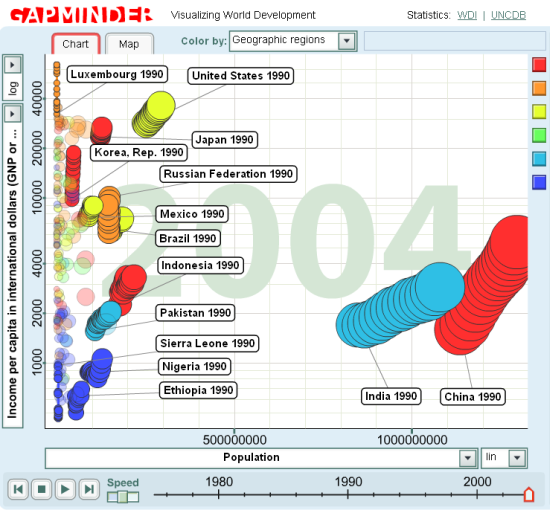
India and China are notable, not only because of their population, but in the different trajectories traced out over time by the income/population relationship (per-capita income rising much faster in China than in India).

The Big Red Dots and Their Neighbors to the North

Speaking of China and its neighbors, they seem to be increasingly friendly with their neighbors to the north (the ones with all the oil and natural gas), as evidenced by this story about security cooperation.
Russia and China moved to fortify their growing security cooperation in Central Asia but reassured the United States that their new-found unity of purpose in the region was not designed to subvert US interests there.

Russian President Vladimir Putin however acknowledged growing "competition" to a new Central Asian security organization led by Moscow and Beijing while Chinese President Hu Jintao said the new group had become an "important force" for peace and stability in the world.
...
One source who asked not to named said the US embassy in Beijing earlier this month delivered a message to the SCO (Shanghai Cooperation Organization) secretariat voicing concern that some members may regard the group as a vehicle for countering US influence in the region. This could not immediately be confirmed in Moscow.
On the GapMinder website you can select military spending for one of the axes.

The Big Red Dots and Internet Usage

Also at GapMinder, you can select internet usage and a number of other similar data series to see how fast China is changing in other ways - China's dots are hard to miss. This report discusses the China internet boom and how it's changing the publishing business.
In China, print is being overtaken by digital dreams: at the end of last year, the country had 110 million Internet users, with 64.3 million on broadband, and that number keeps growing. Last year was also the first time revenue for the print medium dipped significantly for some companies.

The rise of new media is being driven by a whirlwind of capital. Toodou.com, positioned as "a personal multimedia platform", raised more than US$100 million in venture capital in just 13 months after its founding.

"We are still searching for a business model that will enable us to turn a profit," said Chen Weijia, marketing director. "The cost of handling multimedia content is much more expensive. For text, thousands of words may take up only a few kilobytes, but one second of a podcast will require a few megabytes. That's why we need to set up a stable platform for our users."
They're really gettin' the hang of capitalism.

Don't Forget to Send Back that Postcard Every Month

Columbia house is expanding into the lucrative prescription drug business, or so the Onion would have you believe.
Music and DVD mail-order giant Columbia House is offering a new direct-mail subscription drug program for the estimated 10 million senior citizens who have not yet signed up for the government’s Medicare prescription medication plan.

A Celebrex fan looks over paperwork for her membership in the new Columbia House program.

"This is the best way to enjoy all the top medications by today’s pharmaceutical superstars at a low, low price," said Columbia House spokeswoman Sandra Farrell. "There’s no more waiting in line for the latest releases at the pharmacy, and because Columbia House sells directly to the consumer, you can kiss Dr. Middleman goodbye."

The Columbia House program, which was launched in January, offers a wide array of AARP chart-toppers and many popular prescriptions from the past through its supplementary color catalogue conveniently found in more than 400 Sunday newspapers nationwide. Qualified seniors may choose either 12 generic drugs for one cent, or five brand-name medications for 49 cents each, plus shipping and handling. Members are then obligated to buy five more brand-name medications over two years at their regular price, ranging from $12.99 to $549.99.
Just watch out for the shipping and handling charges when you're fulfilling the terms of your original agreement - they really add up.

Read more...

There are Wonderful Opportunities Today

Thursday, June 01, 2006

What does it tell you when the largest pension fund in the U. S. hires a commodity veteran as their chief investment officer? Russel Read, set to take over the California Public Employees' Retirement System (CalPERS) today, is of the opinion that at least 10 percent of the $207 billion fund ought to be invested in things like crude oil and lean hogs or the related equities, with maybe some gold coins and silver bars thrown in for good measure.

Wait a minute - that's at least $21 billion!

It's clear that people who manage money for a living are embracing the whole idea of commodities as an investment class and, as the months go by, they are growing more and more comfortable with the thought of parking school teachers' nest eggs in things like sugar, natural gas, and nickel.

Maybe in a year or two you'll see some sort of commodity fund in your 401k plan - or at least an equity fund that specializes in natural resource companies.

~~~~~~~~~~~~~~~~~~~~~~~~Advertisement~~~~~~~~~~~~~~~~~~~~~~

As of last Friday, for the year, the Dow was up 5%, the S&P500 was up a few percent, and the Nasdaq got a goose egg - with CDs now paying over five percent in the U.S., it hardly seems worth the trouble.

Over at Iacono Research the commodity-rich Model Portfolio has achieved a hefty 23% year-to-date gain, and the best part is, aside from a well-timed rebalancing in April, there have been only a handful of trades all year. To learn more about this successful investment approach, click here.

~~~~~~~~~~~~~~~~~~~~~~~~~~~~~~~~~~~~~~~~~~~~~~~~~~~~~~~~~~

So, CalPERS and commodities - lots of commodities, apparently, in the months ahead. They will join a growing number of institutional investors who seem to be more scared by the future of the dollar than they are the future of copper.

According to this story($) from the current issue of BusinessWeek, it's all a matter of thinking long term - when more and more investors look out years from now, decades from now, more and more of them think their bottom line will improve by investing in hard assets.

The volatile markets of the past few weeks have shaken many investors' faith in commodities. Not Russell Read. The former Deutsche Bank Asset Management investment picker, who begins his new job as chief investment officer at the $207 billion California Public Employees' Retirement System (CalPERS) on June 1, finds comfort on the tree farm he started five years ago near his summer home in Brooks, Me.

The farm is part of a project Read is conducting with the University of Maine to restore the land to the way it looked in the 1700s. It'll be 45 to 100 years before his 10,000 trees reach maturity, a fact that doesn't bother Read. "The investment world can be dominated by short-term thinking," says the 43-year-old. But this "is a reminder that some of the best investments can take lots of time."
Read will need patience in his new job managing the largest and most closely followed pension fund in the U.S. CalPERS is often at the forefront of hot investment topics, from securities regulation to corporate governance. With Read, it'll wade into another controversial arena: commodities. Read says that, while crude oil, pork bellies, and the like aren't part of CalPERS' investment mix now, they will be -- soon. "Commodities [have been] fairly scary investments for most institutions," he says. But "there are wonderful opportunities today."

In March, investment research firm Ibbotson Associates released a study showing that, of the asset classes it examined, commodities were the top performer in the years since 1970. Commodities are also considered a diversification tool, because their performance does not track that of stocks or bonds. Ibbotson found that in each of the eight years in which stocks declined, commodities were the top performers. "The models are telling us a very large percentage -- 10% or higher -- should be allocated to commodities," says Thomas M. Idzorek, Ibbotson's director of research. Read agrees with that view.
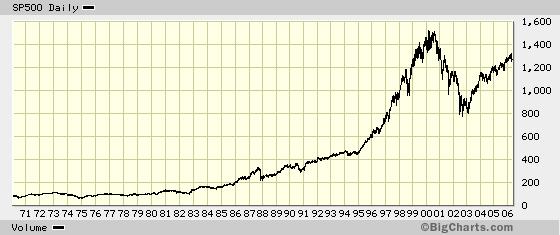
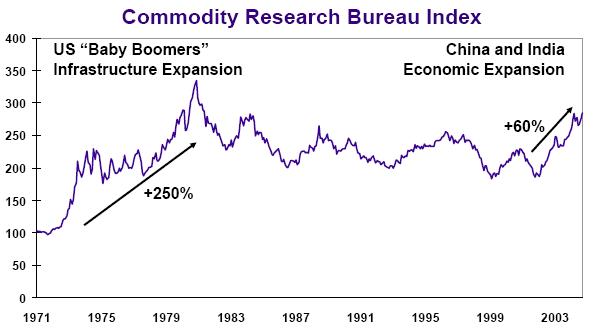
It's not clear exactly what asset classes the Ibbotson study examined, because it's hard to make the case that commodities have outperformed equities since 1971 when looking at the charts below, but commodities sure had a good run through the seventies.

And today, it feels a lot more like the early 1970s than it does the early 1990s. You keep hearing that bad word from the 1970s economy - stagflation.
Many individuals today are of the mistaken impression that investment history began when the last bull market in stocks started in the early 1980s. They have little appreciation for what happened in the fifteen years prior to that time and how that may relate to today.

They may have more appreciation for a longer view of history in another few years - individuals are always the last to adopt broad changes such as the shift to commodities, and this time will likely be no different. The change in thinking amongst institutional investors is well underway.

Yet, there are skeptics - worried that commodities are in some sort of a bubble - that the top is in after only a few years of stellar returns, where some commodities have not exceeded their nominal peak from twenty five years ago and are still far below the inflation adjusted levels seen when Ronald Reagan had his eye on the Oval Office.
Skeptics worry that CalPERS is entering too late. The prices of many commodities have doubled in recent years, and investors are getting twitchy. "Right now a lot of people are struggling with the fear that they may allocating at a cyclical peak," says Bryan Decker, chief investment strategist at the consulting firm Evaluation Associates. Read acknowledges that this isn't a good time to plunge in headlong. He says he'll be looking less at the commodities themselves and more at companies and technologies that benefit from their high prices, such as oil and alternative energy producers. "It's a great time for innovation," he says. "It's as if long-dormant technologies like wind and solar power have been reborn."

Read's interest in commodities runs deep. His grandmother was a trader in Chicago; his father managed a chemical company. Attending high school in Houston during the 1970s oil boom, he entered a national science competition with solar panels he made from spray-on silicon. He went on to get a PhD in political economy from Stanford University, writing his thesis on the impact of natural resources on economic growth. In 1997, he helped create the first commodities mutual fund, the $2 billion Oppenheimer Real Asset fund.

Read's investment ideas blend with CalPERS' social activism. In the past, though, CalPERS got superior returns by shaking up companies other investors had abandoned. By targeting commodities, Read will have to figure out a way to beat the market in an asset class that has already been discovered.
It's funny that the author of this story refers to commodities as "an asset class that has already been discovered". Like that's a bad thing? It just starts getting good after others "discover" an asset class, which seems to be the case for institutional investors and commodities - most retail investors have yet to join the party.

Institutional investors, especially the ones managing the largest pension fund in the land, don't make rash decisions when it comes to allocating money in their investment portfolio - they make sound, long-term decisions, and the news from CalPERS is one of the most bullish signs for commodities yet.

Read more...
IMAGE

  © Blogger template Newspaper by Ourblogtemplates.com 2008

Back to TOP